Food and beverage service describes how an order moves from the guest to the kitchen or bar and how the finished food or drink reaches the guest. The method chosen affects staffing, equipment, speed, presentation, food safety, accessibility, cost and the overall character of the experience.
A hotel may use several methods on the same day: buffet service at breakfast, plated service at lunch, counter service in the lobby café, banquet service for a conference and in-room dining at night. The right question is therefore not “Which method is best?” but “Which method best supports this menu, volume, space, team and guest promise?”
This guide explains the main methods, compares their operational strengths and gives supervisors a practical way to select, train and measure the right service system.
Food and beverage service methods at a glance
Most operations can be understood through four broad families:
| Service family | How the guest receives the order | Common examples |
|---|---|---|
| Table service | A server takes the order and delivers food and beverages to the table | Plated, family, silver, French and gueridon service |
| Assisted or self-service | The guest selects some or all items from a display or service line | Buffet, cafeteria and assisted live stations |
| Single-point service | Order, payment and collection happen mainly at one point | Café counter, quick service, grab-and-go and vending |
| Specialised service | The flow is adapted to a particular setting or delivery need | Banquets, room service, takeaway and delivery |
These families overlap. A banquet can be plated or buffet. A café may combine counter ordering with table delivery. An in-room dining menu may be prepared by the same kitchen that serves an à la carte restaurant. Managers should define the actual workflow rather than relying only on a label.
Service method versus outlet type
A service method is the process used to take, produce, deliver, clear and close an order. An outlet type is the commercial setting, such as a fine-dining restaurant, coffee shop, beach bar, banquet hall or staff cafeteria.
Confusing the two creates weak training. “Fine dining,” for example, describes positioning and expectations; it is not one universal method. A fine-dining outlet might use plated service for most courses, silver service for selected dishes and gueridon finishing for a signature item. Similarly, a casual restaurant may use table service even though its language, pacing and equipment are less formal.
A good SOP states:
- where and how the order is taken;
- who owns the table or transaction;
- where payment occurs;
- how allergy and dietary information is controlled;
- how food is checked before release;
- how the guest receives the order;
- how clearing, feedback and recovery are completed.
Main types of table service
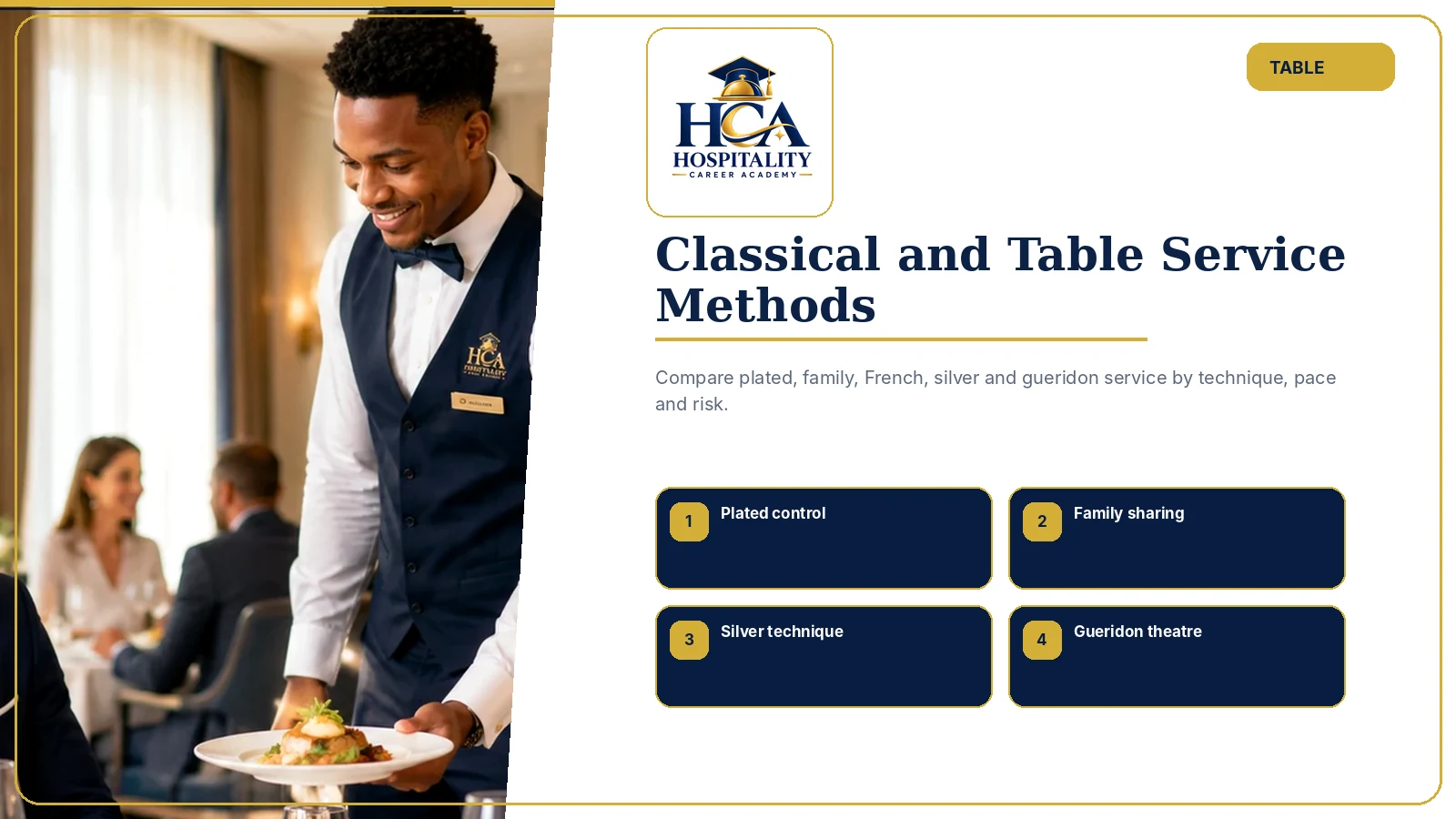
American or plated service
The kitchen portions and plates each dish before it reaches the dining room. The server verifies the table, seat, dish and modifier, then delivers the completed plate.
Best suited to: hotel restaurants, casual and upscale dining, functions and outlets that need reliable portion control and predictable timing.
Advantages:
- strong kitchen control over presentation and portion size;
- easier seat-position accuracy;
- efficient training compared with tableside methods;
- consistent course pacing when the kitchen and floor communicate well.
Risks to control: plates waiting at the pass, incomplete tables, incorrect modifiers, unsafe handling of hot plates and “auctioning” food because seat positions were not recorded.
English or family-style service
Food is delivered in shared dishes and portioned by the host, guests or service team. The method can feel social and generous, but it needs more table space and clear serving utensils.
Best suited to: family meals, groups, sharing concepts and selected banquet formats.
Risks to control: cross-contact between dishes, unclear portion availability, awkward reaching, congestion on small tables and uncertainty about which shared dish is safe for a guest with an allergy.
French service
Classical French service is highly personalised and may involve presenting, finishing or serving dishes near the table. Definitions vary between training systems, so a property should state exactly what its version includes.
Best suited to: premium restaurants and experiences where theatre and personal attention justify extra labour, time and equipment.
Risks to control: inconsistent technique, crowded aisles, temperature loss and excessive ceremony that slows the guest rather than serving them.
Russian or silver-style service
Food is attractively arranged on platters, presented, and portioned onto the guest’s plate by a trained server. Some organisations use “silver service” as a wider term, so supervisors should teach the observable technique rather than arguing about terminology.
Best suited to: formal dining, diplomatic or ceremonial events and premium banqueting.
Risks to control: unstable platter handling, poor portion control, reaching across guests, wrong service direction and insufficient practice.
Gueridon service
A trolley or side table is used to carve, flambé, mix, assemble or finish food beside the guest. It can be memorable and profitable when the item is distinctive and the team is competent.
Best suited to: signature dishes, tableside desserts, carving or finishing experiences.
Risks to control: flame and heat, trolley stability, aisle width, ventilation, missing mise en place, allergen cross-contact and long table occupation. Local fire, food-safety and workplace rules always take priority over theatrical presentation.
Assisted, self-service and single-point methods
Buffet service
Guests select food from a display, sometimes with service employees or chefs supporting live stations. Buffets can handle high volume and offer choice, but they require active supervision—not passive replenishment.
A safe buffet workflow includes protected displays, clean utensils, controlled holding conditions, accurate labels, allergen procedures, replacement of contaminated equipment, small-batch replenishment and clear responsibility for each station. Local law and the property’s approved food-safety system are decisive; international references such as the FDA Food Code can support training but do not replace local requirements.
Cafeteria or service-line operation
Guests move along a visible line, select items and pay at a defined point. Employees may portion every item or only selected products.
Success depends on readable menus, logical product order, fast payment, accessible counter design and a collection point that does not collide with arriving guests. The team must know how to answer ingredient, allergy and payment questions even when the concept is designed for speed.
Counter and quick service
The guest orders and usually pays at a counter, kiosk or digital channel. The order is prepared immediately or called for collection.
Controls include order confirmation, queue management, accurate modifiers, secure payment, clear collection identifiers and a process for correcting errors without sending the guest back through the full queue.
Grab-and-go and vending
Products are pre-packed for fast purchase. This reduces interaction but increases the importance of packaging, date control, labelling, stock rotation, storage conditions and visible assistance for guests who need more information.
Specialised food and beverage service
Banquet and event service
Banquet service delivers an agreed menu to a defined number of guests according to an event order and timeline. The actual method may be plated, buffet, family-style, reception or a combination.
The team must know the event objective, guest count, dietary list, room plan, timing cues, VIP protocol, service stations, clearing plan and escalation route. A banquet is successful when the event runs smoothly—not merely when every plate leaves the kitchen quickly.
Room service or in-room dining
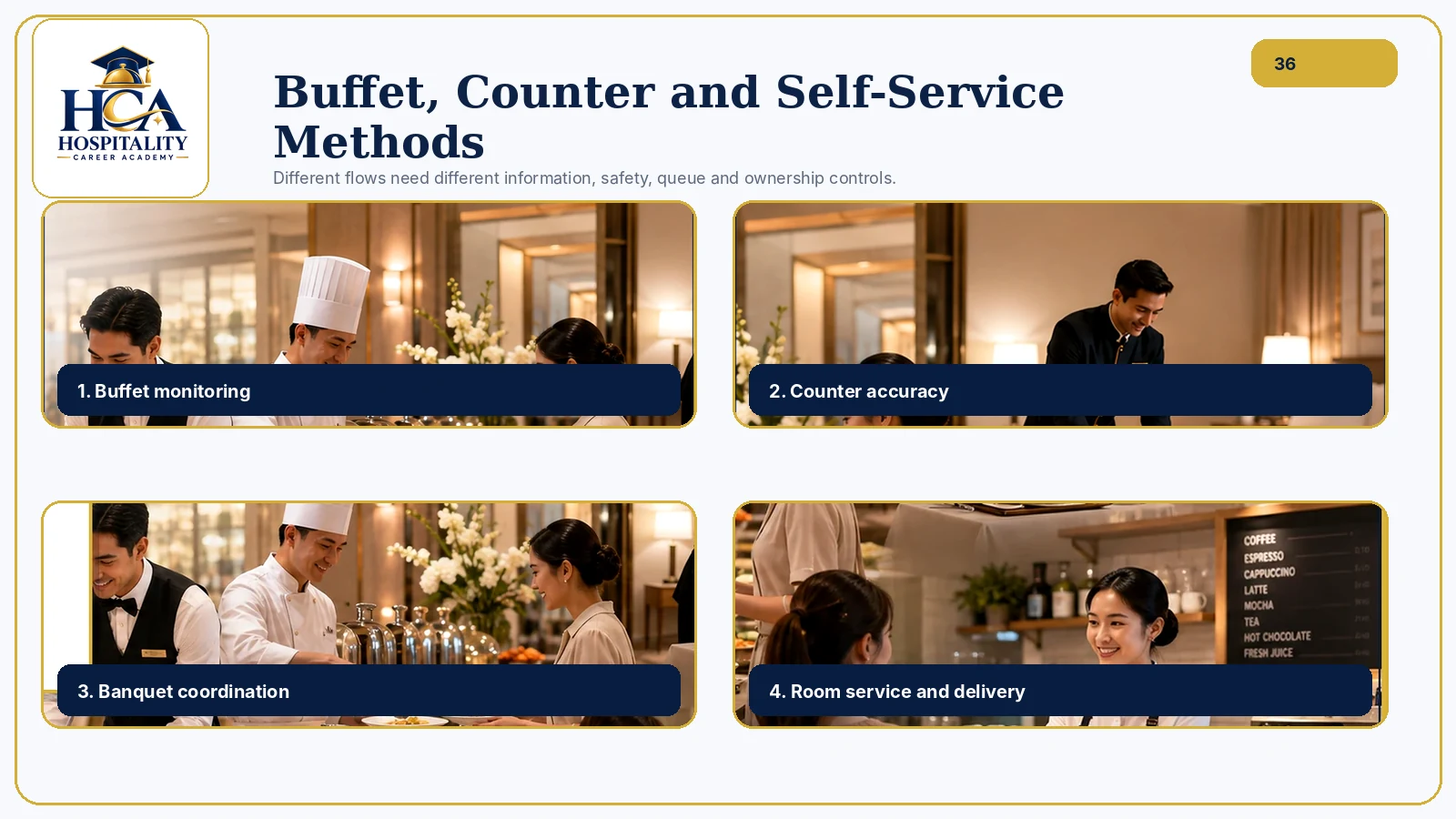
Room service adds telephone or digital order taking, room verification, tray or trolley preparation, privacy, secure delivery, room-entry etiquette and collection. Employees should confirm the order and estimated delivery time, protect room information and avoid entering until the guest gives permission.
Takeaway and delivery
Takeaway prioritises item checks, packaging, labelling, temperature protection and collection accuracy. Delivery adds route time, driver handover, tracking, responsibility boundaries and a recovery process when the package or timing fails.
Third-party delivery does not remove the restaurant’s responsibility for accurate product information and careful preparation. The operation should define where responsibility transfers and how complaints are investigated.
Comparison matrix: which method fits which need?
| Method | Guest involvement | Relative speed | Skill and labour | Main operational strength | Main control point |
|---|---|---|---|---|---|
| Plated | Low | Medium to fast | Medium | Portion and presentation control | Pass and seat accuracy |
| Family-style | High | Medium | Medium | Social sharing experience | Space and cross-contact |
| Silver/Russian | Low | Slower | High | Formal personalised service | Technique and platter safety |
| Gueridon | Interactive | Slow | High | Theatre and customisation | Heat, space and competence |
| Buffet | High | Fast access | Medium to high | Choice and volume | Holding, labels and replenishment |
| Counter | High | Fast | Medium | Convenience and queue efficiency | Order/payment accuracy |
| Room service | Low | Variable | Medium | Privacy and convenience | Delivery accuracy and entry etiquette |
| Delivery | Low | Variable | Medium | Reach beyond the outlet | Packaging, handover and route time |
The matrix is a decision aid, not a universal ranking. A method can perform brilliantly or poorly depending on planning and execution.
A seven-step method for selecting the right service system
- Define the guest promise. Is the priority speed, ceremony, personalisation, choice, convenience or social sharing?
- Analyse the menu. Consider plating complexity, holding tolerance, allergens, portion control and whether the dish travels well.
- Model demand. Estimate covers, arrival peaks, table turns, queue length, course timing and collection volume.
- Assess people and competence. Identify staffing level, required technique, language needs, supervision and training time.
- Check the space and equipment. Review aisles, table size, service stations, power, ventilation, storage, payment points and accessible routes.
- Build safety and information into the flow. Protect food, control cross-contact, make labels and prices clear, and define escalation.
- Test and improve. Run a controlled trial, observe the journey and measure both guest and operational outcomes.
A selection meeting should include culinary, service, food safety, finance and—where relevant—engineering, technology and accessibility owners. A beautiful concept on paper can fail if one of these functions cannot deliver it safely.
Food safety, allergens, accessibility and payment controls
Service method decisions must include four non-negotiable areas:
Food safety
Use the approved local food-safety plan. Define holding, replenishment, cleaning, handwashing, utensil replacement and corrective actions. Do not publish universal temperature or time limits unless they are verified against the law and procedure used by the property.
Allergy and dietary communication
Ask neutrally, record accurately and escalate through the approved workflow. Never promise that an item is safe without authorised confirmation. At buffets and shared-table formats, explain cross-contact limitations honestly.
Accessibility
Menus, counters, routes and digital ordering should be usable by people with different needs. Offer a human alternative when a kiosk or QR journey creates a barrier. Train staff to ask how they can assist rather than making assumptions.
Payment and privacy
Explain prices and conditions before commitment. Protect card data, room numbers and personal information. Do not announce sensitive details across a dining room or collection area.
How to train and assess food and beverage service methods
Training should move through five stages:
- Explain: define the method and why the operation uses it.
- Demonstrate: show correct body position, equipment, language and safety controls.
- Practise: use empty equipment before adding live products or guests.
- Simulate: run realistic scenarios such as an allergy question, a delayed table or a contaminated buffet utensil.
- Observe and coach: assess performance during service and record a specific development action.
A simple observation scorecard can rate:
| Area | Evidence to observe |
|---|---|
| Preparation | Correct station, equipment, labels and mise en place |
| Communication | Clear explanation, order confirmation and teamwork |
| Technique | Safe handling, correct sequence and professional movement |
| Accuracy | Correct guest, item, modifier, portion and payment |
| Safety | Hygiene, allergy process, hot equipment and clear routes |
| Guest awareness | Pace, accessibility, privacy and recovery ownership |
Use a clear scale such as Not yet demonstrated / Demonstrated with support / Demonstrated independently / Can coach others. This is more useful than a vague “good” or “poor.”
Common mistakes to avoid
- Treating fine dining, casual dining and cafés as if they were service methods.
- Choosing a theatrical method without the space or competence to support it.
- Measuring only speed while ignoring accuracy, safety and guest comfort.
- Filling a buffet excessively instead of replenishing with control.
- Using informal allergy notes that do not reach the kitchen correctly.
- Copying a “serve ladies first” rule without considering seat positions, accessibility, child safety, guest preference and property SOP.
- Launching digital ordering without an accessible human alternative.
- Assuming a third-party delivery partner owns every service failure.
Related HCA guides
- restaurant sequence of service
- types of buffet service in hotels
- room-service order taking and delivery
- HCA professional training
Update references
- Types of Food and Beverage Service — Hospitality Career Academy
- FDA Food Code — U.S. Food and Drug Administration
- Web Content Accessibility Guidelines (WCAG) 2.2 — World Wide Web Consortium
- Restaurant Sequence of Service — Hospitality Career Academy
Frequently asked questions
What are the main types of food and beverage service?
The main families are table service, assisted or self-service, single-point service and specialised service. Each family contains several methods, such as plated, buffet, counter, room service and delivery.
What is the most common restaurant service method?
Plated or American service is common because the kitchen controls portions and presentation while the service team can deliver courses with predictable timing. The correct method still depends on the concept.
Are Russian service and silver service the same?
The terms overlap in many training systems but are not defined identically everywhere. Teach the exact expected technique—such as platter presentation and server portioning—in the property SOP.
Which method is best for a hotel breakfast?
A buffet often supports choice and volume, while à la carte or assisted stations can improve personalisation and control. Many hotels use a hybrid based on demand, staffing, space and food-safety capacity.
How should a new service method be introduced?
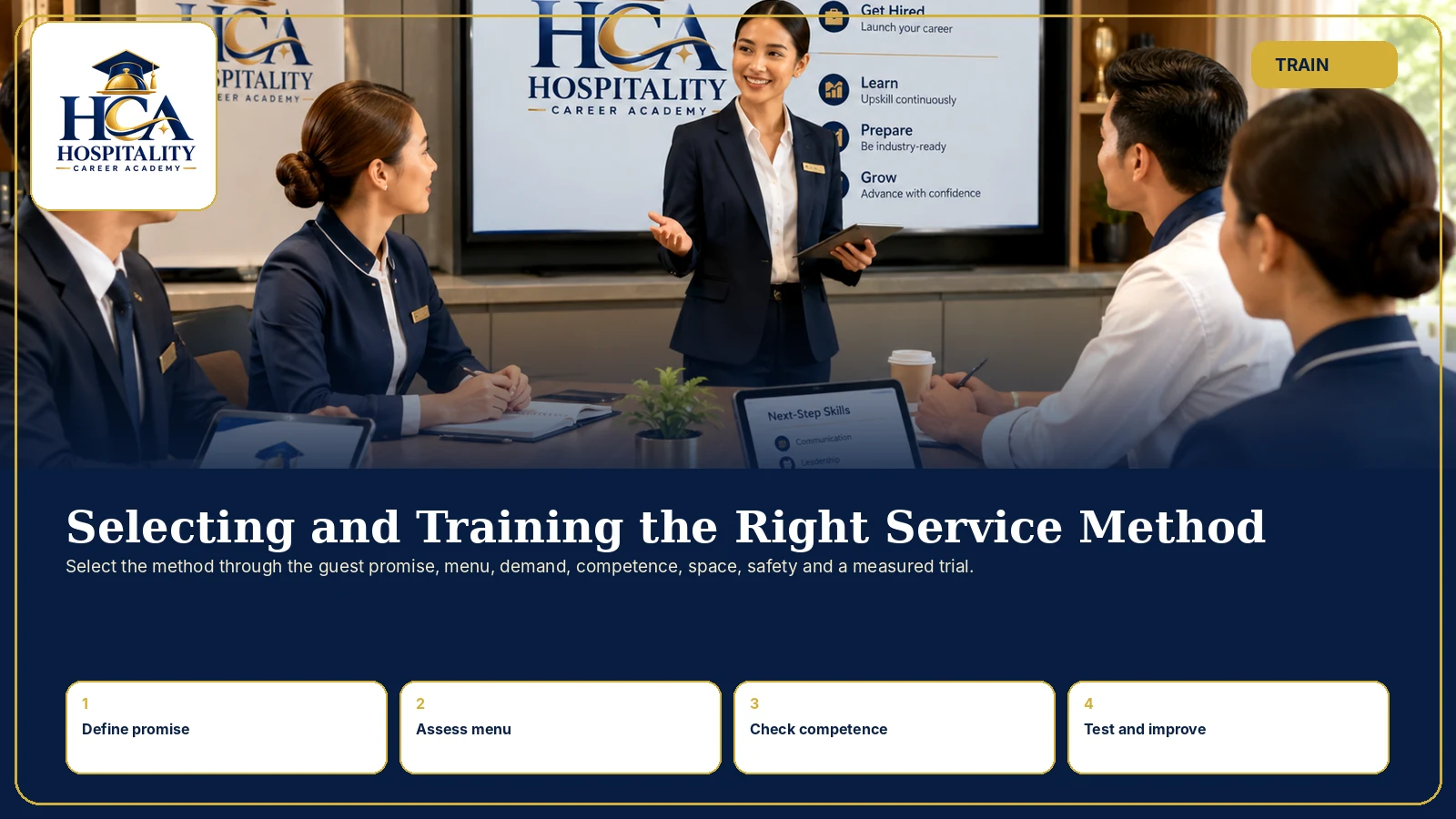
Document the workflow, involve the relevant departments, test it at controlled volume, train through demonstration and practice, then measure accuracy, safety, timing, guest feedback, waste and labour before expanding it.
Final takeaway
Food and beverage service methods are operational systems, not decorative labels. The right method aligns the guest promise with the menu, people, space, technology and safety controls. When teams understand the reason behind the method—and practise the exact behaviour expected—service becomes more consistent, easier to measure and more satisfying for guests and employees.
For deeper role training, connect this guide with HCA’s restaurant sequence of service, buffet operations, room service and professional waiter learning resources.
Frequently asked question
What are the main types of food and beverage service?
The main families are table service, assisted or self-service, single-point service and specialised service. Each family contains several methods, such as plated, buffet, counter, room service and delivery.
Build your food and beverage service skills