Buffet service is a food-and-beverage format in which dishes are displayed at one or more stations and guests select items themselves or receive portions from employees. Hotels do not use one universal buffet. A breakfast restaurant, conference coffee break, staff dining room and luxury brunch require different layouts, staffing and controls.
The right format depends on the meal purpose, guest volume, menu, space, accessibility, service level, food-safety plan, allergens, equipment and labour. This guide explains four practical buffet types and shows how to select, open, operate, measure and close them responsibly.
Buffet service in one minute
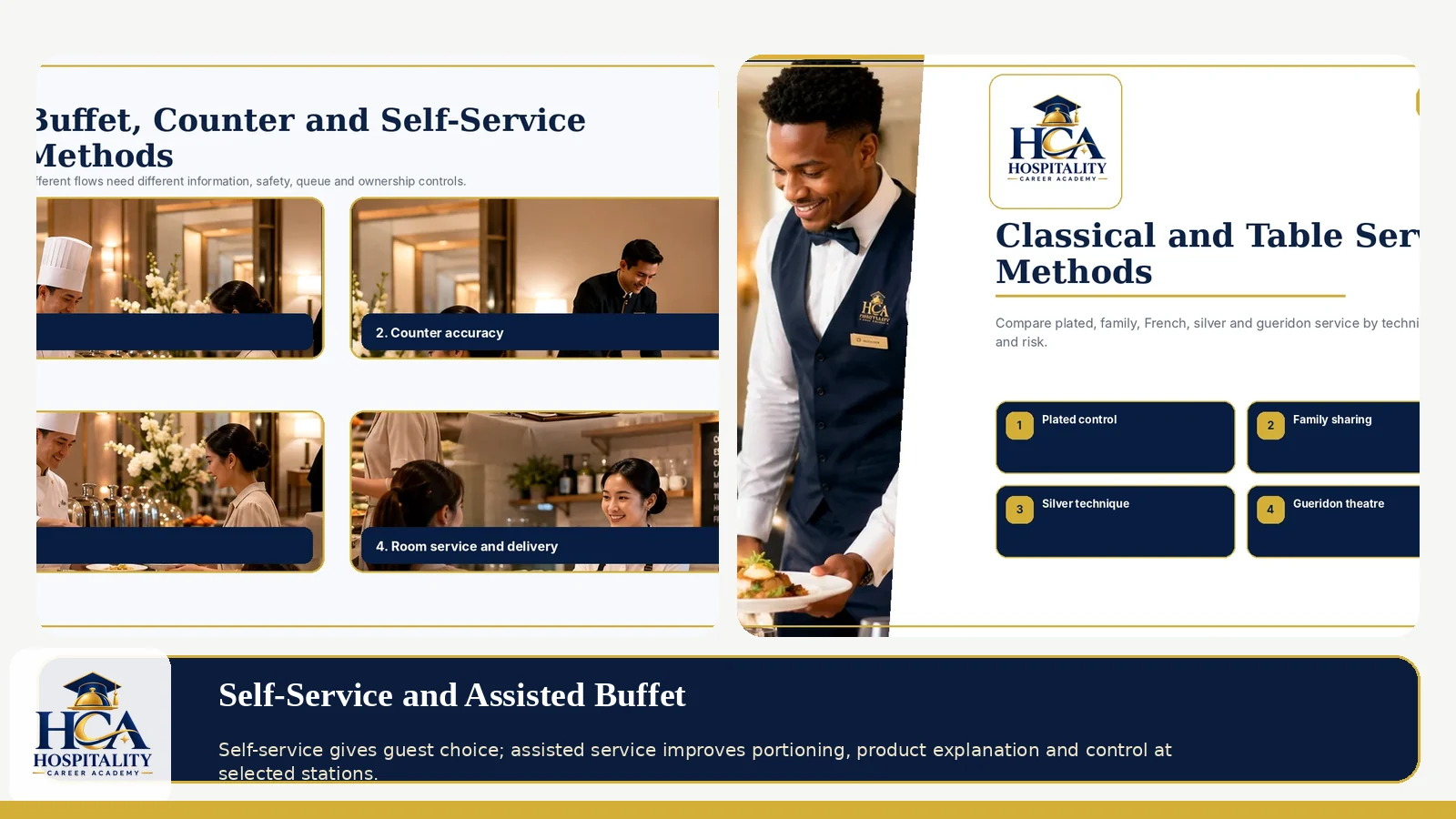
- Self-service buffet: guests select and portion most items.
- Assisted buffet: employees portion or hand over selected dishes.
- Live or action station: food is prepared, finished or assembled to order.
- Pre-portioned display or grab-and-go: guests select individually presented items.
Many hotels operate a hybrid buffet. A breakfast may use self-service cereals and bakery, an assisted egg or carving station, a live omelette station and pre-portioned yoghurt or fruit.
What buffet service is—and is not
A buffet separates food display and guest selection from a fully plated table-service sequence. It can provide variety and handle volume efficiently, but self-service does not mean unattended service. Employees still need to welcome, explain, replenish, clean, monitor controls, support accessibility, clear tables and respond to contamination or allergen concerns.
“Breakfast buffet,” “brunch buffet,” “international buffet,” “dessert buffet” and “themed buffet” describe the meal or concept. They are not necessarily different service methods. The four service types describe who portions the food and how it reaches the guest.
The four main buffet service types
1. Self-service buffet
Guests move along the display and portion items using shared or individual utensils. It works well for familiar products, predictable demand and high volume.
Operational needs include:
- intuitive flow from plates to food, condiments and cutlery;
- one appropriate utensil for each item;
- clear labels and staff able to answer questions;
- active monitoring and fast spill response;
- small-batch replenishment;
- enough duplicate high-demand items to reduce queues;
- accessible support for guests who need assistance.
Self-service becomes risky when stations are left without an owner, utensils migrate between dishes or old and new food are topped up together without the approved procedure.
2. Assisted buffet
The guest chooses from displayed food while an employee portions selected items. It is common at carving stations, premium seafood, delicate desserts, high-cost proteins or points requiring product explanation.
Benefits can include:
- consistent portions;
- improved presentation;
- less guest contact with the food or serving utensil;
- better product conversation;
- support for guests who need assistance.
The station still fails if one employee must portion, answer allergen questions, replenish, clean and manage a queue alone. Define roles and an escalation route when the answer is unknown.
3. Live or action station
Food is cooked, finished or assembled in front of the guest. Examples include eggs, pasta, noodles, grills, crêpes, waffles, salads or desserts.
A live station adds freshness and interaction, but requires:
- approved equipment and safe installation;
- ventilation and fire controls where applicable;
- raw-to-ready separation;
- utensil, hand-hygiene and cleaning controls;
- order and queue management;
- clear menu and allergen information;
- a backup plan for equipment failure or demand peaks.
The employee must balance conversation with safe production. The show must never override temperature, cross-contact or fire safety.
4. Pre-portioned display or grab-and-go
Food is presented in individual portions for quick selection. Examples include yoghurt, salads, desserts, sandwiches, fruit cups or packaged breakfast items.
This format can improve speed, portion consistency and display protection. It may also increase packaging, preparation work and waste if demand is forecast poorly. Labels, date control, storage, refill sequence and disposal rules remain essential.
Common hotel buffet concepts
Hotels combine the methods above into different concepts:
- Breakfast buffet: high early volume, familiar items and live egg stations.
- Brunch buffet: longer duration, premium displays and multiple action stations.
- Conference buffet: timed waves, coffee breaks and fast replenishment.
- Banquet buffet: planned event menu, controlled guest count and service schedule.
- Themed or international buffet: cuisine-led presentation requiring accurate labels and knowledgeable staff.
- Dessert or afternoon-tea buffet: delicate products, portion presentation and temperature sensitivity.
- Staff cafeteria: high-volume, value-controlled service with clear nutrition and hygiene standards.
The concept does not remove the need to choose the service type at each station.
How to select the right buffet mix
| Decision factor | Questions | Possible response |
|---|---|---|
| Guest volume | How many guests arrive in each 15-minute period? | Duplicate plates, drinks or high-demand dishes |
| Menu | Which items are fragile, high-risk, premium or made to order? | Use assisted or live stations selectively |
| Space | Where will queues cross tables, doors or emergency routes? | Reorient stations or separate demand points |
| Staffing | Who welcomes, serves, replenishes, cleans and supervises? | Simplify the menu or add station ownership |
| Food safety | What are the approved holding, display and corrective controls? | Use proper equipment, logs and smaller batches |
| Allergens | How are recipes, labels, utensils and questions controlled? | Designate trained staff and escalation |
| Accessibility | Can guests reach, read and use the display safely? | Adjust height, route, signage and assistance |
| Waste and value | What is the forecast and refill rule? | Reduce batch size and review last-hour production |
A beautiful buffet that cannot be monitored is not operationally ready.
Layout and station planning
Start with the guest route
Map arrival, plates, cold items, hot items, live stations, drinks, condiments, cutlery, seating and exit. Avoid forcing guests to cross incoming traffic repeatedly. Keep emergency routes and service access clear.
Separate demand peaks
Coffee, bread, eggs and popular hot items often create queues. Duplicate or relocate them where evidence supports it. Drinks may work better as table service or a separate island depending on the concept.
Protect service access
Employees need a route for replenishment, dirty-item removal, cleaning and emergency response. Do not make staff push hot or heavy equipment through a guest queue.
Use clear information
Labels should identify the item accurately and match the approved recipe. Provide readable placement and the property’s approved allergen communication. Decorative names are not enough when the guest needs to understand ingredients.
Food safety, allergen and operating controls
Food law and numeric limits vary by jurisdiction. The hotel must follow its current local code, approved HACCP or food-safety plan and qualified food-safety leadership. Do not import a foreign temperature or time rule into the operation without verification.
Core controls usually include:
- approved suppliers, receiving and storage;
- validated recipes and allergen information;
- safe cooking, cooling, reheating and holding processes;
- suitable equipment and protective display arrangements;
- clean hands, utensils and contact surfaces;
- a separate utensil for each dish;
- active supervision of guest self-service;
- time and temperature records where required;
- small-batch replenishment rather than uncontrolled topping up;
- removal and replacement after contamination or loss of control;
- clean plates for additional visits according to local procedure;
- clear corrective actions and disposal authority.
Allergen control
A label alone is not an allergen programme. The operation needs:
- an approved recipe and ingredient source;
- a controlled method for recipe or supplier changes;
- trained staff who know where verified information is stored;
- dedicated or controlled utensils where the plan requires them;
- an escalation route when the answer is uncertain;
- honest communication about cross-contact controls and limitations.
Never promise “allergen-free” unless the operation has verified authority to make that statement.
Staffing a buffet
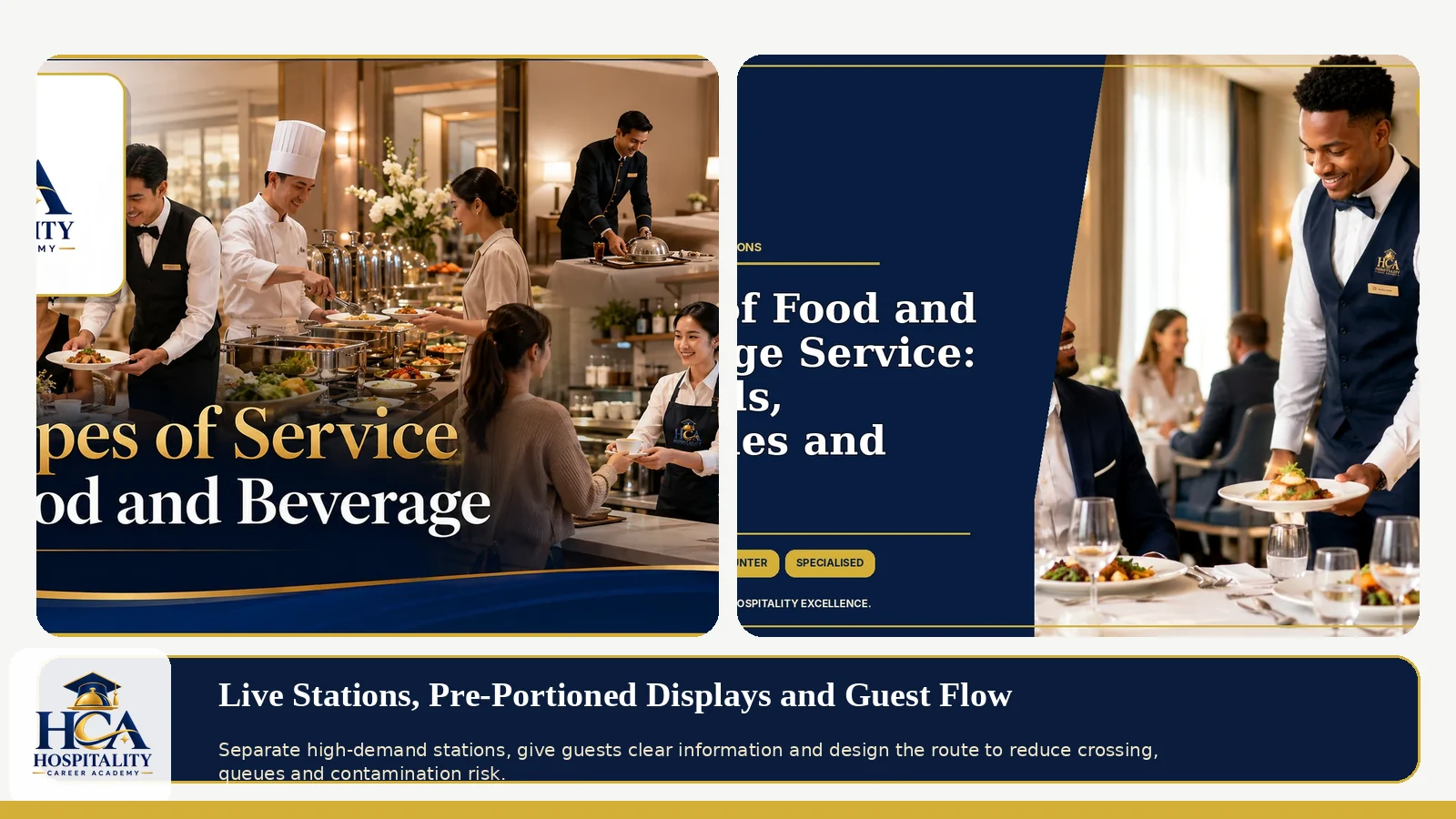
Assign explicit station roles:
- Host or greeter: explains the format, seating and special support.
- Buffet supervisor: owns readiness, records, corrective action and coordination.
- Station attendant: monitors appearance, utensils, labels, guests and replenishment.
- Chef or live-station cook: prepares safely and communicates product information.
- Runner: moves replenishment through the approved route.
- Table-service team: beverages, clearing, guest checks and recovery.
- Stewarding: clean equipment, dish flow, waste and back-of-house sanitation.
One employee can cover more than one role only when volume and risk make it realistic.
Opening checklist
Before opening:
- confirm the menu, recipes and labels;
- inspect equipment, guards, lighting and service routes;
- verify approved holding and display conditions;
- place correct utensils and backups;
- check plates, bowls, glassware and cutlery;
- brief forecast, VIPs, children, groups and dietary requirements;
- assign each station and escalation contact;
- confirm spill, breakage and contamination response;
- test live-station equipment;
- photograph or sign off the approved presentation if the property uses that control.
Operating checklist
During service:
- welcome and explain the format;
- monitor queues and accessibility;
- check labels and utensils continuously;
- replenish in controlled small batches;
- record required checks;
- remove a dish immediately when control is uncertain;
- clean spills safely and quickly;
- communicate unavailable items honestly;
- observe guest behaviour without embarrassing anyone;
- check tables, beverages and satisfaction;
- update the kitchen on demand and last-hour production.
Closing checklist
At closing:
- stop production at the planned time;
- follow the approved disposition rules for remaining food;
- do not return displayed food to storage unless the approved process permits it;
- reconcile key records and corrective actions;
- clean and sanitise equipment and surfaces;
- inspect damage, breakage and maintenance needs;
- record waste by useful category;
- review guest feedback, queue points and refill gaps;
- hand over unresolved safety or equipment issues.
Control waste without creating safety risk
Waste reduction begins with forecasting, batch size, menu engineering, pan depth, station location and communication—not by keeping food beyond the approved limit. Track waste as overproduction, plate waste, spoilage, quality rejection and unavoidable preparation loss. Different causes require different action.
A smaller final-hour display can remain attractive when the team uses narrower pans, more frequent replenishment and intentional presentation.
Buffet KPIs that support learning
Use a balanced set:
- opening readiness on time;
- required food-safety checks completed;
- allergen information accuracy;
- refill gaps and station downtime;
- peak queue time;
- covers per labour hour with quality context;
- food waste per cover and by cause;
- guest feedback on variety, freshness and ease;
- incidents, corrective actions and repeat failures;
- equipment reliability;
- table-clearing and beverage response.
Do not reward low waste if it encourages unsafe reuse, empty displays or poor variety.
Three practical scenarios
Breakfast egg-station queue
Demand peaks at 9:00. Add a simple order-and-collection method, reduce menu complexity during the peak, assign a queue host and pre-prepare only what the approved process permits. Measure wait time and wrong orders.
Allergen question at a dessert buffet
The attendant does not guess. They pause service of the uncertain item, use the verified recipe source and contact the designated knowledgeable person. If safe assurance cannot be given, communicate that honestly and offer an approved alternative.
Repeated empty hot dish
Check forecast, batch size, runner route, kitchen production time, pan capacity and communication. A bigger pan may increase holding time and waste; the answer may be smaller, faster batches and a clearer trigger.
Common buffet mistakes
- Calling the buffet self-service and leaving it unattended.
- Placing too many high-demand items in one queue.
- Using decorative but unclear labels.
- Allowing utensils to move between dishes.
- Topping up without the approved replenishment method.
- Giving allergen answers from memory.
- Measuring food cost without guest flow, waste or safety.
- Blocking service or emergency routes.
- Keeping a full display until the last minute without demand evidence.
- Closing without recording waste, incidents and equipment issues.
Final takeaway
The best hotel buffet is not the largest display. It is the buffet that matches demand, allows guests to move comfortably, gives accurate information, protects food and allergens, supports employees and maintains quality throughout the service. Choose the right mix of self-service, assisted, live and pre-portioned formats, then control every station from opening to closing.
Related HCA guides
- types of food and beverage service
- restaurant sequence of service
- food safety, HACCP and allergen training
- professional waiter training
Update references
- Types of Buffet Service in Hotels: Formats, Setup and Controls — Hospitality Career Academy
- FDA Food Code 2022 — U.S. Food and Drug Administration
- Serving Up Safe Buffets — U.S. Food and Drug Administration
- Keeping Your Buffet Safe — HACCP System — Centre for Food Safety, Hong Kong
- Provide a Buffet Service — UK National Occupational Standards
- Dubai Food Code — Dubai Municipality
Frequently asked questions
What are the four main types of buffet service?
Self-service, assisted service, live or action stations, and pre-portioned display or grab-and-go. Hotels often combine them.
What is assisted buffet service?
The guest chooses from displayed food while an employee portions or hands over selected items. It is useful for carving, premium or delicate products and controlled portions.
Is buffet service faster than table service?
It can handle high volume efficiently, but poor layout, too few stations or slow replenishment can create longer waits than organised table service.
How should allergens be managed?
Use approved recipes, accurate labels, trained staff, controlled utensils and the property’s cross-contact and escalation procedure. Local law and the approved food-safety plan control.
Which temperature should a hotel use?
Use the current limit in the applicable local food code and the property’s approved HACCP plan. Do not treat a foreign guideline as a universal rule.
Sources and update note
This guide uses the HCA article, the FDA Food Code and buffet guidance, Hong Kong Centre for Food Safety HACCP material, UK occupational standards and Dubai Municipality’s food-code resource. Reviewed 2 September 2026. Local law and the approved property food-safety system always control.
Frequently asked question
What are the four main types of buffet service?
Self-service, assisted service, live or action stations, and pre-portioned display or grab-and-go. Hotels often combine them.
Explore HCA food-and-beverage training