
Hotel teams often use the terms market, market segment and target market as if they mean the same thing. They are connected, but they describe different decisions. Confusing them can lead to weak marketing, unclear pricing and guest experiences that try to satisfy everyone but serve nobody particularly well.
This guide gives hotel owners, commercial teams, students and operational leaders a clear practical distinction. It also explains how segmentation and targeting affect rooms, offers, service design and daily operations.
Key takeaway: Segmentation divides a broad market into meaningful groups. Targeting is the decision to prioritise one or more of those groups. Positioning explains why those chosen guests should prefer your hotel.
Four terms to understand
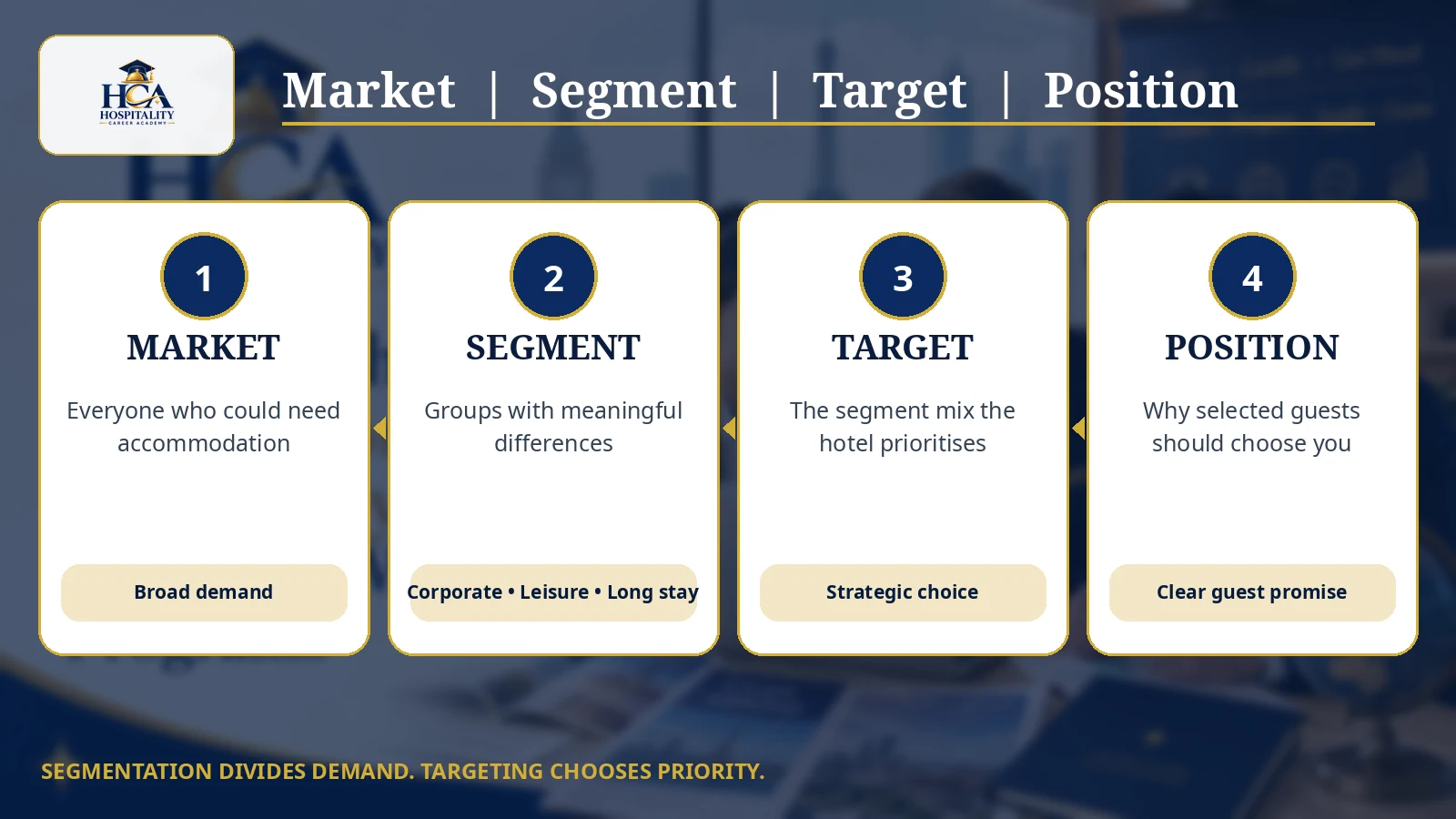
Market
The broad set of potential customers and demand relevant to the hotel. For a city hotel, this may include people travelling to the destination for business, leisure, events, medical reasons, government work, relocation or visiting friends and relatives.
Market segment
A group within the broader market whose members share meaningful characteristics or booking behaviour. Hotels may segment demand by purpose of travel, booking channel, rate type, length of stay, geography, company account, group status or other useful criteria.
Target market
The segment or combination of segments the hotel deliberately chooses to prioritise because they fit its location, product, capabilities and commercial goals.
Positioning
The clear place the hotel wants to occupy in the selected guest’s mind—for example, “a convenient long-stay business hotel near the district” or “a family-friendly beach resort with easy activities and flexible accommodation”.
Comparison table
| Term | Main question | Hotel example | Typical decision |
|---|---|---|---|
| Market | Who could potentially stay with us? | Travellers requiring accommodation in Dubai Marina | Estimate broad demand and competitors |
| Market segment | Which groups behave or need differently? | Corporate transient, long stay, weekend leisure, groups | Analyse demand patterns and needs |
| Target market | Which segment or segments will we prioritise? | Long-stay corporate guests and relocating families | Focus product, pricing and sales effort |
| Positioning | Why should those guests choose us? | Spacious serviced apartments with hotel support near key offices | Shape message and guest promise |
Segmentation comes before targeting
A common mistake is to call a chosen customer group a “segment” and a “target market” at the same time without showing the decision process. A clearer sequence is:
- Define the broad market relevant to the hotel.
- Divide demand into useful segments.
- evaluate each segment’s attractiveness and fit.
- Select the target segment or target mix.
- Position the hotel for those guests.
- Align product, price, distribution, communication and service delivery.
- Monitor results and adjust when demand changes.
A segment exists because it is a meaningful group in the market. It becomes a target when the business chooses to pursue it.
Worked example: an urban serviced residence
Imagine a serviced residence located near offices, a hospital and a metro station.
Broad market
People who need accommodation in the area.
Possible segments
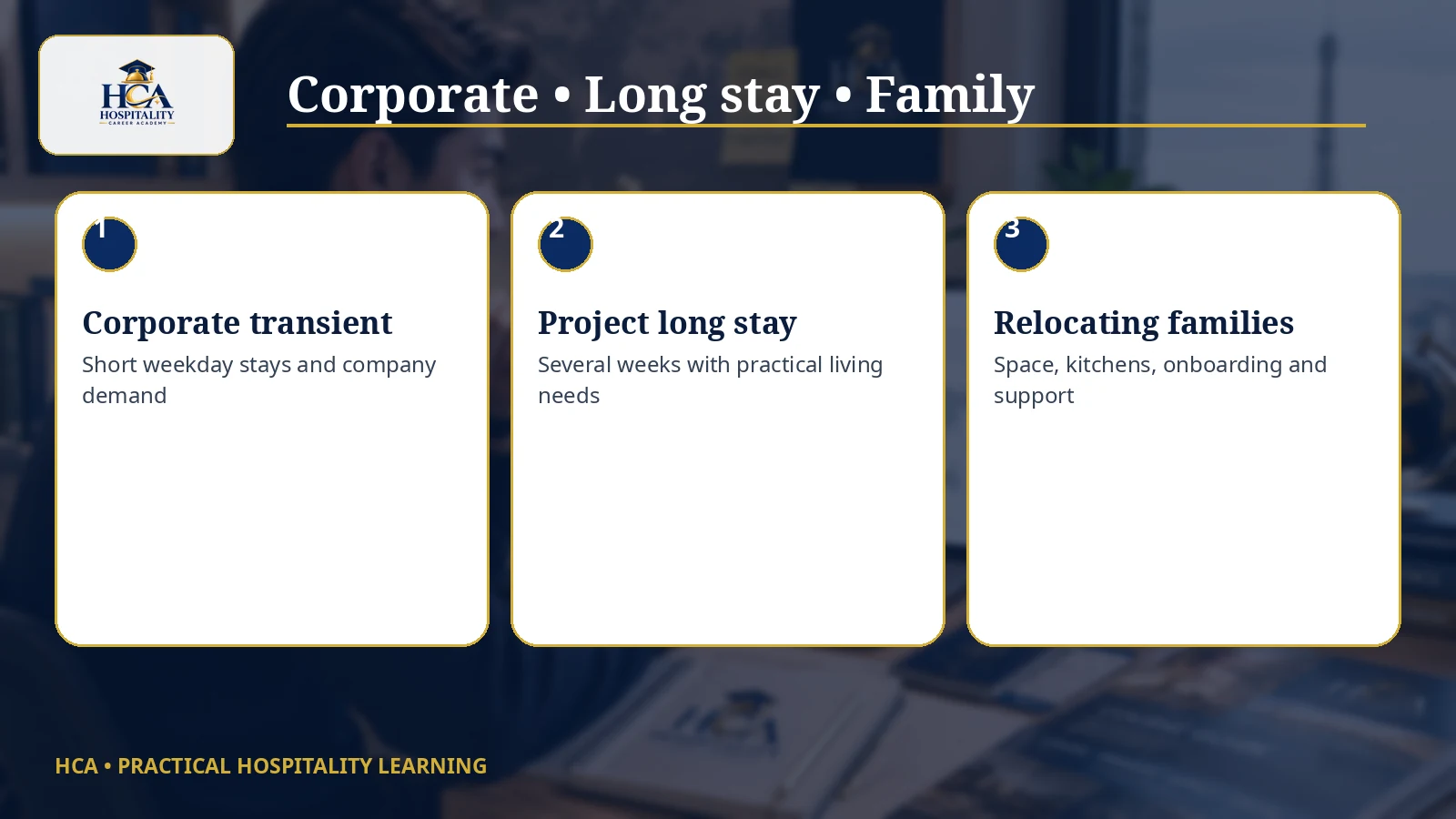
- corporate travellers staying three to five nights;
- project teams staying several weeks;
- families relocating to the city;
- medical travellers and accompanying family members;
- weekend leisure visitors;
- airline or company contract guests;
- small groups attending nearby events.
Target-market decision
After reviewing demand, product and competition, the property may choose to prioritise:
- long-stay project teams;
- relocating families;
- selected corporate transient accounts during weekdays.
Positioning
“Spacious, practical long-stay accommodation with hotel service, kitchen facilities and convenient access to major workplaces.”
Operational effect
This decision influences more than advertising. The property may need:
- storage and kitchen equipment suited to longer stays;
- flexible housekeeping frequency;
- efficient maintenance and laundry support;
- family onboarding information;
- reliable invoicing for company accounts;
- sales relationships with relocation and project companies;
- rates that reflect length of stay and included services.
Targeting therefore becomes an operational promise. Marketing cannot position the hotel for long stays if the service model remains designed only for one-night guests.
How hotels create useful market segments
A segment is useful when it helps the hotel make better decisions. Common approaches include:
Purpose of travel
Business, leisure, event, medical, relocation, government, crew or visiting friends and relatives.
Booking behaviour
Direct website, travel agent, online travel agency, global distribution system, company account, group contract or walk-in.
Stay pattern
Day use, one night, short stay, extended stay, weekday, weekend, seasonal or event-driven.
Value and rate behaviour
Negotiated corporate, retail flexible, advance purchase, package, wholesale, contract or group rate.
Needs and service preferences
Families, accessibility needs, wellness travellers, luxury guests, budget-conscious guests, digital-first travellers or guests requiring high-touch assistance.
Do not create so many segments that the team cannot use them. The best structure is detailed enough to guide decisions but simple enough to maintain consistently in the PMS, CRS and reporting process.
What data should a hotel review?
Segmentation should be informed by several sources rather than one assumption:
- PMS and reservation data;
- channel and rate-code production;
- company-account and group history;
- length of stay and booking window;
- day-of-week and seasonal patterns;
- cancellation and no-show behaviour;
- guest feedback and service requests;
- sales-team knowledge;
- competitor and destination demand;
- campaign and website performance.
Use personal data lawfully and only for legitimate business purposes. Avoid sensitive profiling or assumptions about guests based on nationality, appearance or personal characteristics. Segment using relevant, supported information and the organisation’s privacy rules.
How to choose a target market
A large segment is not automatically the best target. Review each option against practical criteria:
Demand potential
Is there enough current or future demand to justify attention?
Product fit
Can the room types, location, facilities and service model meet the segment’s needs?
Commercial quality
Consider achievable rate, length of stay, cost to serve, channel cost, cancellation risk and total spending—not only room volume.
Access
Can the hotel reach the segment through suitable sales relationships, channels or marketing?
Competitive position
Does the hotel offer a credible advantage, or would it compete only through discounting?
Operational capability
Can the team deliver the promise consistently? A family target may require connecting rooms, children’s facilities and clear safety information. A corporate target may require fast invoices, reliable internet and efficient weekday service.
Risk balance
Avoid dependence on one company, one channel or one event period. A balanced target mix can protect demand across seasons and days of the week.
How targeting affects the hotel operation
Rooms and facilities
Room configuration, work areas, storage, connecting options, kitchen facilities and accessible features may be prioritised differently.
Pricing and packages
The hotel may design length-of-stay rates, family packages, meeting offers, weekend promotions or corporate agreements.
Distribution
Different segments use different channels. The hotel should place inventory and content where the chosen guests actually search and book.
Sales activity
The sales team can prioritise specific companies, relocation partners, event organisers or travel-trade relationships.
Guest communication
Website content, photography, pre-arrival messages and front-desk explanations should reflect the target guest’s real questions.
Service design
Breakfast timing, housekeeping frequency, check-in support, transport, payment and follow-up may need adjustment.
Common mistakes
Treating demographics as the whole segment
Age and income may help in some cases, but travel purpose, stay pattern and booking behaviour are often more useful operationally.
Selecting every segment
A hotel can welcome many types of guests without treating every group as an equal strategic priority.
Choosing based on opinion alone
Statements such as “families are our main market” should be tested against booking data, seasonality, rate and service usage.
Targeting a group the product cannot serve
Marketing luxury, family or long-stay benefits without the required facilities and service creates disappointment.
Failing to update segments
Demand changes with new transport, offices, attractions, competitors, regulations and economic conditions. Review the structure regularly.
Mixing reporting codes
If staff use segment and rate codes inconsistently, the commercial analysis becomes unreliable. Definitions, training and audits matter.
A simple hotel segmentation worksheet
For each proposed segment, record:
- segment name and clear definition;
- main booking purpose;
- common stay pattern;
- primary channels;
- needs and pain points;
- expected commercial value;
- hotel strengths and gaps;
- operational changes required;
- sales or marketing route;
- key performance indicators;
- review date.
Relationship with HCA’s full segmentation guide
This article answers one focused question: What is the difference between a hotel market segment and a target market? For deeper guidance on building segment definitions, analysing production and connecting segmentation to commercial action, use HCA’s full Hotel Target Market Segmentation guide.
Keeping these two pages distinct avoids repetition: this page is the terminology and decision explainer; the full guide is the implementation resource.
Final takeaway
A hotel market is the broad demand opportunity. Segmentation divides that market into groups with meaningful differences. Targeting selects the groups the hotel will prioritise. Positioning gives those guests a clear reason to choose the property.
When the process is done well, the result is not only better marketing. It creates more relevant offers, clearer sales priorities and an operation designed around the guests the hotel has chosen to serve especially well.
Frequently asked question
Is a target market the same as a market segment?

No. A market segment is a defined group within the broader market. A target market is the segment or combination of segments the hotel selects as a strategic priority. The hotel may recognise many segments but actively target only some of them.
Sources and update note
- HCA: Hotel Target Market Segmentation.
- HCA: live hotel, career and training context for Egypt and the GCC.
Reviewed and substantially rewritten on 2 September 2026. Segment names, reporting codes and privacy requirements vary by property, system and market; validate the final model against live hotel data and local requirements.
Related HCA guides
- Hotel Target Market Segmentation
- Hotel Types Based on Their Target Markets
- HCA reservations and revenue course
Update references
- Hotel Target Market Segmentation — Hospitality Career Academy
Frequently asked question
Is a target market the same as a market segment?
No. A market segment is a defined group within the broader market. A target market is the segment or combination of segments the hotel chooses as a strategic priority.
Read the full hotel segmentation guide