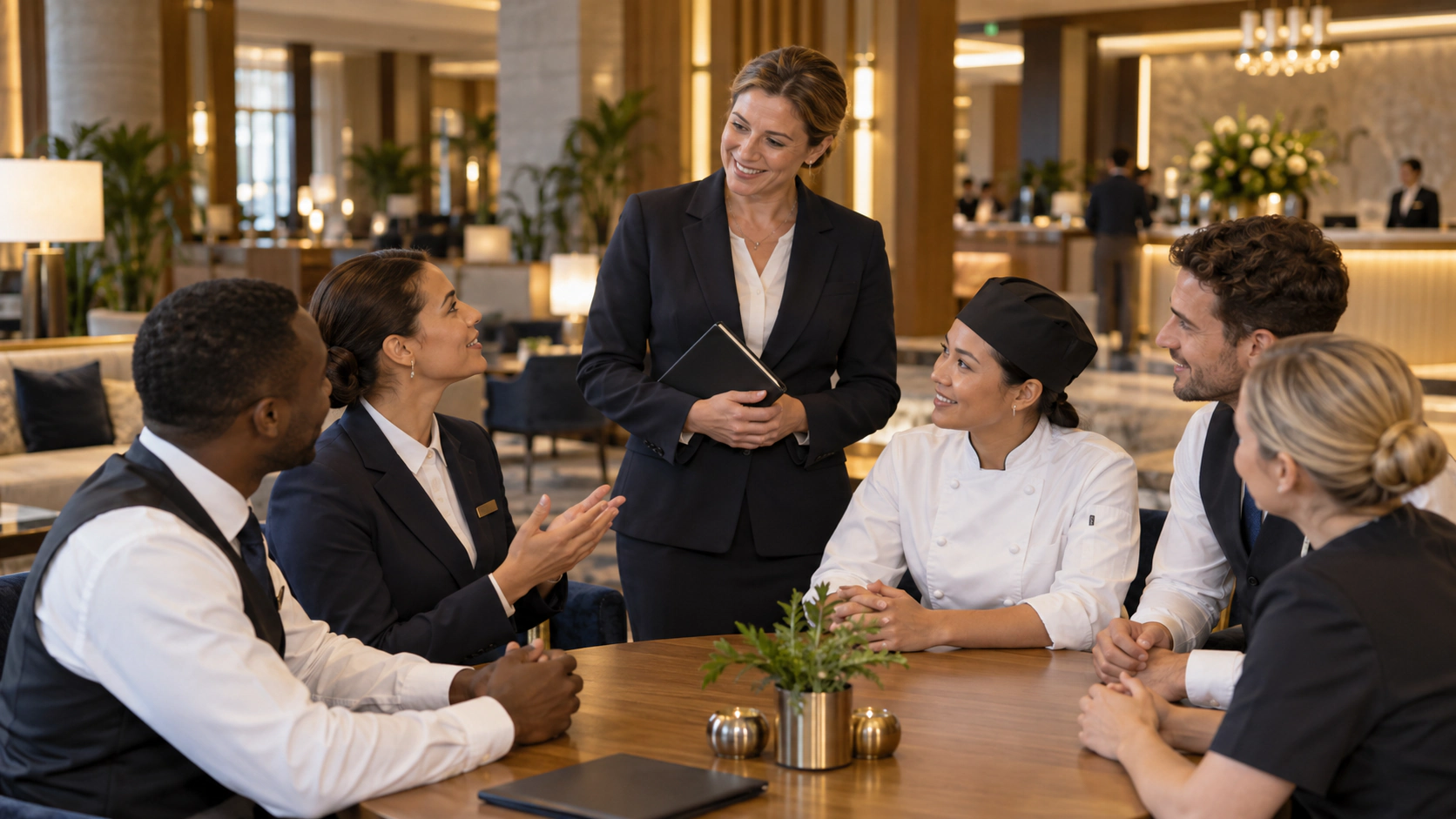
The hospitality industry is often described as “hotels and restaurants,” but the real field is wider and more connected. Hospitality businesses create places, services and experiences in which people sleep, eat, meet, celebrate, relax, travel or receive care away from home. Their success depends on combining human service with safe, reliable operations.
This guide explains what belongs to hospitality, how it relates to tourism, which departments and job families exist, what the working environment is really like and how a beginner can choose a career path.
Hospitality and tourism are connected—but not identical

UN Tourism defines tourism around the movement of visitors outside their usual environment. Hospitality focuses more directly on receiving, accommodating, serving and supporting people during an experience.
The two fields overlap, but neither is simply another name for the other.
- A hotel is part of hospitality and often supports tourism.
- A neighbourhood restaurant may serve mostly local residents and still be hospitality.
- An airline or travel agency belongs to the wider visitor economy, but its operating model is not the same as a hotel or restaurant.
- A conference can involve hospitality, events, travel and business services together.
This distinction helps learners avoid overbroad definitions. Hospitality is best understood through the guest experience and the operating systems that make that experience possible.
Main sectors of the hospitality industry
1. Accommodation
Accommodation provides temporary or extended stays. Examples include:
- hotels and resorts;
- serviced apartments and branded residences;
- hostels and guest houses;
- motels and roadside accommodation;
- holiday villages and lodges;
- selected short-stay rental operations.
Accommodation teams manage reservations, arrival, rooms, cleanliness, security, maintenance, billing and departure.
2. Food and beverage
Food and beverage operations include:
- restaurants;
- cafés and coffee shops;
- bars and lounges where lawful and licensed;
- banquet and catering operations;
- room service and in-room dining;
- quick-service and takeaway outlets;
- event food service.
This sector combines product quality, food safety, service timing, guest interaction, cost control and sales.
3. Meetings, events and celebrations
Hospitality supports:
- conferences and exhibitions;
- weddings and social events;
- corporate meetings;
- sports and cultural events;
- private dining and outside catering.
Event operations connect sales, planning, banquets, kitchen, audio-visual support, security, finance and guest service.
4. Wellness, recreation and guest experiences
Depending on the property, this may include:
- spas and wellness centres;
- fitness facilities;
- pools and beaches;
- clubs and recreation;
- concierge experiences;
- family and children’s activities.
These operations require qualified staff, clear safety boundaries and accurate communication about what is available.
5. Travel and tourism support
Travel agencies, tour operators, destination services, cruise activities and transport providers form part of the wider tourism and visitor economy. Hospitality professionals often coordinate with them, especially for arrivals, transfers, excursions, groups and destination information.
The hospitality guest journey
A guest experience begins before arrival and continues after departure.
| Stage | Typical guest need | Departments involved |
|---|---|---|
| Discover | understand the product and trust the promise | marketing, sales, revenue, reservations |
| Book | receive accurate rates, terms and confirmation | reservations, e-commerce, finance |
| Prepare | share preferences and plan arrival | reservations, front office, concierge, housekeeping |
| Arrive | feel recognised, safe and informed | front office, bell, security, guest relations |
| Stay or dine | receive the promised service | rooms, F&B, engineering, spa, recreation |
| Resolve | get help when something goes wrong | operating department, duty manager, security or specialist teams |
| Depart | receive an accurate bill and clear farewell | front office, cashiering, finance, transport |
| Follow up | provide feedback or return | guest relations, marketing, loyalty, sales |
The guest sees one experience even when the business uses many departments. Strong hospitality therefore depends on handovers and shared information.
Core hotel departments
Front office and guest services
Handles arrivals, departures, room assignment, guest accounts, information, requests and coordination. Roles may include receptionist, concierge, bell attendant, guest-relations agent, telephone operator, night auditor and duty manager.
Housekeeping
Maintains guest rooms, public areas, linen and presentation standards. Roles include room attendant, public-area attendant, linen-room employee, supervisor and executive housekeeper.
Food and beverage
Operates restaurants, bars, banquets, room service and cafés. Roles include host, waiter, captain, bartender, barista, banquet employee, outlet supervisor and restaurant manager.
Culinary
Plans, prepares and controls food production. Roles include commis chef, chef de partie, sous chef, pastry chef, stewarding employees and executive chef.
Reservations and revenue
Controls booking accuracy, inventory, distribution, pricing support and demand analysis. Roles include reservation agent, supervisor, revenue analyst and revenue manager.
Sales, marketing and e-commerce
Builds demand, manages accounts, creates campaigns, maintains digital content and supports direct and third-party channels.
Engineering and maintenance
Protects the building, equipment, utilities and guest comfort through preventive and corrective maintenance.
Security, safety and loss prevention
Supports people, property, access, incidents, emergency response and investigations within lawful authority.
Human resources and learning
Supports workforce planning, recruitment, onboarding, employee relations, development, performance and policy implementation.
Finance and purchasing
Manages accounting, payments, revenue controls, budgets, procurement, stock and financial reporting.
Not every property uses the same structure. A smaller hotel may combine roles, while a resort or luxury property may have more specialised teams.
What hospitality work is really like
Hospitality can be rewarding, social and internationally transferable, but it also has real demands.
Service happens when guests need it
Many operations run early, late, overnight, on weekends and during holidays. Employees should understand shift patterns before accepting a role.
Emotional control matters

Team members may support tired, disappointed or stressed guests. Professionalism requires calm communication without accepting abuse, discrimination or unsafe behaviour.
Safety and compliance are part of service
Food safety, fire procedures, key control, data privacy, payment security, chemical handling and incident reporting are not “back-office” issues. They protect guests, employees and the business.
Teamwork is operational
A friendly team is valuable, but operational teamwork also means accurate handovers, task ownership, escalation and follow-up.
Standards differ by property
Luxury, economy, resort, residence, restaurant and event operations may share service principles but use different products, staffing and procedures. Learn the standard of the property you work in.
Common hospitality job families
Guest-facing operational roles
- receptionist;
- concierge;
- restaurant host;
- waiter or server;
- barista;
- guest-relations agent;
- reservations agent;
- spa receptionist;
- recreation attendant.
Behind-the-scenes operational roles
- room attendant;
- public-area cleaner;
- steward;
- cook or commis chef;
- maintenance technician;
- storekeeper;
- laundry employee;
- security officer.
Commercial and support roles
- sales coordinator;
- marketing associate;
- e-commerce specialist;
- revenue analyst;
- HR coordinator;
- learning coordinator;
- accountant;
- purchasing officer.
Leadership roles
- supervisor;
- captain or team leader;
- duty manager;
- department manager;
- director or head of department;
- hotel or general manager.
Skills that transfer across hospitality
The exact technical skills differ, but these capabilities support many roles:
- Communication — listening, speaking, writing and handover.
- Service orientation — understanding needs and taking appropriate action.
- Accuracy — protecting details, records, payments and status.
- Team coordination — sharing information and supporting the wider operation.
- Problem-solving — identifying cause, options, authority and next steps.
- Digital confidence — learning PMS, POS, reservation, reporting or communication systems.
- Cultural awareness — working respectfully with diverse guests and colleagues.
- Safety awareness — recognising hazards and following escalation rules.
- Commercial awareness — understanding value, revenue, cost and guest choice.
- Reliability — arriving prepared and completing commitments.
How to choose a hospitality career path
Step 1: Choose the work environment
Do you prefer a hotel lobby, restaurant floor, kitchen, office, event venue, guest room, spa or technical area?
Step 2: Choose the type of interaction
Do you enjoy continuous guest contact, occasional service contact, analytical work, creative work, technical work or people development?
Step 3: Review the real role
Read the job description, shift pattern, physical demands, required language, systems, qualifications and authority boundaries.
Step 4: Test the path
Use job shadowing, an internship, a short course, a controlled volunteer project or an entry role to learn whether the work suits you.
Step 5: Build evidence
Employers need proof. Evidence may include:
- a completed training course;
- a role-play assessment;
- system practice;
- a sample menu, report or project;
- guest-service examples;
- language ability;
- a supervisor reference;
- reliable work history.
A 90-day hospitality career exploration plan
Days 1–30: Explore
- Compare three sectors and five roles.
- Review actual vacancies in your target market.
- Identify common skills and shift requirements.
- Complete one introductory learning module.
Days 31–60: Practise
- Build one role-specific skill.
- Complete scenarios or practical tasks.
- Improve hospitality English or Arabic terminology.
- Create a simple evidence portfolio.
Days 61–90: Apply with focus
- Select one primary and one alternative role.
- Tailor the CV to verified evidence.
- Research target employers.
- Practise interviews and role scenarios.
- Apply through official sources and track outcomes.
Common misconceptions
- “Hospitality means hotels only.” Hotels are important, but the field also includes food service, events, wellness and other guest experiences.
- “Good personality is enough.” Attitude matters, but technical standards, safety and accuracy also matter.
- “The guest is always right.” Guests deserve respect and fair resolution, but employees must still follow law, safety, privacy and authority limits.
- “Management is only guest service.” Managers also handle people, finance, risk, systems and performance.
- “One course guarantees a job.” Training strengthens readiness; hiring decisions remain with employers.
Frequently asked question
What is the best hospitality job for a beginner?
There is no universal best role. A suitable starting job matches your language, schedule, physical ability, interests and current skills while providing safe training and realistic development. Front office, food and beverage, housekeeping, reservations, culinary and support roles can all lead to strong careers when the person builds competence and evidence.
Final takeaway
The hospitality industry connects people, places, products and operations. It is not defined only by friendliness; it depends on reliable systems, safe work, accurate information and teams that deliver one coherent guest experience.
Use the downloadable HCA sector and career explorer to compare job families, identify your fit and build a focused learning and application plan.
Practical HCA working resource supplied with this article.
Related HCA guides
Frequently asked question
What is the best hospitality job for a beginner?
There is no universal best role. A suitable starting job matches your language, schedule, physical ability, interests and current skills while providing safe training and realistic development.
Download the hospitality sector and career explorer