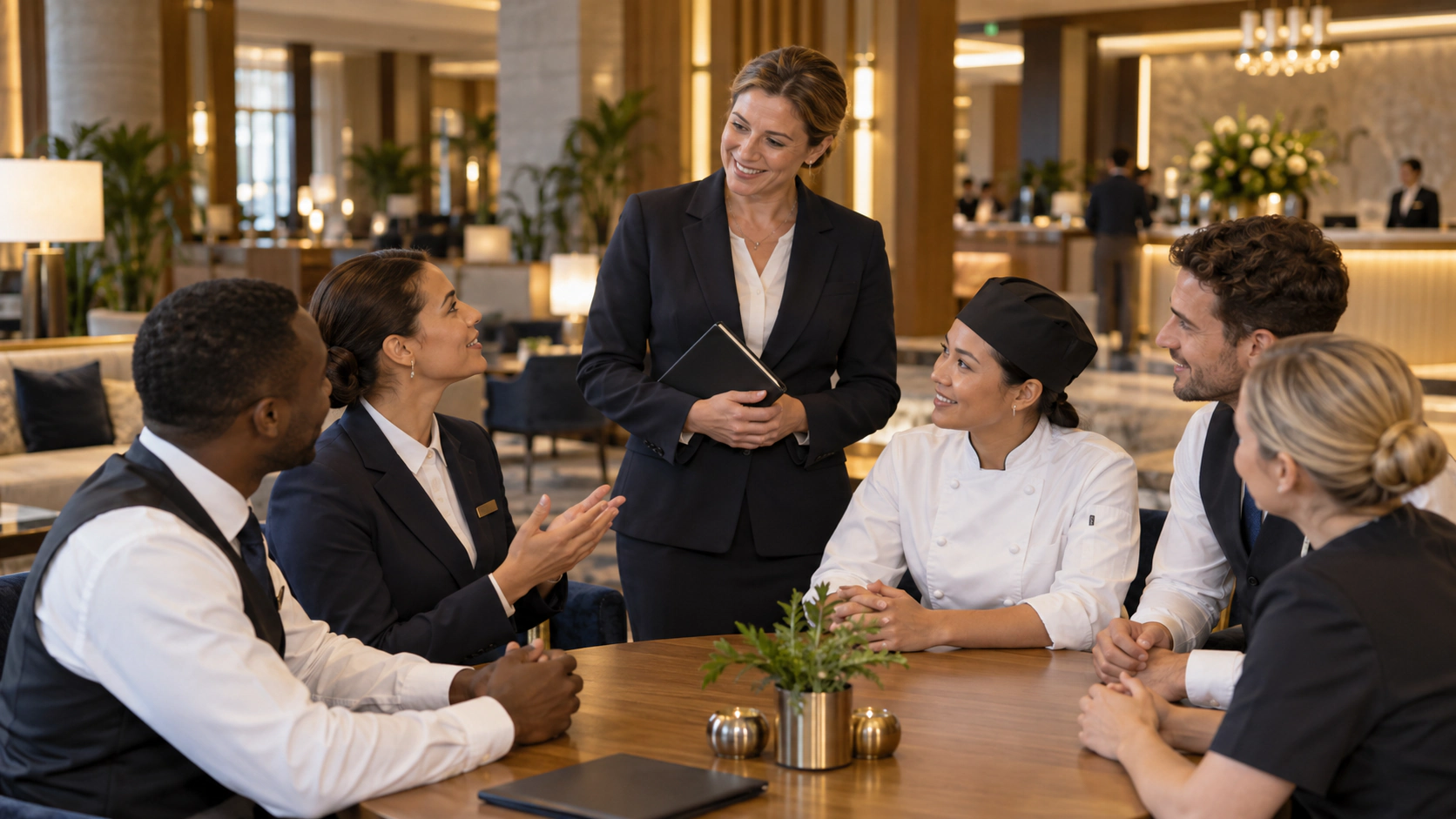
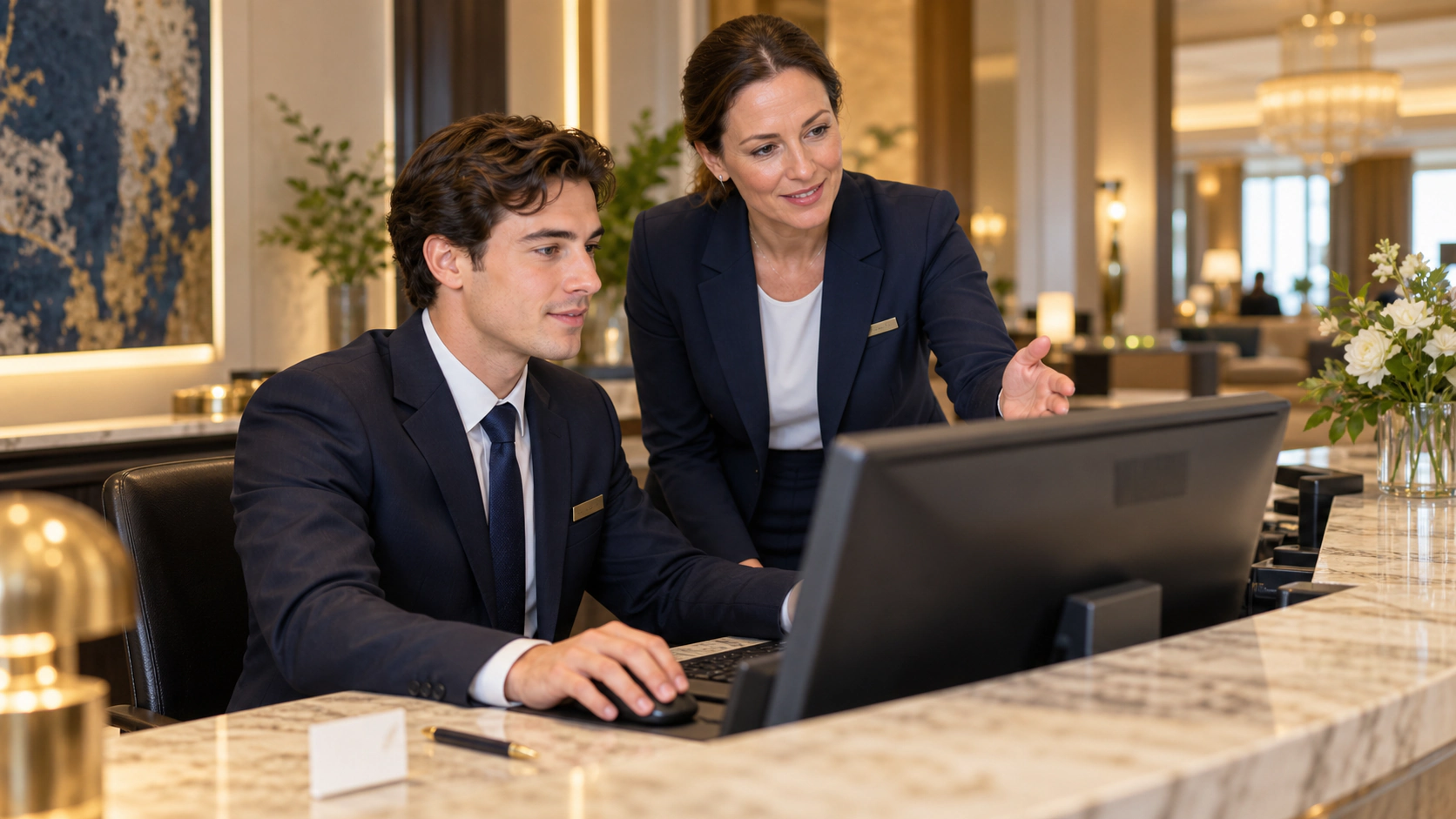
A hospitality career is built through behaviour that guests and colleagues can actually experience. Employers may use words such as communication, teamwork or adaptability, but a candidate becomes valuable only when those qualities appear in real situations: a clear shift handover, an accurate reservation, a calm response to a complaint or a safe decision during pressure.
This guide explains ten essential hospitality skills as observable workplace competencies. It also shows how to practise each one and how to build evidence for a CV, interview or development conversation.
1. Clear communication
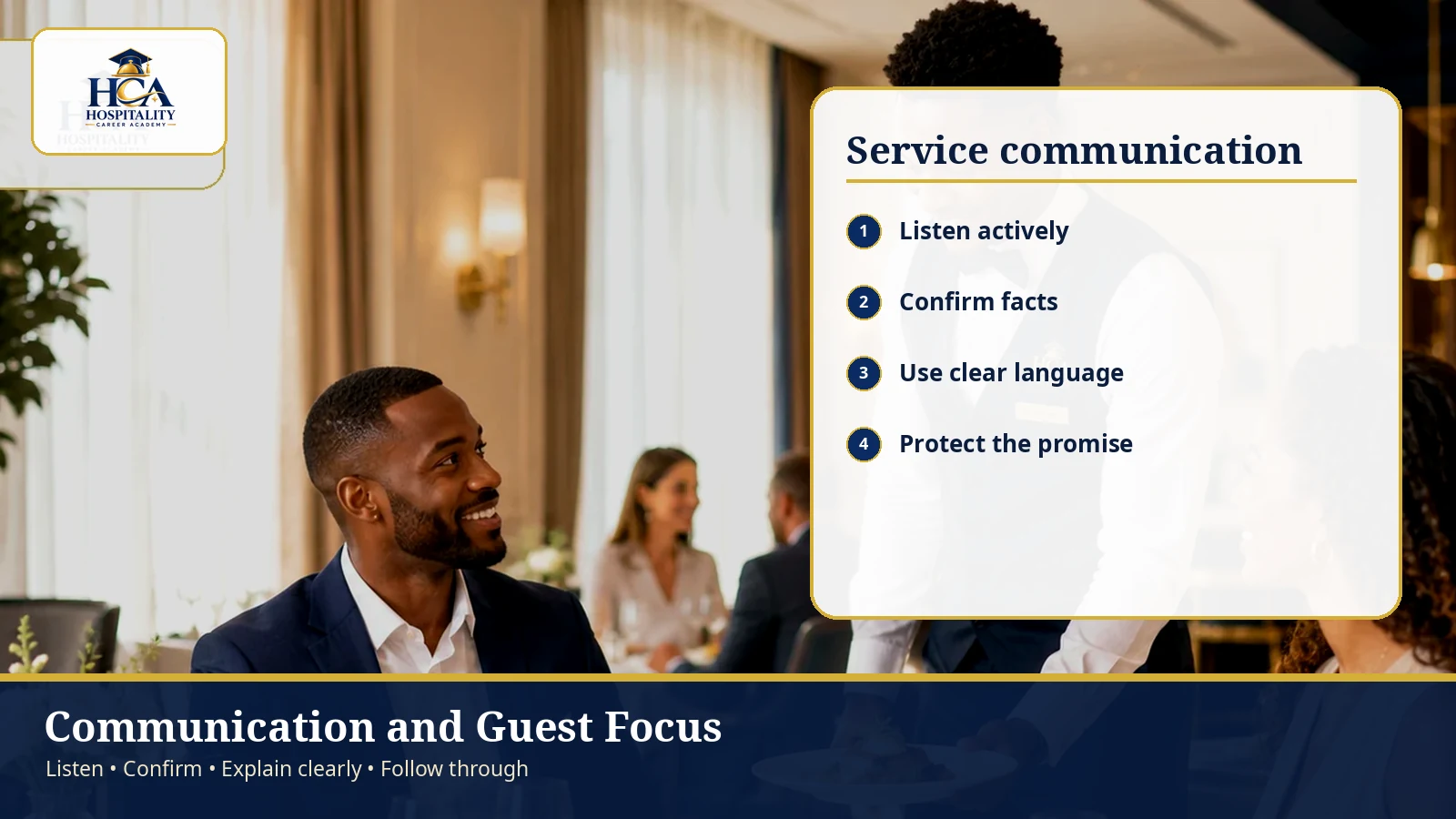
Hospitality employees communicate with guests, colleagues, supervisors, suppliers and other departments. Good communication means giving the right information to the right person at the right time and checking that it was understood.
What good performance looks like
- greets guests clearly and professionally;
- listens without interrupting;
- asks relevant questions before acting;
- explains policies without sounding defensive;
- records requests accurately;
- gives complete shift handovers;
- adjusts language for the guest’s level of understanding.
Practice task
Choose one common request, such as a late checkout or restaurant reservation. Practise explaining what is available, what must be confirmed and what will happen next in fewer than sixty seconds.
Evidence for your CV or interview
Describe a situation where clear communication prevented an error, improved coordination or reassured a guest.
2. Guest-service judgement
Customer service is not simply saying yes. It is understanding the guest’s need, protecting hotel standards and finding the best appropriate response within your authority.
A strong hospitality employee can distinguish between:
- a preference and a confirmed promise;
- an urgent safety issue and a routine request;
- a solution they may authorise and one that needs escalation;
- genuine personalisation and an assumption about the guest.
Practice task
Review five guest requests and classify each one as: handle directly, verify first, escalate or decline with explanation. Discuss why.
3. Teamwork and cross-department coordination
The guest sees one hotel experience, not separate departments. A front office employee depends on housekeeping for room readiness. A restaurant team depends on the kitchen, stewarding and purchasing. Engineering, security, sales and finance also influence service delivery.
What good performance looks like
- shares information before it becomes a problem;
- respects the responsibilities of other departments;
- avoids blaming colleagues in front of guests;
- confirms who owns the next action;
- supports the team during peak periods without abandoning critical duties;
- closes the loop after a handover.
Practice task
Take one problem—such as an air-conditioning complaint—and map what front office, engineering, housekeeping and duty management each need to know.
4. Attention to detail and accuracy
Small errors can have large consequences in hospitality. A wrong date, missing allergen note, incorrect room status or incomplete payment record can affect safety, revenue and trust.
Attention to detail means more than noticing decoration. It includes:
- checking names, dates, prices and quantities;
- following the correct sequence;
- reading alerts and special requests;
- inspecting the final result;
- documenting changes;
- recognising when information does not match.
Practice task
Ask a trainer to prepare a reservation, bill, room inspection or event order with six deliberate errors. Find and explain each one.
5. Problem-solving and service recovery
Hospitality employees regularly work with imperfect conditions: delayed rooms, missing items, booking errors, equipment faults or changing guest needs. Problem-solving requires calm fact-finding, prioritisation and follow-through.
Use a simple sequence:
- Listen and confirm the issue.
- Identify the guest or operational impact.
- Check facts and available options.
- Act within authority.
- Escalate when required.
- Give a realistic update time.
- Confirm the final result.
A quick answer is not always a good answer. Reliable problem-solving includes ownership and closure.
6. Time management and prioritisation
A hospitality shift rarely follows a perfect plan. Several tasks can become urgent at the same time. Time management means deciding what must happen first while protecting service and safety.
A useful priority order is:
- safety and security;
- a guest waiting in front of you;
- time-sensitive operational commitments;
- tasks affecting other departments or many guests;
- routine administration.
This order is not absolute. The employee must use judgement and ask for support when demand exceeds capacity.
Practice task
Give the trainee six simultaneous tasks: a ringing telephone, a guest at the desk, a fire-panel message, an email request, a delayed room and a colleague asking for a report. Ask them to explain the order they would use and why.
7. Adaptability and emotional control
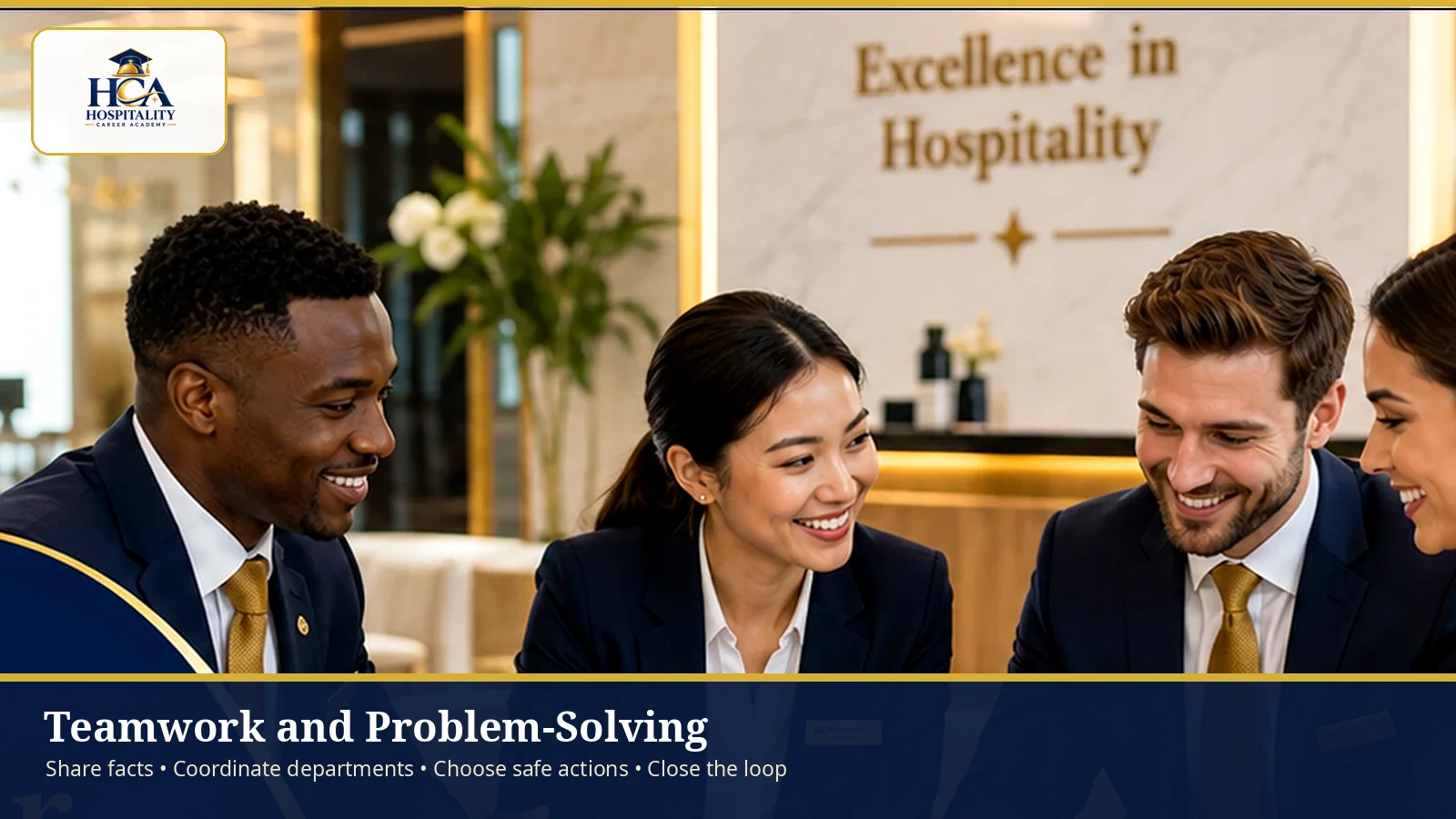
Hotels and restaurants change quickly. Occupancy rises, weather affects operations, a group arrives early or a colleague becomes absent. Adaptability means changing the plan without losing standards.
Emotional control is part of this skill. It does not mean hiding every feeling. It means preventing frustration, embarrassment or panic from controlling the guest interaction.
Useful habits
- pause before responding;
- separate the person from the problem;
- use neutral, respectful language;
- ask for help early;
- reset after a difficult interaction;
- learn from the event instead of carrying it into the next guest conversation.
8. Commercial awareness and responsible selling
Hospitality is both a service operation and a business. Employees should understand how their actions influence revenue, cost and guest value.
Commercial awareness includes:
- knowing the products and services available;
- explaining benefits honestly;
- offering relevant upgrades or additions;
- protecting rate, discount and payment controls;
- reducing waste;
- understanding that a resolved problem may protect long-term value;
- never pressuring or misleading the guest.
Practice task
Prepare two benefit-led recommendations: one for a room upgrade and one for a restaurant item. The recommendation should match a stated guest need and include no exaggerated claim.
9. Digital and systems confidence
Modern hospitality depends on property-management systems, point-of-sale systems, reservation platforms, email, digital communication and reporting tools. Systems confidence does not mean clicking quickly. It means completing the correct process accurately and knowing when to stop and ask.
What good performance looks like
- logs in through the approved method;
- protects passwords and guest data;
- reads alerts before changing a record;
- uses notes and status fields consistently;
- avoids unsafe shortcuts;
- checks the result after saving;
- reports a system issue through the correct channel.
Practice task
Complete a common transaction in a training environment, then explain each control point: what could go wrong, how the error would affect the guest and how you verified the final result.
10. Learning mindset and professional ownership
Hospitality standards evolve, and every property has its own procedures. Strong employees remain coachable. They ask questions, apply feedback and take responsibility for improving performance.
A learning mindset is visible when an employee:
- admits what they do not know;
- seeks clarification before creating risk;
- records learning points;
- practises a weak skill;
- requests feedback;
- applies the correction on the next shift;
- shares useful learning with colleagues.
Professional ownership also means arriving prepared, maintaining grooming, completing assigned tasks and communicating early when something cannot be finished.
A role-based hospitality skills matrix
The same ten skills appear differently across departments.
| Skill | Front office example | Food and beverage example | Housekeeping example |
|---|---|---|---|
| Communication | Explains registration and room status | Confirms an order and allergen information | Reports room status and defects |
| Guest-service judgement | Handles an early-arrival request | Responds to a delayed course | Protects privacy in an occupied room |
| Teamwork | Coordinates with housekeeping and bell | Coordinates with kitchen and bar | Coordinates with engineering and front office |
| Accuracy | Checks dates, payment and room type | Enters the correct items and table number | Replenishes the correct amenities and linen |
| Problem-solving | Owns a room or billing concern | Recovers a service error | Responds to a missing item or maintenance defect |
| Time management | Balances queue, calls and follow-up | Manages table sequence and clearing | Completes rooms in priority order |
| Adaptability | Handles a group arriving early | Responds to menu or staffing changes | Adjusts to room-priority changes |
| Commercial awareness | Recommends a suitable room option | Uses responsible upselling | Controls supplies and reduces waste |
| Systems confidence | Uses PMS and communication tools | Uses POS and reservation systems | Updates room status and work orders |
| Learning mindset | Applies coaching after observation | Practises service sequence | Uses inspection feedback to improve |
How to assess your current level
Rate each skill from 1 to 4:
- 1 — Awareness: I understand the idea but need close guidance.
- 2 — Developing: I can perform simple examples but am inconsistent.
- 3 — Competent: I perform independently in normal situations.
- 4 — Strong: I remain reliable under pressure and can support others.
Do not rate yourself only by confidence. Add one piece of evidence for every score. If you select level 3 in complaint handling, identify a real situation, what you did and how the case ended.
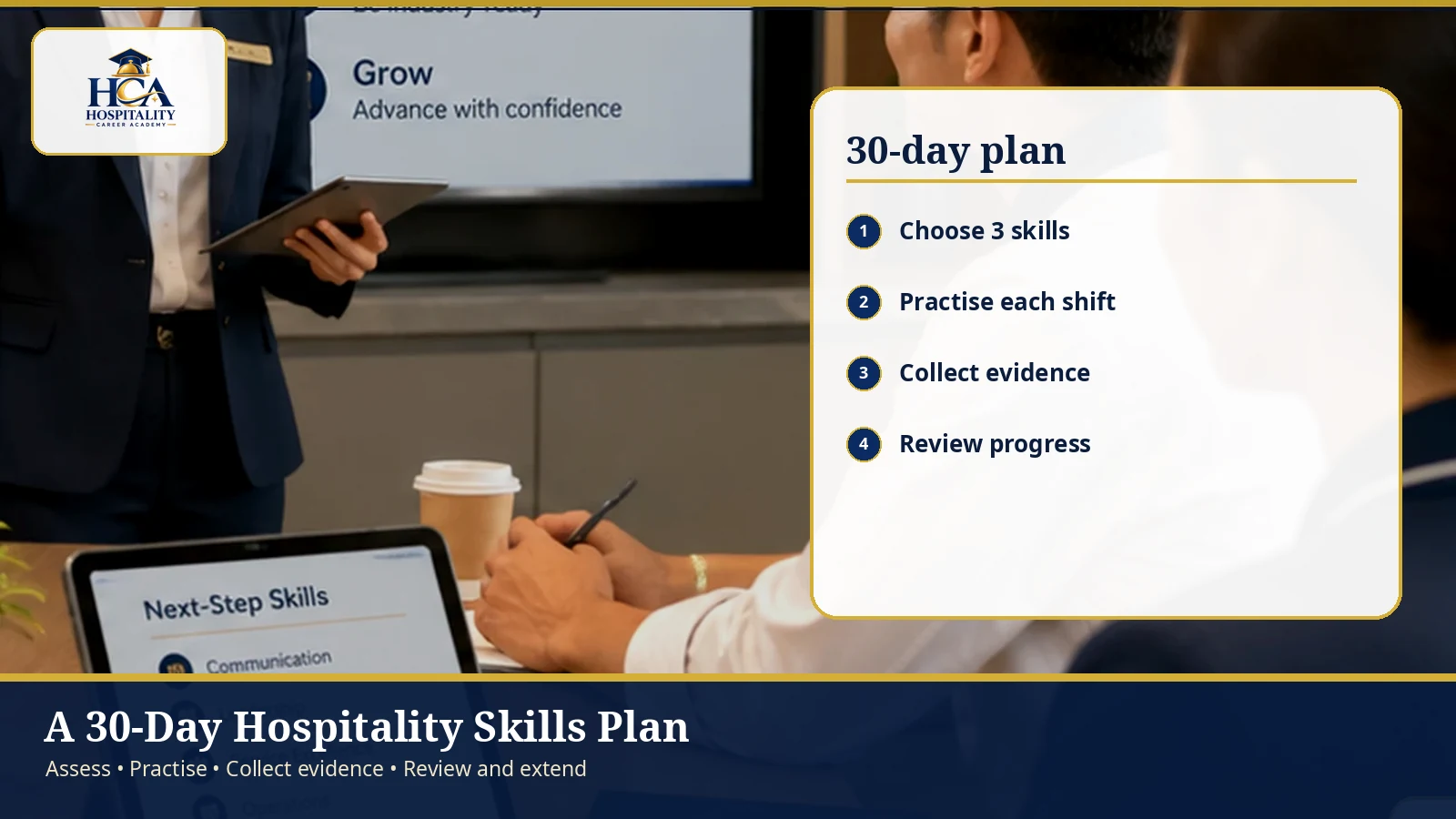
A 30-day skill-development plan
Week 1: Select and observe
- Choose two skills with the greatest impact on your target role.
- Ask a supervisor what competent performance looks like.
- Observe a strong colleague and record specific behaviours.
Week 2: Practise deliberately
- Complete two role-plays or controlled exercises.
- Use a checklist to prevent missing steps.
- Request one clear improvement point.
Week 3: Apply during work
- Use the skill in real situations.
- Record two examples of application.
- Ask whether your communication and documentation were complete.
Week 4: Review and demonstrate
- Repeat the self-rating with evidence.
- Discuss progress with a supervisor or mentor.
- Choose the next skill and continue the cycle.
Common mistakes when developing hospitality skills
Avoid these traps:
- collecting certificates without applying the learning;
- listing skills on a CV without examples;
- treating “multitasking” as doing everything at once;
- confusing friendliness with professional guest-service judgement;
- learning software clicks without understanding the process;
- resisting feedback because it feels personal;
- focusing only on technical ability and ignoring teamwork or communication.
Final takeaway
The ten most important hospitality skills are not abstract personality words. They are practical behaviours: clear communication, guest-service judgement, teamwork, accuracy, problem-solving, prioritisation, adaptability, commercial awareness, systems confidence and professional ownership of learning.
Choose two skills at a time, define the evidence of competent performance and practise them in realistic situations. Over time, this creates something more valuable than a long list on a CV: a reliable professional reputation.
Related HCA guides
- hotel receptionist skills
- hospitality leadership and team management
- free HCA hotel CV builder
- HCA hospitality courses
Update references
- Hotel, Motel, and Resort Desk Clerks — O*NET OnLine — U.S. Department of Labor
- Lodging Managers — O*NET OnLine — U.S. Department of Labor
- ISO 22483:2020 — Hotels — Service requirements — International Organization for Standardization
- HCA Academy — Hospitality Career Academy
Frequently asked question
What are the most important skills for a hospitality career?
The core transferable skills are communication, guest focus, teamwork, problem-solving, emotional control, time management, attention to detail, digital confidence, commercial awareness and learning agility.
Build your hospitality skills with HCA