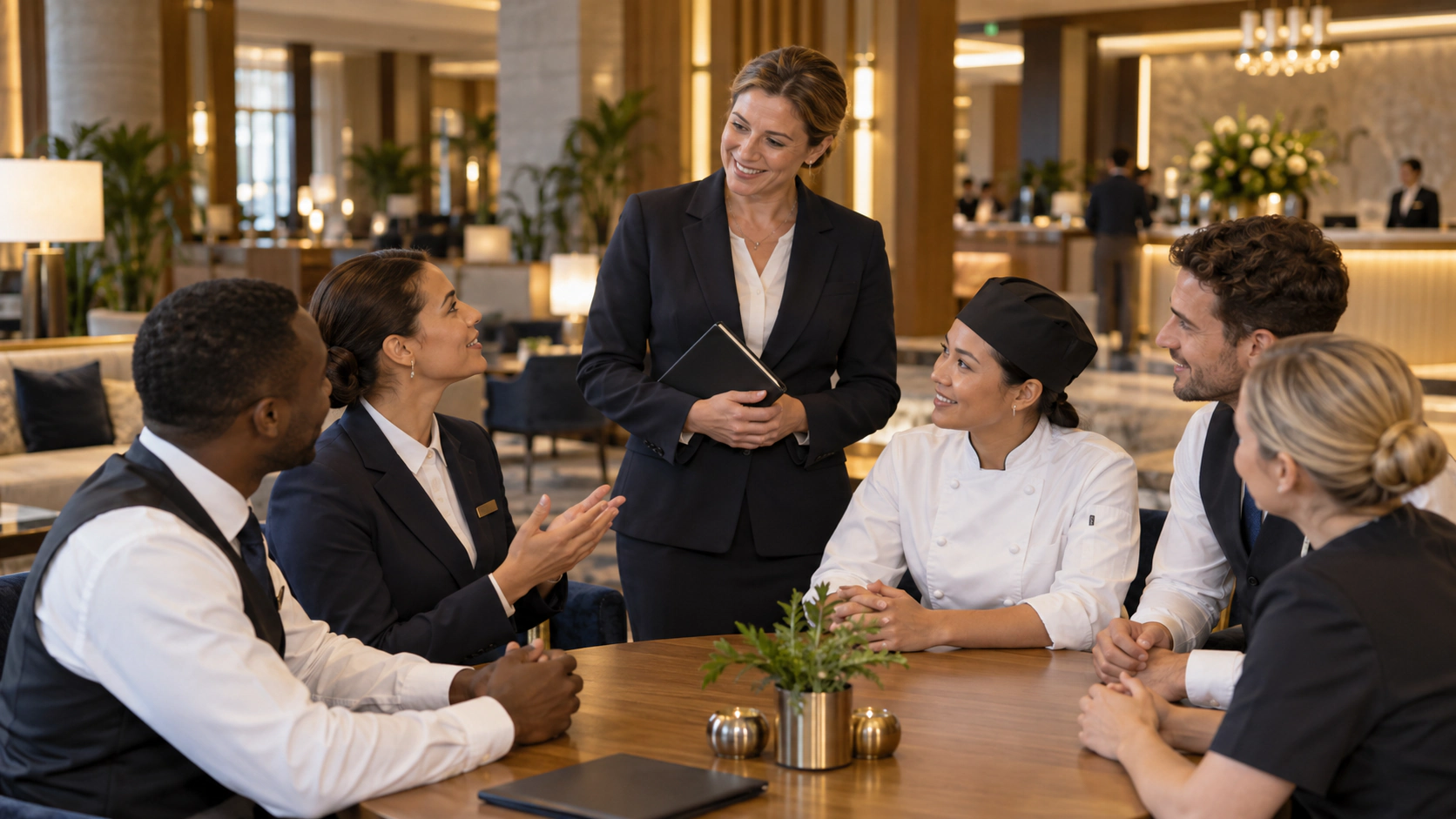
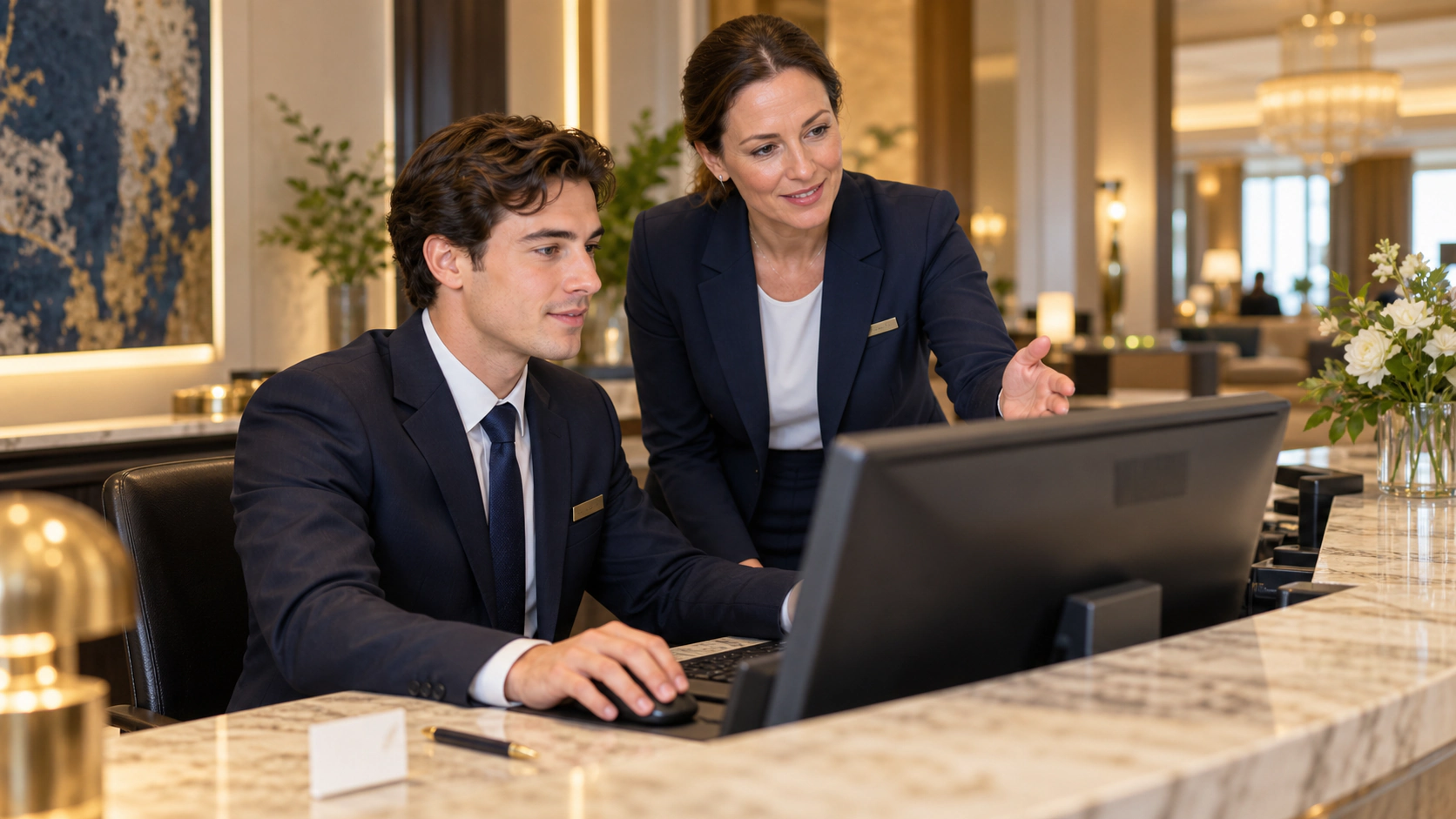
A hotel is divided into departments because the operation needs specialist skills, clear accountability and safe controls. The guest, however, does not experience separate departments. The guest experiences one stay. A room delay can begin with reservations, continue through housekeeping and engineering, and end as a front-office complaint. A banquet promise can involve sales, culinary, stewarding, security, finance and events. Understanding hotel departments therefore means understanding both what each team owns and how work moves between teams.
This guide maps the main departments, explains why hotel structures differ, and gives practical tools for room-status handovers, daily briefings, shared indicators and escalation.
Hotel departments in one minute
| Department group | Typical functions | Main operational question |
|---|---|---|
| Executive office | General management, strategy, owners, brand and governance | Are priorities, authority and risk clear? |
| Rooms division | Front office, reservations, concierge, guest relations, housekeeping and laundry | Is the room and guest journey accurate and ready? |
| Food and beverage | Restaurants, bars, banquets, room service, culinary and stewarding | Can the hotel deliver the menu safely, on time and profitably? |
| Property support | Engineering, security, IT, procurement and stores | Are the building, systems, people and supplies protected? |
| Commercial | Sales, marketing, ecommerce, distribution and revenue management | Are we attracting and converting the right demand at sustainable value? |
| Business support | Finance, HR, learning, legal and administration | Are people, records, controls and resources managed responsibly? |
| Property-specific | Spa, recreation, residences, retail, transport, golf or attractions | What specialist experiences does this property operate? |
A small hotel may combine several functions under one manager. A large resort may have separate departments for laundry, landscaping, recreation, events, security, transport and multiple kitchens. The correct organisation chart is the one that matches the property’s scale, risk, service promise and local requirements.
Why hotel structures differ
Hotel structures change according to room count, outlet mix, ownership, brand, location, opening hours, guest profile and whether services are operated internally or outsourced. A limited-service hotel may combine reception, reservations and basic revenue activity. A convention hotel may require a large events team. A resort may operate beaches, pools, landscaping, transport and recreation. A branded residence may add owner relations, community management and long-stay services.
Job titles also vary. “Guest service agent,” “front desk agent” and “receptionist” may describe similar work, while a “rooms controller” can have very different authority from one property to another. For training and accountability, define the actual decision rights and outputs, not only the title.
Executive office and hotel leadership
The general manager and executive committee align guest experience, people, profit, compliance, property condition and owner or brand expectations. Leadership should not mean approving every small action. It means setting direction, assigning authority, reviewing risk and ensuring departments solve problems together.
Typical executive responsibilities include:
- setting the business plan and operating priorities;
- approving budgets, staffing and major expenditure;
- reviewing guest, employee, safety and financial performance;
- confirming emergency and crisis governance;
- resolving cross-department conflicts;
- communicating with owners, brands and regulators where applicable;
- developing department heads and succession plans.
A strong executive team asks, “Who owns the outcome, what evidence will show completion, and what risk remains?”
Rooms division: front office, reservations and housekeeping
Front office and guest services
Front office manages arrivals, registration, room assignment, keys, guest accounts, requests, departures and much of the live communication during a stay. Concierge, bell, door, transport, telephone or guest-relations teams may sit within the same division.
The department needs accurate reservation details, verified room status, approved payment controls, privacy safeguards and reliable handovers. Warm service cannot compensate for an insecure key process or an incorrect bill.
Reservations
Reservations controls booking accuracy, availability information, rates, inclusions, deposits, modifications, cancellations and pre-arrival details. It should record what was promised in a form that front office, revenue and operations can understand. Special requests are requests—not guarantees—unless the hotel has confirmed them under an approved process.
Housekeeping and laundry
Housekeeping cleans and inspects guestrooms and public areas, manages linen and amenities, reports defects, protects hygiene standards and processes lost property. Laundry may be internal or outsourced. Productivity targets must not encourage unsafe lifting, incorrect chemical use or incomplete cleaning.
The critical room-status handover
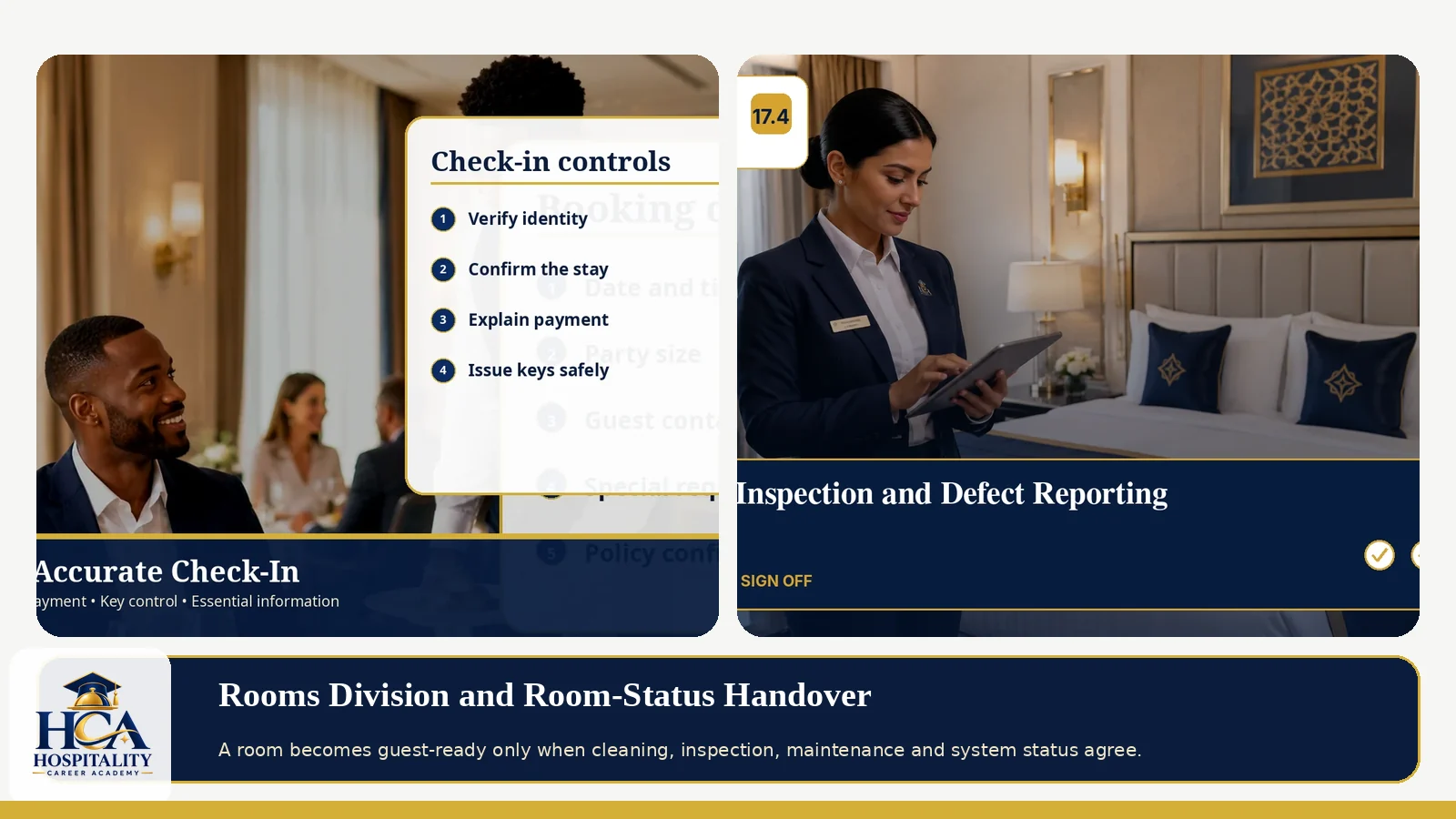
A room is not ready merely because cleaning is finished. A reliable release process may require:
- departure confirmed and belongings cleared under policy;
- cleaning completed;
- inspection passed where required;
- maintenance defects assessed and resolved or accepted;
- minibar, linen and amenities completed where relevant;
- system status updated by an authorised role;
- arrival priorities and special requirements checked.
Front office should not promise a time that housekeeping has not confirmed. Housekeeping should not release a room with a blocking defect. Engineering should state whether a defect is cosmetic, operational or safety-related and who can return the room to inventory.
Food and beverage, culinary and stewarding
Food and beverage includes restaurants, bars, lounges, banquets, room service, minibar and catering. Culinary teams plan and produce food; stewarding cleans and stores equipment and supports sanitation and waste control.
The division coordinates forecasts, menus, allergen information, function sheets, opening hours, staffing, stock, cash control and guest recovery. A high-volume breakfast buffet may look simple to the guest but relies on purchasing, receiving, culinary production, holding controls, replenishment, table clearing and accurate communication.
Sales should not sell a menu, room layout or service time that operations cannot safely deliver. Culinary should communicate unavailable items early. Service teams should never guess about allergens or ingredients.
Engineering, security and information technology
Engineering
Engineering protects the building and technical systems: guestrooms, kitchens, utilities, air conditioning, lifts, pools, water, lighting, life-safety equipment and preventive maintenance. Local law and qualified specialists govern technical work.
A useful work order records the location, verified symptom, safety or guest impact, priority, owner, access requirement, status and confirmation. “Fixed” should mean the issue was tested—not merely that someone attended.
Security and safety
Security supports access control, incident response, investigations, emergency coordination and protection of people, property and information. Safety remains everyone’s responsibility: every department reports hazards and follows emergency procedures.
Information technology
IT supports networks, devices, integrations, system access, cybersecurity, backups and recovery. Hotels often rely on third-party systems, but the property still needs named owners for accounts, permissions, incidents and data handling. Access should be limited to the information required for the authorised role.
Commercial departments: sales, marketing, ecommerce and revenue
Sales develops corporate, group, leisure, event and partnership business. Marketing manages positioning, content, campaigns and public communication. Ecommerce and distribution maintain the hotel across direct and third-party channels. Revenue management forecasts demand and guides pricing, restrictions and inventory.
These teams must work with operations. A package is not ready because the advertisement is attractive. The rooms, inclusions, restaurant capacity, transport, terms, system codes and staff briefing must all be ready. Finance should understand the net contribution after commission, discounts and included services.
Finance, human resources and procurement
Finance manages budgets, income, expenses, credit, reconciliation, payroll interfaces, audit trails and reporting. Department managers still own the accuracy and approval of the transactions they create.
Human resources supports workforce planning, recruitment, contracts, onboarding, employee relations, compensation, learning, performance and required records. HR provides frameworks and governance; operational leaders remain responsible for daily supervision and safe work.
Procurement, receiving and stores source, verify, protect and issue goods. Clear specifications and forecasts must come from the departments using the items. A cheap purchase that fails quickly, creates waste or does not meet the specification can be more expensive than the approved alternative.
Six cross-department workflows every hotel should define
1. Room readiness
Reservations and front office set arrival priorities; housekeeping cleans and inspects; engineering resolves defects; the authorised role releases the room in the system.
2. Guest request or complaint
The receiving colleague records the facts, confirms the desired outcome, acts within authority, assigns the next owner, gives a realistic update time and closes the loop with the guest.
3. Group or event delivery
Sales transfers the signed agreement; events converts it into an operational plan; culinary, service, rooms, engineering, security and finance confirm capacity, changes and billing.
4. Emergency or safety incident
The emergency plan overrides normal service routines. Staff protect life, activate the approved response, preserve accurate information and use designated communication channels.
5. Payment, credit and billing
Reservations, front office, outlets and finance use approved payment, posting, correction and escalation controls. Sensitive card or identity information must not be copied into informal messages.
6. Forecast to staffing and purchasing
Revenue and sales provide demand information; department heads convert it into rosters, production, stock and maintenance plans; finance reviews cost and variance.
A practical handover and daily briefing system
A useful handover contains seven items:
- Verified facts — what is known, not assumed.
- Impact — guest, safety, room, revenue or employee effect.
- Action completed — what has already happened.
- Owner — one named role or person accountable for the next step.
- Deadline — when action or the next update is due.
- System record — where the official status is stored.
- Closure — who confirms completion and informs the guest or team.
A short operations briefing can cover yesterday’s unresolved items, today’s occupancy and events, priority arrivals and departures, room risks, maintenance, staffing, food-and-beverage demand, security matters and decisions needed. Keep the meeting focused on action; detailed problem-solving can continue with the relevant people afterward.
Use RACI carefully
A RACI map can clarify who is Responsible, Accountable, Consulted and Informed. It is helpful for repeatable processes such as room release, group arrival, lost property or promotion launch. It should not become a complicated chart no one uses.
For each workflow, identify one accountable owner, the people doing the work, the expertise required before a decision and the colleagues who need the outcome. During an emergency, follow the approved command structure rather than debating a matrix.
Shared hotel indicators
Department measures should connect to shared outcomes. Useful examples include:
- room-status accuracy and rooms ready by agreed priority;
- request and complaint closure within promised updates;
- preventive-maintenance completion and repeat defects;
- reservation, order and billing accuracy;
- food-safety and safety-control completion;
- forecast accuracy and labour alignment;
- employee turnover, attendance, learning and internal progression;
- guest feedback by journey stage;
- revenue contribution and cost control without unsafe shortcuts.
A dashboard is a signal for discussion, not a substitute for judgment. Always investigate whether a target encourages hiding problems or rushing controlled work.
Three operating scenarios
Early arrival and no inspected room
Front office acknowledges the guest and checks priorities. Housekeeping confirms the realistic sequence. Engineering identifies any blocked rooms. The duty leader approves available alternatives. The guest receives one owner and a timed update—not several departments blaming each other.
Last-minute banquet change
Events verifies the client request and commercial approval. Culinary checks production feasibility and allergens. Service checks staffing and setup. Engineering confirms power or equipment. Finance records the charge or approved waiver. The revised function sheet becomes the shared source of truth.
Air-conditioning failure in an occupied room
The receiving colleague records the symptom and guest impact. Engineering assesses urgency and access. Front office controls room-move options. Housekeeping prepares the alternative room. Security supports only if needed. The duty manager follows up after the technical or accommodation solution.
Common coordination mistakes
- Using department names instead of one accountable owner.
- Treating email or chat as proof that a handover was accepted.
- Keeping different definitions of “ready,” “urgent,” “VIP” or “resolved.”
- Selling before operational capacity is confirmed.
- Measuring speed without accuracy, safety or guest effort.
- Solving the guest’s immediate issue but not recording the recurring cause.
- Expecting HR, security or finance to own operational supervision that belongs to department leaders.
Final takeaway
Hotel departments create expertise and control, but their value depends on coordination. Strong operations define ownership, use shared information, protect safety and privacy, set realistic deadlines and confirm that the outcome was completed. When departments understand both their specialist role and their handovers, the hotel becomes easier to operate and more reliable for the guest.
Related HCA guides
- hotel front desk training checklist
- hotel housekeeping training checklist
- types of food and beverage service
- hotel general manager career guide
Update references
- Hotel Departments Explained: Roles, Responsibilities and Workflow — Hospitality Career Academy
- Lodging Managers — O*NET OnLine, U.S. Department of Labor
- Lodging Managers — Occupational Outlook Handbook — U.S. Bureau of Labor Statistics
- About Ergonomics and Work-Related Musculoskeletal Disorders — CDC/NIOSH
Frequently asked questions
Which hotel department is the most important?
No single department delivers the entire stay. The most critical team changes with the situation, and reliable coordination is more valuable than internal competition.
What is the difference between front office and housekeeping?
Front office manages booking-facing arrival, stay and departure interactions. Housekeeping cleans and inspects rooms and public areas. They share responsibility for accurate room readiness and guest requests.
Who owns a guest complaint?
The colleague or department receiving it should protect ownership until the next responsible person accepts the handover. The final owner depends on the issue and the hotel’s authority map.
Why do hotel organisation charts differ?
Property size, service level, outlets, ownership, brand, location, outsourcing and local requirements change how functions are grouped and led.
Sources and update note
This guide uses HCA operational training practice together with current O*NET and U.S. Bureau of Labor Statistics lodging-management descriptions and CDC/NIOSH ergonomics guidance. Reviewed 2 September 2026. Apply local law, brand standards, contracts and the hotel’s approved procedures.
Frequently asked question
Which hotel department is the most important?
No single department delivers the entire stay. The most critical team changes with the situation, and reliable coordination is more valuable than internal competition.
Explore HCA hotel-operations training