Hotel room names can be confusing because one label may describe the bed, another the number of occupants, another the layout, and another the hotel’s own sales category. A “double room” does not always mean two beds. A “junior suite” does not always have a separate bedroom. And a “deluxe room” has no universal size or feature standard.
The safest approach is simple: compare the actual room details, not the name alone.
Quick answer: the main ways hotels classify rooms
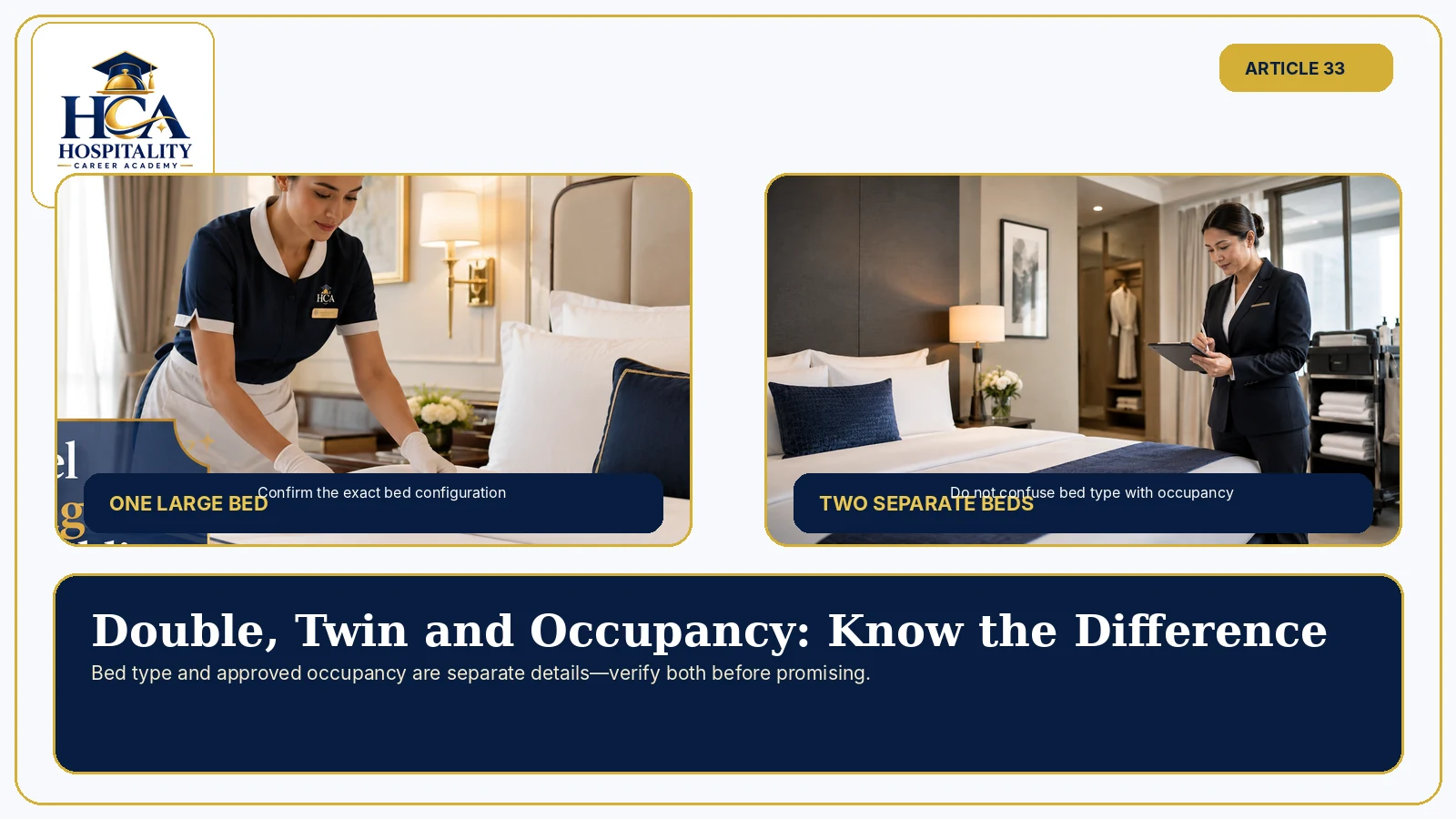
Hotels commonly describe rooms by:
- Bed type: single, double, queen, king or twin beds.
- Occupancy: single, double, triple, quad or family use.
- Layout: studio, junior suite, one-bedroom suite or apartment.
- Connection: connecting, adjoining or nearby rooms.
- Features: balcony, view, accessible features, kitchenette or club access.
- Sales category: standard, superior, deluxe, premium, executive or another property-specific name.
- Accommodation style: room, suite, villa, bungalow, residence or penthouse.
These categories can overlap. A product may be sold as a deluxe king sea-view room for two adults, combining a sales category, bed, view and occupancy in one name.
Room type, bed type, occupancy and sales category are different
Understanding the difference prevents booking errors.
| Term | What it normally describes | Example | What must be verified |
|---|---|---|---|
| Room type | The product configuration | Twin room | Bed count, layout and features |
| Bed type | Size or number of beds | King bed | Actual dimensions and whether extra beds are allowed |
| Occupancy | Approved number of guests | Triple occupancy | Adults, children, age rules and bedding |
| Sales category | Position within that hotel | Deluxe | Space, view, floor, amenities and rate inclusions |
| Feature | A specific characteristic | Balcony | Whether it is guaranteed or only requested |
Maximum occupancy depends on room design, local fire and safety rules, bed configuration and hotel policy. Never assume that a large bed means the room can legally accommodate more people.
Hotel room types by bed and occupancy
Single room
A single room is intended or priced for one guest. It may contain a single bed, a double bed or even a queen bed, depending on the property.
Verify: bed size, whether a second occupant is permitted and whether the quoted rate is single-occupancy only.
Double room
A double room generally means accommodation for two guests. It often has one double, queen or king bed—but in some markets the term is used loosely.
Verify: whether “double” describes occupancy or the physical bed.
Twin room
A twin room normally contains two separate beds for two guests.
Verify: bed width, whether the beds can be joined, and whether the room can take an extra bed.
Triple room
A triple room is approved for three guests. It may contain three separate beds, one double plus one single, or an approved sofa or rollaway arrangement.
Verify: permanent bedding versus an added bed, extra-bed charge and remaining floor space.
Quad or family room
A quad room normally accommodates four people. A family room may accommodate adults and children in several configurations.
Verify: maximum adults, child-age limits, bunk beds or sofa beds, extra charges and whether all sleeping places are proper approved beds.
Queen and king rooms
These labels describe the principal bed. Bed dimensions vary between countries and brands, so exact measurements may matter for some travellers.
Verify: number of beds, bed dimensions if essential and maximum occupancy.
Standard, superior, deluxe and premium rooms
These are usually property-specific sales categories, not universal industry measurements.
Standard room
Often the entry-level room in a hotel’s current inventory. It should still meet the property’s basic service and maintenance standard.
Superior room
Frequently positioned above standard through additional space, an improved location, a higher floor or selected amenities. The exact difference must be checked.
Deluxe or premium room
Often offers more space, a stronger view, upgraded design, preferred location or extra benefits. Another hotel may call the same product “premier,” “grand” or “executive.”
A salesperson should never say “deluxe is much bigger” unless the room facts support that statement.
Suites and room layouts
Studio
An open-plan unit where sleeping and living functions share one main space. Some studios include a kitchenette. In extended-stay hotels, “studio” often distinguishes the product from an apartment with a separate bedroom.
Junior suite
Usually a larger open-plan room with a defined seating area. It may not have a door separating the bedroom and living area.
Verification rule: the word “suite” alone does not guarantee a separate room.
One-bedroom or full suite
Normally includes a bedroom separated from the living area. It may also provide a dining area, kitchenette, guest bathroom or sofa bed.
Verify: number of bathrooms, kitchen facilities, usable sofa bed, occupancy and whether lounge or other benefits are included.
Two-bedroom suite or apartment
Usually combines two bedrooms with a common living area. Some products have ensuite bathrooms for both rooms; others do not.
Verify: bathroom configuration, bed types in each room, connecting doors and maximum occupancy.
Executive or club room
A category that may include a preferred floor, upgraded amenities or club-lounge access. Lounge hours, breakfast, evening service, guest access and child policies differ by property and rate.
Penthouse
A premium unit at or near the highest level of a building, commonly associated with substantial space, privacy or views. It is a product-positioning term, not a standard layout.
Villa, bungalow or residence
A more independent unit, often with multiple rooms, kitchen facilities, outdoor space or a private entrance. Resort villas may still receive hotel services while offering greater privacy.
Connecting, adjoining and nearby rooms
These terms are often misunderstood.
- Connecting rooms: two rooms with an internal door between them.
- Adjoining rooms: often next to each other, but the definition varies and may not include an internal door.
- Adjacent or nearby rooms: close to each other, perhaps across a corridor or on the same floor.
When an internal door is essential for children, a carer or group coordination, ask whether connecting rooms are guaranteed. A note on a reservation may remain a request subject to availability.
Safe reservation wording
- “I have recorded connecting rooms as a priority request. At this stage they are not guaranteed.”
- “The hotel has confirmed two connecting rooms in writing.”
- “The rooms are adjacent, but there is no internal connecting door.”
Do not use “next to each other” unless the property has actually confirmed the location.
Accessible hotel rooms
An accessible room contains design or communication features intended to support guests with disabilities. The required features vary by jurisdiction, property and individual need. Possible features include:
- step-free route;
- wider clearances;
- lower or reachable controls;
- grab bars and transfer space;
- roll-in shower or accessible bathtub configuration;
- visual or audible alarms;
- lowered peephole or storage;
- accessible desk, switches or wardrobe;
- communication features for guests who are deaf or hard of hearing.
The label “accessible room” is not enough to confirm suitability. Ask the guest which specific features are essential, describe verified room details and record them accurately. Do not ask for a diagnosis or make assumptions about ability.
Where local law applies, follow the required reservation and availability rules. For example, U.S. ADA guidance requires lodging reservation systems to describe accessible features in enough detail for a person to assess whether the room meets their needs.
Rooms by view, floor and location
Hotels may sell categories such as:
- sea view, garden view, city view or landmark view;
- high-floor or low-floor room;
- pool access or swim-up room;
- balcony or terrace room;
- corner room;
- quiet-zone room;
- club-floor room;
- near-lift or away-from-lift room.
A “sea-view room” might offer a full, partial or side view. A high-floor request may be subject to availability. A balcony may be Juliet-style rather than walk-out. Describe the verified feature instead of assuming what the name means.
What does run of house mean?
Run of house, often shortened to ROH, generally means that the hotel assigns an eligible available room at or near arrival. A particular bed, view, floor or location may not be guaranteed unless the rate or confirmation states otherwise.
Before selling ROH, explain:
- the eligible category range;
- which features are not guaranteed;
- maximum occupancy;
- whether bedding remains a request;
- any exclusions in the rate.
A room-features verification worksheet
Reservations, front office and sales teams can use this worksheet before describing a room.
| Field to verify | Confirmed detail | Source | Guaranteed or request? | Last checked |
|---|---|---|---|---|
| Category name | PMS / CRS / fact sheet | |||
| Room area | Approved fact sheet | |||
| Bed count and size | Room inventory | |||
| Maximum adults | Occupancy rule | |||
| Maximum children and age rule | Policy | |||
| Extra bed or cot allowed | Inventory / safety rule | |||
| Separate bedroom | Floor plan | |||
| Bathroom count and type | Floor plan / inspection | |||
| View description | Approved sales copy | |||
| Balcony or terrace | Inventory | |||
| Connecting-room configuration | Room matrix | |||
| Accessible features | Accessibility inventory | |||
| Kitchen or kitchenette | Fact sheet | |||
| Lounge access or inclusions | Rate and benefit rules | |||
| Known differences within category | Operations briefing |
If different rooms inside one category have different layouts, say so clearly and avoid guaranteeing a feature that only some units contain.
Staff-facing selling scripts
Guest asks for “two beds”
“To make sure I select the correct room, do you need two separate beds, or would one large bed for two guests be suitable?”
Guest asks for a suite
“Would you like a separate bedroom and living room, or would a larger open-plan junior suite meet your needs?”
Family requests connecting rooms
“Is an internal connecting door essential? I will check whether it can be guaranteed. If not, I can explain the nearest available alternative without presenting it as the same product.”
Guest asks for an accessible room
“I can help verify the room features. Which access features are essential for your stay, such as a roll-in shower, grab bars, visual alarm or step-free route?”
Guest asks for the “best room”
“What matters most to you—space, a separate living area, the view, a quiet location, kitchen facilities or lounge access?”
Upselling from standard to deluxe
“The deluxe room adds approximately eight square metres and a full sea view. The standard room has the same bed size and core amenities. The additional charge is AED 140 per night, including taxes.”
Only use numbers and benefits that are current and verified.
Booking scenario: choosing the right room for a family
Request: Two adults and two children aged 6 and 11 want one room, separate sleeping space for the children and a bathtub.
A weak response is: “Book a family room.”
A professional response is to verify:
- the property’s child-age and occupancy rules;
- whether the family category has permanent beds, bunk beds or a sofa bed;
- whether a cot or extra bed is permitted;
- the bathroom type;
- whether the preferred configuration is guaranteed;
- the total rate and any extra-bed or breakfast charges.
A suitable confirmation might say:
“The family room is approved for two adults and two children in your age group. It contains one king bed and one bunk bed, and this unit has a bathtub. The total nightly price is AED 720 including taxes and breakfast for four. I have confirmed the bedding and bathroom type in the reservation notes.”
Common room-type booking mistakes
- Treating double room and twin room as the same.
- Assuming every suite has a separate bedroom.
- Promising a view or high floor that is only requested.
- Failing to check child occupancy and bedding.
- Calling adjacent rooms “connecting.”
- Describing accessible rooms only by a general label.
- Selling category names without understanding their actual differences.
- Ignoring varying layouts inside the same category.
- Forgetting to explain ROH limitations.
- Copying outdated website or brochure information into a booking.
Related HCA guides
Update references
- HCA Hotel Room Types article — Hospitality Career Academy
- Americans with Disabilities Act Title III Regulations — U.S. Department of Justice
- Reservation and Transportation Ticket Agents and Travel Clerks — O*NET OnLine
- Hotel Room Upselling: Front Desk Techniques, Scripts and Measurement — Hospitality Career Academy
Frequently asked questions
What is the difference between a double room and a twin room?
A double room is usually intended for two guests and commonly has one larger bed. A twin room normally has two separate beds. Always verify the property’s exact configuration.
Does a suite always have a separate bedroom?
No. A junior suite or studio suite may be open plan. Look for wording such as “separate bedroom” and check the floor plan.
Are connecting rooms guaranteed?
Only when the hotel or booking terms explicitly confirm them. Otherwise, connecting rooms may remain a request subject to availability.
What is the difference between deluxe and superior?
There is no universal difference. Each hotel defines its own categories, so compare space, view, location, amenities and inclusions.
What should staff ask when a guest requests an accessible room?
Ask which specific room features are essential, describe the verified features available and follow the property’s legal, privacy and reservation procedures. Do not ask for a medical diagnosis.
Final takeaway
Hotel room types are easier to understand when you separate five questions: Which beds? How many guests? What layout? Which guaranteed features? Where does the product sit in that hotel’s category structure?
For guests, this prevents unpleasant surprises. For hospitality employees, it improves booking accuracy, honest selling and coordination between reservations, front office, housekeeping and sales.
The room name begins the conversation. Verified details complete the booking.
Sources and review note
This HCA guide was substantively reviewed on 2 September 2026. Room names and features vary by property and market. Staff must use the current approved room matrix, floor plans, occupancy rules, accessibility inventory, rate inclusions and booking conditions before making a guarantee.
Frequently asked question
What is the difference between a double room and a twin room?
A double room is usually intended for two guests and commonly has one larger bed. A twin room normally has two separate beds. Always verify the property’s exact configuration.
Explore HCA reservations and front office training