The main food and beverage service methods include plated service, platter-to-plate service, shared-table service, tableside service, buffet, cafeteria and counter service. Room service, banquets and delivery describe settings or journeys that can combine several methods. To identify a method accurately, ask: who portions the food, where does that happen, and how does it reach the guest?
This guide gives students and hotel teams a practical comparison, explains the confusing classical names, and works through a fictional event decision. It does not rank one method as universally faster, cheaper or more luxurious. Those results depend on the menu, layout, equipment, staffing and actual operating plan.
Food and beverage service methods: comparison table
| Method | What happens | Training example | Key control to practise |
|---|---|---|---|
| Plated / pre-plated | The kitchen portions food onto individual plates; staff deliver them. | A restaurant main course delivered to a recorded seat. | Match the plate and any modification to the correct guest. |
| Platter-to-plate / silver | A server transfers portions from a serving dish to the guest's plate. | A server portions vegetables using service utensils. | Stable handling, planned portions and a safe approach. |
| Shared-table / family-style | Dishes are placed for guests or a host to share and portion. | Several shared dishes at a group dinner. | Enough table space and a suitable serving utensil for each dish. |
| Guéridon / tableside | Staff prepare, portion or finish an item at a trolley or side table. | A trained employee assembles a salad beside the table. | Complete setup, adequate space and competent handling. |
| Buffet / assisted display | Guests choose from a display; staff may serve selected items. | Self-selected breakfast with a staffed egg station. | Display checks, replenishment, utensils and clear information. |
| Cafeteria / service line | Guests move through an ordered selection and collection route. | A tray line with staff portioning main dishes. | Flow between selection, collection, payment and seating. |
| Counter / single-point | The order and collection are organised around a counter or pickup point. | A café order collected using a ticket number. | Correct order identity and a clear handover. |
These descriptions are a working comparison, not a claim that every curriculum uses seven categories. The INFLIBNET Types of Service module groups service broadly as waiter, assisted and self-service. The IHM Rohtak curriculum teaches named methods such as silver, pre-plated, cafeteria, room, buffet and guéridon service. Learn your course's terminology, then describe the actual work.
American, English, French and Russian service: handle the names carefully
American service commonly means food plated in the kitchen. The other national labels are less consistent across teaching materials. They are not reliable instructions on their own.
For example, INFLIBNET's Styles of Service calls English service silver service and describes French service as family service. CSJMU's Types of Service notes also contain English/host/family and French/silver terminology. Their descriptions of Russian service differ as well. This is a real terminology conflict, not a reason to merge all the methods.
For an assessment, use the definitions in the specified curriculum. In a workplace, confirm the demonstrated procedure: kitchen-plated, server portions from a platter, guests share dishes, or staff finish at the table. A supervisor can then observe what happened rather than guess what “French service” meant.
What each method changes for the service team
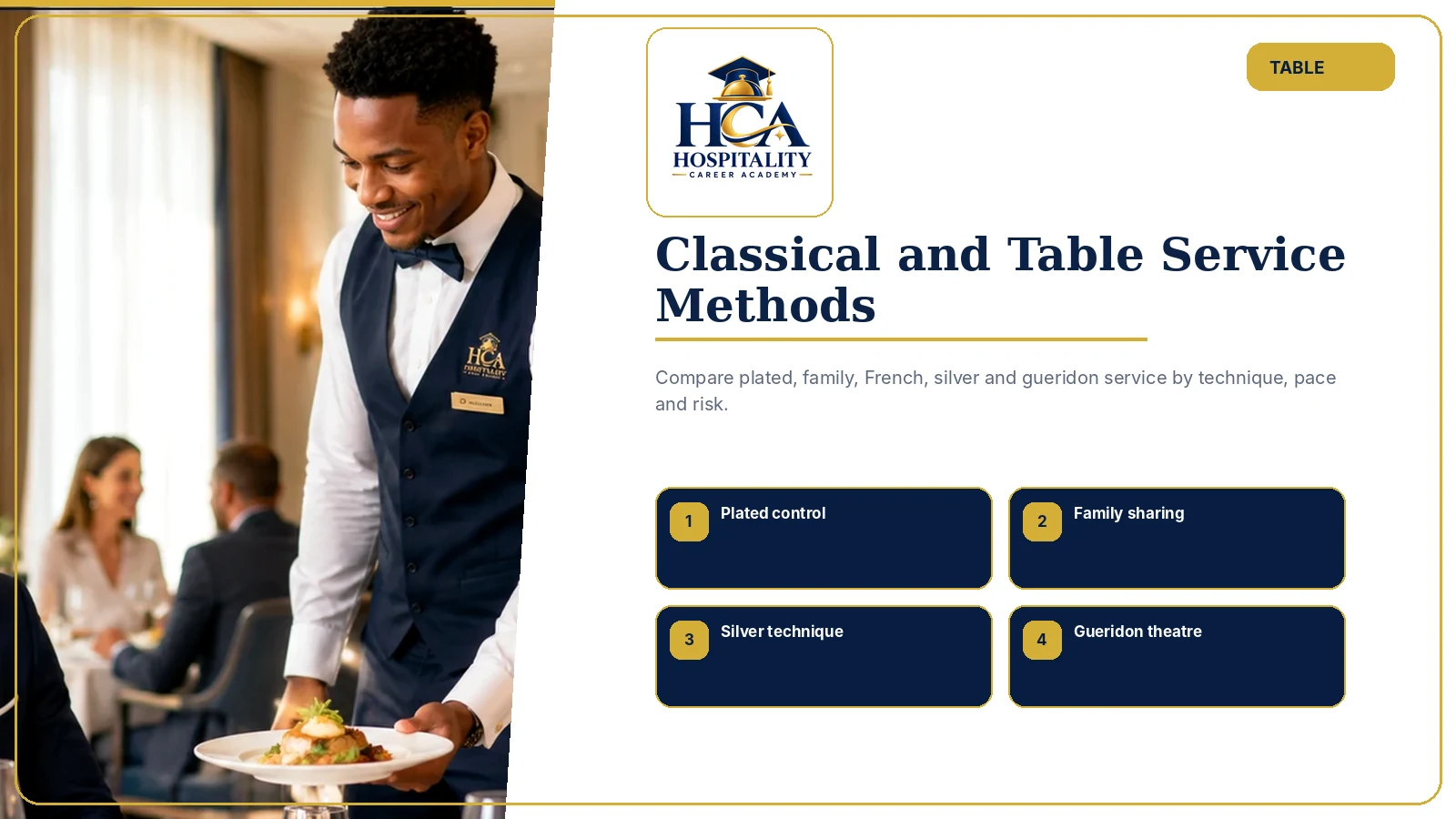
Plated service: organise the pass and the table
The kitchen controls the finished plate, but the dining-room team still controls the destination and sequence. A useful briefing identifies seat positions, who checks the complete table order, and how a missing or incorrect item is reported. In a four-person order, delivering three plates without communicating the fourth plate's status creates an avoidable information gap.
Practise a correction before service: a plate arrives with the wrong accompaniment. Stop the handover, tell the designated colleague and obtain the correct dish through the approved process. Do not quietly move food between plates at the table to make the order look complete.
Platter and shared-table service: identify who portions
In platter-to-plate service the employee controls the transfer; in a shared-table arrangement the guests or host do so. That changes the setup and explanation. A platter intended for six people does not communicate how many portions remain unless the portion plan and service sequence are clear.
For sharing dishes, check usable table space after glasses, plates and personal items are present. Explain what has arrived and where serving utensils belong. Keep any special-meal arrangement separate according to the outlet's procedure; a shared spoon is not an appropriate substitute for an agreed dietary control.
Guéridon service: rehearse the complete station
Tableside work can include carving, assembling or finishing; it does not necessarily involve flame. Rehearse with the actual trolley, tools, ingredients and guest-space arrangement. Check the movement route before approaching. Cooking, hot equipment and flambé require the property's authorised training and safety controls; a written overview is not permission to attempt them.
Buffet and service lines: manage the whole route
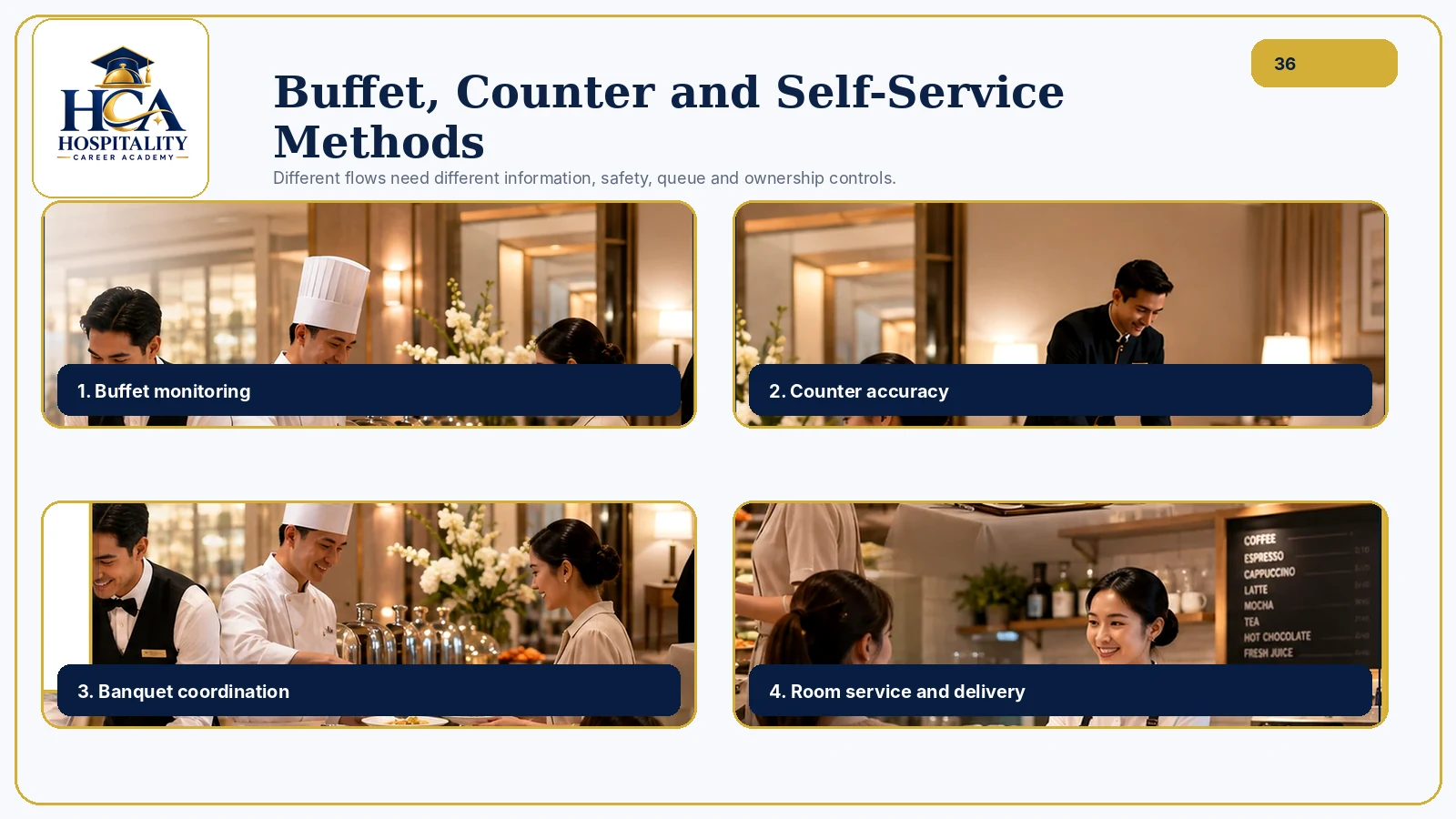
A display is only one part of the system. Guests also need plates, understandable labels, a route to seating, beverage access and help when required. Assign responsibility for checking each station and replacing missing or contaminated utensils. Moving a queue faster at the entrance is not an improvement if it creates a bottleneck at drinks or payment.
At a service line, observe the slowest step. If guests select quickly but wait for one cashier, adding another food tray will not solve that payment delay. At a buffet, guests may revisit stations; do not treat the number of people served once as the complete workload.
Counter service: make collection unambiguous
State whether the guest should wait, collect when called or expect table delivery. Use the outlet's order identifier and confirm the items at handover. A kiosk or mobile order changes how the order is captured; it does not automatically determine whether the food is collected or delivered. Provide a clear route for a guest who needs staff assistance.
Banquet, room service and delivery are different operating contexts
- Banquet or event: the agreed plan may be plated, buffet or shared-table. Confirm the guest count, dietary arrangements, timing cues, service method and clearing plan from the current event instructions.
- Room service: add room/order verification, tray or trolley preparation, a delivery estimate, permission to enter and a collection arrangement. Keep room and payment details private.
- Takeaway or delivery: include packaging, item checks, handover identity and the agreed response if the order is delayed or incomplete.
- Vending or grab-and-go: the product may be collected without a server presenting it. Product information, stock condition and an accessible assistance route still matter.
Likewise, à la carte and table d'hôte describe menu arrangements, not a complete delivery technique. A fine-dining restaurant, café or hotel lounge is an outlet or concept; its name alone does not tell a new employee who portions, serves or clears.
Worked example: a 60-person lunch with a 25-minute service window
Fictional planning exercise: a training lunch has 60 guests. Everyone must receive a main course within a 25-minute window. The kitchen has agreed the menu and special meals. Two small rehearsals produced the following observations; these are invented figures for arithmetic, not industry staffing or productivity standards.
| Trial | Observed first-service rate | Simple calculation for 60 guests | What it does not prove |
|---|---|---|---|
| One buffet line | Three guests complete the line per minute. | 60 ÷ 3 = 20 minutes. | No guarantee that replenishment, drinks, return visits or arrival surges fit the remaining five minutes. |
| Plated service | One coordinated team places 12 main courses per five-minute round. | 60 ÷ 12 = five rounds; 5 × 5 = 25 minutes. | No allowance for disruption; the first and last guests receive their meals at different times. |
The required average is 60 ÷ 25 = 2.4 guests per minute. The buffet trial is above that rate; the plated trial is exactly at it. Neither calculation proves the event is ready. The first has only a nominal five-minute margin, and the second has none.
Before choosing, test the full route with the actual layout. Include the special-meal handover, accessibility needs, replenishment and clearing movements. Check whether the kitchen can sustain the release rate. If the client requires all main courses to arrive nearly together, “everyone served within 25 minutes” is not the same promise.
A second buffet line may help only if it has the people, equipment, supply and space to operate independently. Do not simply double the observed rate on paper. Document the revised plan and rehearse it; if the requirement still cannot be supported, agree a different method or timing before the event.
A short briefing and assessment sheet
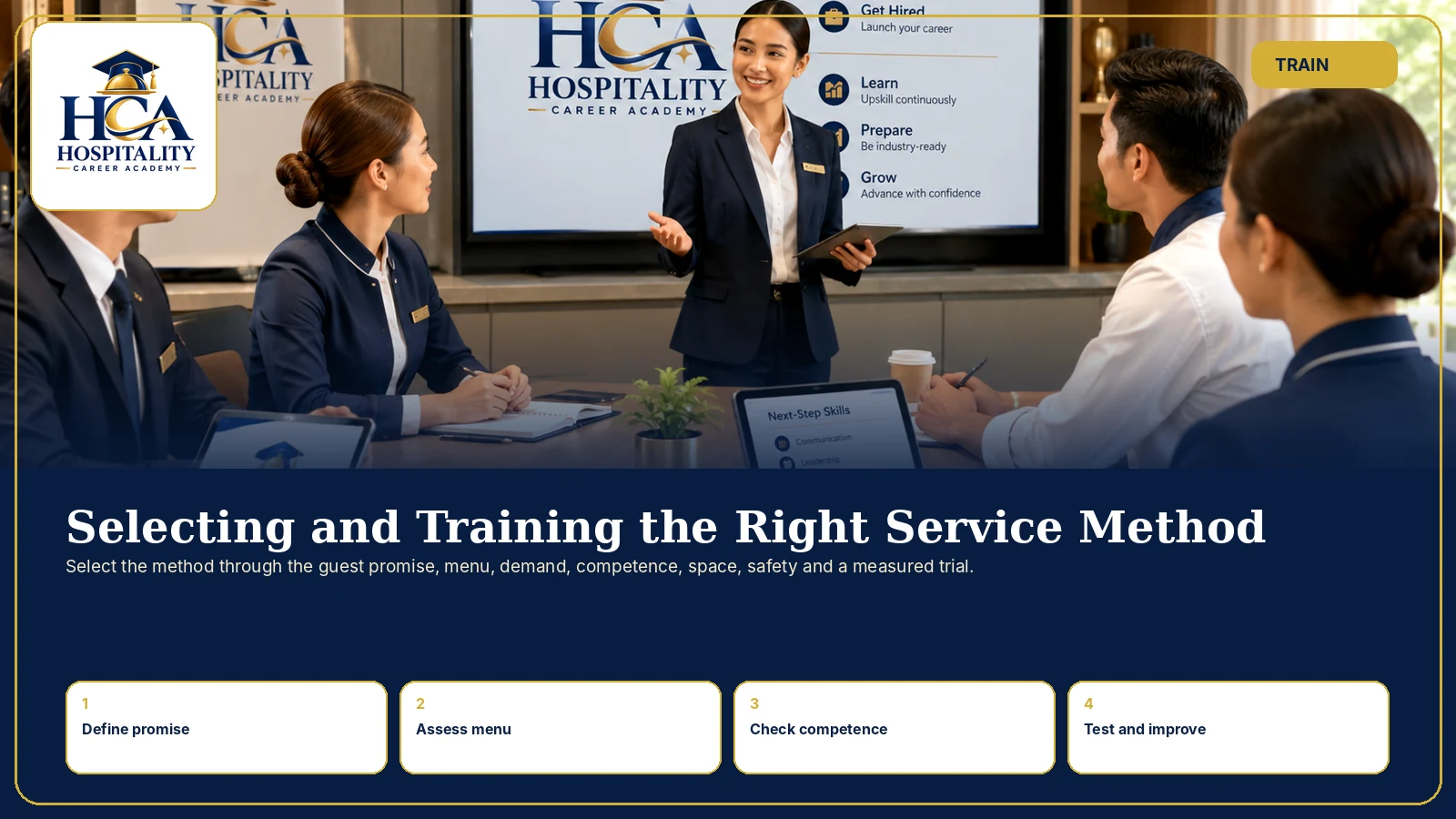
Write one sentence for each point before practice:
- Method: where the food is portioned and who transfers it.
- Ownership: who checks the order, releases it, delivers it and follows up.
- Information: how seat numbers, order identifiers and dietary instructions reach the right colleague.
- Exceptions: what to do when an item is missing, a guest asks an ingredient question or the promised timing slips.
- Finish: who clears, handles payment where relevant and resets the area.
Observe a complete practice order rather than only how a plate is carried. Record accuracy, the longest wait, handover problems and specific coaching points. These responsibilities align with the ordering, serving, guest follow-up and clearing tasks described in O*NET's waiter occupation profile; they remain relevant across methods.
Use the property's current food-safety, allergy and equipment procedures. A method label does not establish safe holding times, temperatures or an allergen guarantee. If a guest asks whether a dish is suitable, use the authorised ingredient-check and escalation process rather than infer from its appearance.
Frequently asked questions
How many types of food and beverage service are there?
There is no single count used by every course. Some group service into waiter, assisted and self-service; others separately identify single-point and specialised service. State the classification you are using and explain each method.
Is silver service the same as Russian service?
The labels overlap in some teaching systems but are not used consistently. Clarify whether the task is platter-to-plate portioning, sideboard preparation or another demonstrated procedure.
Is buffet service always faster or less labour-intensive?
No. A buffet shifts work into preparation, station supervision, replenishment and clearing. Measure the complete guest journey and workload in the actual setting.
Is every tableside service flambé?
No. Tableside work can include cold assembly, carving or portioning. Flame is a separate activity requiring the relevant authorisation, equipment and training.
Continue with the procedure you will use
Use HCA's restaurant sequence of service for the wider guest journey, the buffet service guide for display operations, and the room-service order and delivery guide for in-room dining. A good explanation of a method should let a learner describe and practise the work, not merely memorise its name.
About this guide: This guide was prepared with AI assistance. Primary sources are linked where used; worked scenarios and figures are fictional training material. Images are existing HCA illustrations created with AI assistance.
Frequently asked question
How many types of food and beverage service are there?
There is no single count used by every course. Some group service into waiter, assisted and self-service; others separately identify single-point and specialised service. State the classification you are using and explain each method.
Read the restaurant service sequence