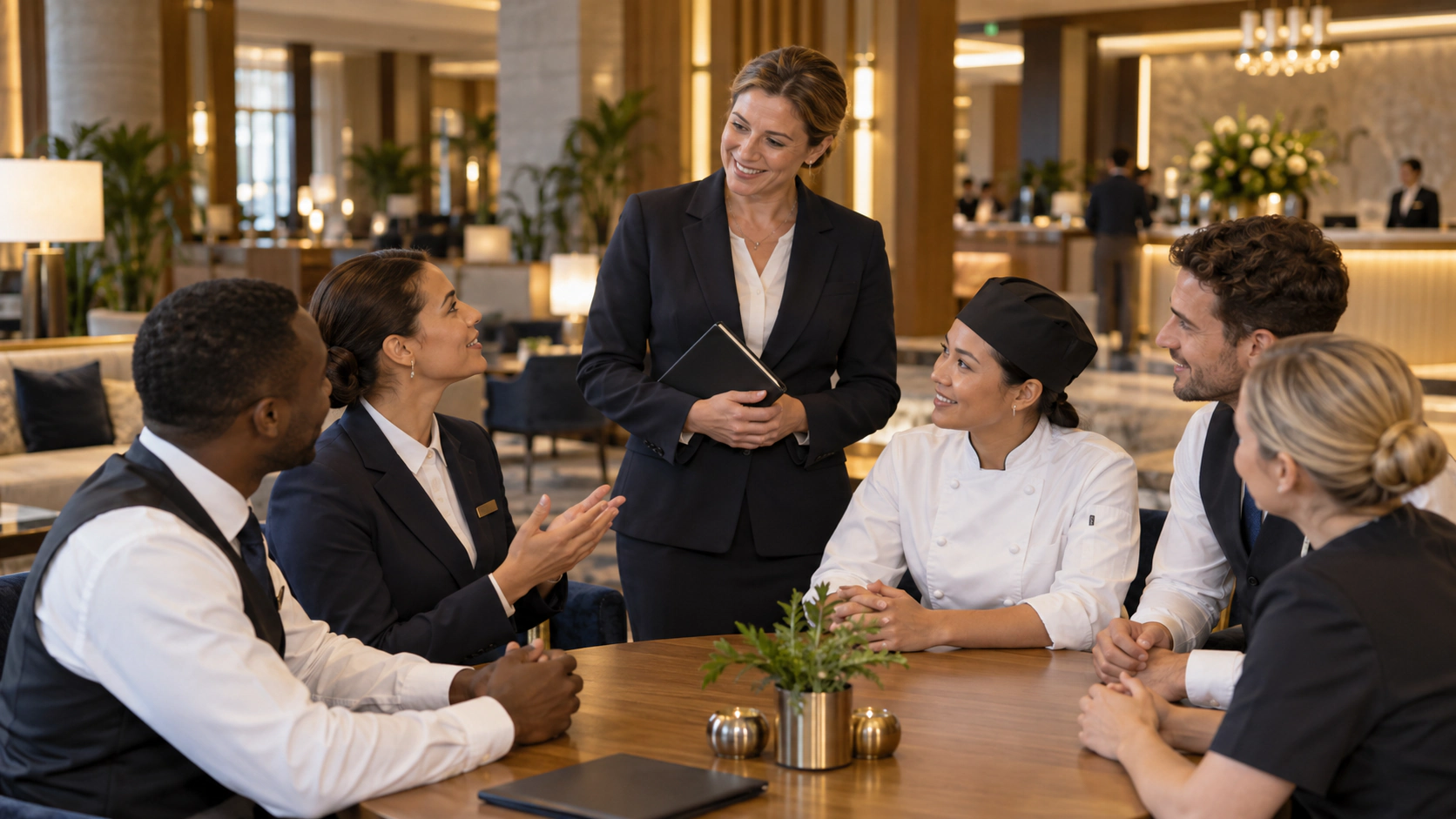
A restaurant sequence of service is the agreed order of actions that takes a guest from preparation and arrival through ordering, dining, payment and farewell. It creates a shared operating rhythm for the host, server, bar, kitchen, cashier and manager.
The sequence is not a rigid script. The language, timing and level of ceremony should match the restaurant concept, meal period, local culture, guest pace and approved SOP. What should remain consistent is the control behind the experience: a prepared team, an accurate order, safe delivery, clear ownership and a professional close.
This guide presents 12 practical steps, realistic service language, common risks, role-play scenarios and an observation checklist for training.
The 12 steps at a glance

| Step | Service action | Guest experience | Critical control |
|---|---|---|---|
| 1 | Brief and prepare | The restaurant feels ready | Reservations, menu, station, safety and ownership |
| 2 | Welcome and identify | The guest is acknowledged | Privacy, reservation and honest waiting time |
| 3 | Seat and introduce | The guest feels guided | Table readiness, accessibility and server ownership |
| 4 | Offer water and menus | Choices are clear | Clean menus, prices and no pressure |
| 5 | Explain and identify needs | The guest can order safely | Allergies, unavailable items and concept explanation |
| 6 | Take and confirm the order | The guest feels heard | Modifiers, seat positions and repeat-back |
| 7 | Send and pace the order | Courses arrive logically | Accurate POS entry and kitchen communication |
| 8 | Serve beverages and accompaniments | The meal begins smoothly | Glassware, timing and responsible service |
| 9 | Serve each course | The right dish reaches the right guest | Table, seat, dish, modifier and allergy verification |
| 10 | Check satisfaction and recover | Problems are noticed early | Specific check-back, authority and follow-up |
| 11 | Clear, reset and present the bill | The close feels organised | Guest pace, accuracy and payment security |
| 12 | Thank, farewell and close the record | The guest leaves recognised | Final assistance, feedback and operational closure |
Before the guest arrives
1. Brief and prepare
A strong service begins before the doors open. The pre-shift briefing should be short, specific and connected to the expected business.
Confirm:
- reservations, VIP notes and large parties;
- celebrations and accessibility requests;
- menu changes, sold-out items and specials;
- ingredients that need special allergen attention;
- expected covers and likely peak times;
- table and station ownership;
- who can approve discounts or service recovery;
- coordination with bar, kitchen, reception and cashier;
- cleanliness, equipment and safe service routes.
Each server should check mise en place, menus, cutlery, glassware, trays, service cloths, POS access, payment equipment and the condition of assigned tables.
Briefing language
“We expect 86 covers. Table 12 has a nut allergy note, but we will confirm directly with the guest. Sea bass is unavailable. The manager on duty approves recovery. Please record seat positions and tell the kitchen immediately through the approved allergy process.”
The briefing does not replace direct confirmation with the guest or the restaurant’s food-safety procedure.
Welcome and understand the guest
2. Welcome and identify the reservation
Acknowledge arriving guests promptly, even if the host is assisting someone else. Eye contact, a smile and a brief verbal acknowledgement prevent guests from feeling ignored.
Sample language
“Good evening. Welcome to [restaurant]. I’ll be with you in just a moment.”
When ready:
“May I have the reservation name, please?”
Do not announce a full name, room number or personal details loudly. If the table is not ready, give an honest estimate and explain where the guest can wait.
“Your table is being prepared and should be ready in approximately ten minutes. May I invite you to the lounge, or would you prefer to wait here?”
Avoid saying “five minutes” automatically when the real wait is unknown.
3. Escort, seat and introduce ownership
Walk at a comfortable pace and guide rather than point. Check that the table is fully ready before seating. Offer appropriate help with chairs, mobility aids, children’s equipment or belongings without assuming what the guest needs.
Once seated, establish ownership:
“My name is Lina, and I’ll be looking after your table this evening.”
If another colleague will take over, communicate that clearly. Guests should not need to guess who is responsible.
4. Offer water and present the menus
Provide clean, current menus in the correct language or accessible format. Explain water choices transparently and without pressure.
“May I offer still, sparkling or filtered water?”
The order of water, aperitif, bread and menu presentation differs by concept. Follow the approved sequence rather than copying fine-dining rituals into a casual outlet.
Check menu condition and remove old inserts or unavailable promotions. If a QR menu is used, keep a practical alternative for guests who cannot or do not wish to use a phone.
5. Explain the concept and identify dietary needs
Give guests enough time to read. Explain the concept, ordering style, sharing format, specials and unavailable items. Ask a neutral question before recommending food:
“Before I make any recommendations, does anyone have an allergy or dietary requirement we should know about?”
Do not promise that a dish is safe based on memory. Record the information through the approved method, alert the kitchen and involve a trained manager or chef when required.
For a sharing concept, explain approximate portions and how courses will arrive. For tasting menus, confirm the pace and substitutions before sending the order.
Take, send and pace the order
6. Take and confirm the order
Listen without interrupting. Use seat positions if the system supports them. Clarify cooking preference, side choice, modifiers, course order, beverage size and any shared dishes.
Sample order confirmation
“May I confirm: one medium rib-eye for seat one with sauce on the side; the grilled sea bass for seat two; and the mushroom risotto for seat three. The risotto is the allergy-marked dish, and I will confirm the kitchen’s procedure with the manager. Is that correct?”
Repeat-back is especially important for allergies, temperatures, substitutions and large tables. Suggestive selling should help the guest complete the experience, not pressure them into a higher price.
“The grilled prawns pair well with the citrus salad. Would you like to hear about it, or have you already decided?”
7. Enter, send and pace the order correctly
Enter the order immediately and review it before sending. Check:
- table and cover count;
- seat positions;
- course numbers;
- modifiers and cooking temperatures;
- allergy or dietary alerts through the approved workflow;
- beverage and food timing;
- special occasion instructions that are appropriate and consented.
Do not rely on a verbal allergy message alone if the restaurant requires a formal system entry. Coordinate firing times so the table receives complete courses together.
If the kitchen reports a delay, inform the guest before they need to ask:
“I want to update you that the main course will take about ten minutes longer than expected. The chef is preparing it now. May I refresh your drinks while you wait?”
Never invent a reason. Give confirmed information and own the next step.
Deliver and manage the meal
8. Serve beverages, bread and accompaniments
Use the correct glassware and avoid touching food-contact surfaces. Announce beverages where helpful and place them safely. Follow local law and the restaurant’s responsible-beverage policy.
Monitor water discreetly. Do not interrupt an important conversation every few minutes. Replace empty bread or accompaniments according to the concept and guest preference rather than automatically creating waste.
For hot beverages, warn the guest when appropriate and place handles, pots and milk safely.
9. Serve each course accurately
At the pass, verify:
- table number;
- seat position;
- dish name;
- modifier and cooking preference;
- presentation and required accompaniments;
- allergy-specific confirmation according to the approved process.
Serve from the direction defined by the outlet while avoiding unnecessary reaching. Where seat positions are recorded, do not “auction” food by calling dishes around the table.
“The grilled sea bass with lemon beurre blanc for you. The sauce is served separately as requested.”
Name the dish briefly and allow the guest to continue the conversation. Detailed storytelling belongs where the concept promises it.
10. Check satisfaction and recover problems
Return after the guest has had enough time to assess the dish but early enough to correct a problem. There is no universal number of minutes or bites for every restaurant.
Use a specific question:
“How is the temperature of your steak?”
or
“How are you finding the spice level of the curry?”
Observe signals such as untouched food, missing cutlery or a guest looking for assistance. If something is wrong:
- listen without arguing;
- acknowledge the impact;
- remove any immediate safety risk;
- clarify the desired outcome;
- explain what you will do and the expected time;
- involve the person with authority;
- follow up after the solution;
- record recurring causes.
A useful response might be:
“I’m sorry the steak is overcooked. I’ll ask the kitchen to replace it immediately and will update you within two minutes. My manager will also visit the table.”
Do not blame the kitchen or another colleague in front of the guest.
Close the experience well
11. Clear, reset, offer dessert and present the bill
Read the table before clearing. In many full-service restaurants, staff wait until everyone has finished; in casual settings, guests may prefer used plates removed sooner. Ask when uncertain.
Clear quietly, separate waste away from guests and reset only what the next course needs. Offer dessert, coffee or another appropriate option without pressure.
“May I bring the dessert menu, or would you prefer coffee or tea?”
Present an accurate, itemised bill when requested or at the appropriate time. Never assume who will pay. Protect card and personal data and follow the approved payment process.
If the guest questions the bill, review it calmly:
“Thank you for pointing that out. I’ll verify the item now and return with the corrected bill or an explanation.”
12. Thank, farewell and close the service record
Thank the guest sincerely and offer relevant final assistance.
“Thank you for dining with us. I hope you enjoyed the evening. May I assist with transport or directions?”
Acknowledge guests again as they leave. Then close the operational loop:
- update the table status;
- record recovery or follow-up commitments;
- return lost property through the approved process;
- share useful feedback with the team;
- reset the station;
- flag maintenance or safety issues.
The experience is not complete until the system and team are ready for the next guest.
How the sequence changes by outlet
Breakfast buffet
The host manages arrival and seating, while servers focus on beverage service, table maintenance and guest guidance. Buffet monitoring and clearing become central, but the same controls—welcome, dietary communication, check-back and farewell—remain.
Fine dining
The sequence may include amuse-bouche, wine presentation, crumbing, multiple cutlery changes and more detailed dish explanation. Extra ceremony must never weaken accuracy or make the guest feel uncomfortable.
Casual café
Ordering may happen at a counter or by QR code. The sequence is shorter, but acknowledgement, accurate information, safe delivery, recovery and thanks still matter.
Banquet
The sequence follows the event plan rather than individual table pace. Synchronized service, dietary seat maps, speech timing and communication with the banquet kitchen are essential.
Room service
The journey starts by phone or digital order and includes tray setup, room-entry etiquette, secure delivery, posting and collection. It has its own detailed SOP.
Restaurant service role-play scenarios
Scenario 1: table not ready
Situation: a couple arrives on time, but the previous guests have not left.
Good performance: acknowledge, verify the reservation privately, give an honest estimate, offer a waiting option, update before the promised time and take ownership.
Weak performance: blame the previous guests, promise an unrealistic wait or disappear without an update.
Scenario 2: allergy question
Situation: a guest asks whether a dish is completely free from a specific allergen.
Good performance: thank the guest for telling you, avoid guessing, record the information, consult the approved person and explain the restaurant’s process without making an unsupported guarantee.
Weak performance: answer from memory or say “it should be fine.”
Scenario 3: delayed main course
Situation: the kitchen informs you of a 15-minute delay.
Good performance: confirm the facts, update the guest proactively, offer a suitable interim action within authority and return when promised.
Weak performance: avoid the table and wait for a complaint.
Scenario 4: billing error
Situation: an extra beverage appears on the bill.
Good performance: acknowledge, verify, correct through the authorised process and return promptly.
Weak performance: argue or remove the item without documentation.
Observation checklist for training
Score each behaviour as Not demonstrated, Developing, Competent or Consistently strong.
| Area | Observable behaviour |
|---|---|
| Preparation | Knows reservations, menu changes, station and escalation owner |
| Welcome | Acknowledges promptly and protects guest privacy |
| Needs | Asks about dietary requirements and listens without assumptions |
| Order | Records modifiers and confirms critical details |
| POS and pacing | Sends accurately and coordinates courses |
| Delivery | Verifies table, seat, dish and presentation |
| Check-back | Uses a timely, specific question and observes cues |
| Recovery | Takes ownership, stays within authority and follows up |
| Payment | Presents an accurate bill and protects data |
| Farewell | Thanks, assists and closes records correctly |
The assessor should add one example of evidence and one next action. A score without an observed example is weak coaching.
Useful service measures
Use a balanced set rather than speed alone:
- time to acknowledgement;
- reservation and seating accuracy;
- order and modifier accuracy;
- allergy-process compliance;
- course pacing and table completion;
- check-back and recovery completion;
- billing accuracy;
- guest feedback themes;
- waste or remakes caused by service error;
- competence sign-off results.
Fast service is not successful if it creates errors, unsafe shortcuts or pressure.
Related HCA guides
- types of food and beverage service
- restaurant reservation training
- room-service order taking and delivery
- HCA professional waiter training
Update references
- Restaurant Sequence of Service — Hospitality Career Academy
- Types of Food and Beverage Service — Hospitality Career Academy
- FDA Food Code — U.S. Food and Drug Administration
- Restaurant Reservation Training Guide — Hospitality Career Academy
Frequently asked questions
What is the sequence of service in a restaurant?
It is the planned order of preparation, welcome, menu guidance, order taking, service, check-back, clearing, payment and farewell actions.
How many steps are in a restaurant sequence of service?
There is no universal number. This guide uses 12 practical stages; some concepts divide them further or combine them.
When should a server check back?
After the guest has had a fair chance to assess the dish but early enough to correct a problem. The correct timing depends on the food, pace and outlet.
How should a server handle allergy information?
Ask clearly, record accurately, notify the kitchen through the approved system, avoid unsupported promises and involve a trained manager or chef when required.
Does the same sequence work in every restaurant?

No. The core controls are similar, but language, timing, ceremony, payment and course flow should match the concept and local requirements.
Final takeaway
A strong sequence of service makes the experience feel natural because the team has prepared the details behind it. Train observable behaviours, realistic language and clear authority—not a memorised speech. The goal is consistent control with enough flexibility to respect the guest, the concept and the moment.
Frequently asked question
What is the sequence of service in a restaurant?
It is the planned order of preparation, welcome, menu guidance, order taking, service, check-back, clearing, payment and farewell actions.
Explore professional restaurant-service training