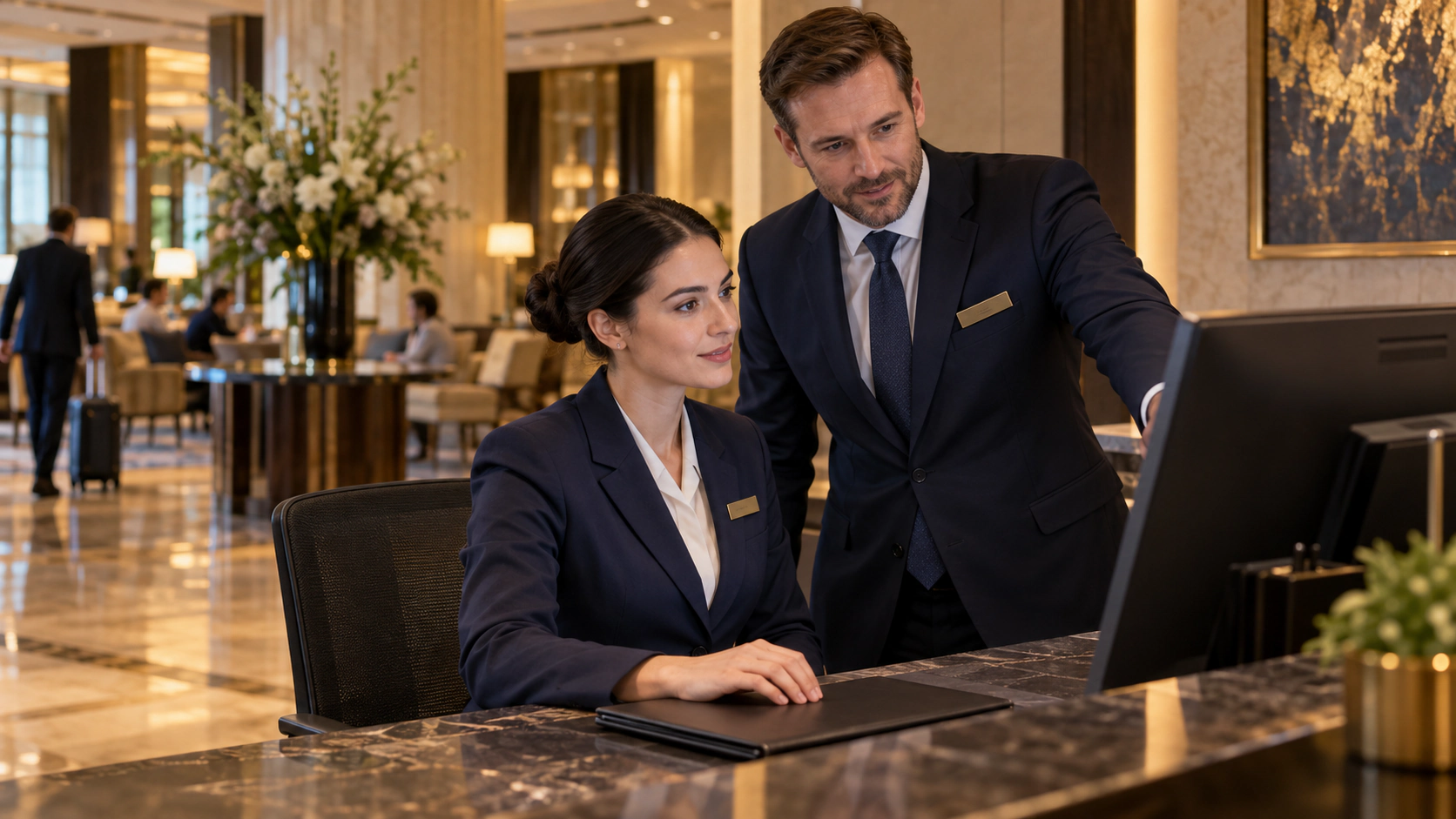
Illustrative image: AI-generated scene with fictional people.
A hotel can deliver warm service and still expose a guest to serious risk if information is handled carelessly. Front-office screens contain names, dates, room details and payment status. Reservations teams receive travel plans and contact information. Sales teams exchange contracts and guest lists. Housekeeping may find documents, devices and confidential papers in rooms. Finance teams receive payment instructions, while restaurants and spas collect bookings, preferences and sometimes health-related details.
Cybersecurity is therefore not only an IT responsibility. It is part of hospitality service, safety and trust. Every employee who can view, speak, print, copy, send, approve or change guest information affects the hotel’s security.
NIST’s hotel-specific guidance describes property-management systems as attractive targets because they connect sensitive guest data, payments and other hotel systems. Its recommended controls include role-based access, stronger authentication, monitoring and protection of sensitive information. The practical lesson for frontline employees is simple: use only the access you need, verify before acting and report anything suspicious quickly.
What information must hotel teams protect?
Guest information is not limited to a passport number or payment card. Depending on the property and service, sensitive or restricted information may include:
- full name, nationality, date of birth and identity documents;
- telephone number, email address and home or company address;
- arrival and departure dates, room number and occupancy status;
- payment details, deposits, billing instructions and refund information;
- loyalty membership, travel history and preferences;
- special requests, accessibility needs or dietary information;
- complaint records, incident reports and compensation decisions;
- employee schedules, payroll details and access credentials;
- corporate contracts, group rooming lists and confidential rates.
A useful rule is minimum necessary access: view, collect, retain and share only the information required for the authorised task. Curiosity is not a business reason.
Seven cybersecurity risks hotel employees face
1. Phishing and fake urgent requests
An email may appear to come from a general manager, supplier, bank, travel agent or guest. It may request an urgent transfer, password reset, attachment download, rate change or updated payment link. The message can look professional and still be false.
Warning signs include:
- pressure to act immediately or secretly;
- an unfamiliar sender address or small spelling change;
- a link that does not match the expected domain;
- a request to bypass the normal approval process;
- an unexpected attachment, QR code or login page;
- a sudden change to bank or payment instructions;
- unusual language from a familiar person.
Do not reply with sensitive information. Verify through a known telephone number or approved internal channel—not the contact details inside the suspicious message.
2. Social engineering at the desk or by telephone
Attackers do not always use technical tools. They may sound confident, helpful or frustrated. A caller might claim to be a spouse, assistant, travel agent, owner, police officer, bank employee or colleague and ask whether someone is staying, which room they occupy or when they will arrive.
Professional service does not mean revealing information. Use the hotel’s identity-verification and escalation procedure. Never confirm a guest’s presence, room number, contact details or travel plan because the requester sounds important.
3. Shared accounts and weak access control
Shared usernames make it difficult to know who changed a reservation, issued a key, opened a folio or exported a report. They also encourage employees to disclose passwords.
Good habits include:
- use your own authorised account;
- enable multifactor authentication where provided;
- never approve an MFA prompt you did not initiate;
- do not write passwords on the workstation;
- lock the screen whenever you step away;
- report access that is too broad or no longer required;
- remove access promptly when roles change or employment ends.
Access should follow the role, not seniority or convenience.
4. Exposed screens, printouts and verbal conversations
A secure system can still leak information through human behaviour. Risks include:
- leaving a reservation screen visible to guests or visitors;
- printing rooming lists and leaving them at the desk;
- reading a room number aloud in a crowded lobby;
- discussing VIPs, complaints or payment issues in public areas;
- placing photocopied IDs in an open tray;
- photographing a screen or document with a personal phone.
Use privacy screens where appropriate, position monitors carefully, collect printouts immediately and dispose of records through the approved confidential-waste process.
5. Personal messaging, email and devices
Personal WhatsApp accounts, private email addresses and personal cloud storage may feel convenient, especially during busy shifts, but they can create uncontrolled copies of guest data. The property loses control over access, deletion, backup and transfer.
Use only approved business channels for guest documents, payment communication and internal records. If a guest sends sensitive information through an unapproved channel, do not forward it around the team. Follow the property’s procedure for moving the case into the approved system and deleting or restricting the uncontrolled copy where authorised.
6. Payment and refund fraud
Payment security includes more than protecting the card number. Frontline risks include fake payment links, changed bank details, refund requests to a different account, remote-card instructions, unattended terminals and staff entering data into an unapproved page.
PCI DSS provides baseline technical and operational requirements for protecting payment account data. Employees should not improvise those controls. Follow the approved payment method, terminal, refund route and authority matrix. Never copy sensitive authentication data into notes, email or messaging apps.
7. Lost devices, outages and third-party failures
Hotels depend on PMS, POS, channel managers, payment gateways, key systems, Wi-Fi, mobile devices and third-party providers. A lost tablet, stolen phone, malware alert or system outage can affect both service and security.
Know the approved downtime procedure before an incident. Paper-based workarounds must also protect data. Do not create uncontrolled spreadsheets, personal photographs or handwritten lists that remain after the system returns.
The HCA frontline security model: STOP, CHECK, VERIFY, ESCALATE, RECORD
This five-step model is designed for frontline decisions. It does not replace the hotel’s technical incident-response plan.
STOP
Pause the transaction, disclosure, click or transfer when something feels unusual. A short delay is safer than an irreversible mistake.
CHECK
Look for mismatched addresses, unusual requests, unexpected urgency, changed payment details, excessive data requests or actions outside normal procedure.
VERIFY
Confirm identity, authority and business need through a trusted source. Use a known number, the PMS record, an approved directory or a supervisor—not the contact route supplied by the suspicious requester.
ESCALATE
Contact the authorised manager, IT, security, finance or data-protection contact. Escalation is professional judgement, not failure.
RECORD
Preserve the message, time, sender, action taken and people notified. Do not alter evidence or continue investigating beyond your role.
Department-by-department examples
Front office and guest relations
- Verify identity before issuing keys, changing contact details or discussing a stay.
- Avoid announcing room numbers or confirming occupancy to third parties.
- Protect screens, registration cards, ID copies and complaint notes.
- Escalate unusual key, visitor, payment or welfare requests.
Reservations, sales and events
- Verify changes to bank details, group contacts and payment instructions.
- Limit rooming-list access to authorised roles.
- Use approved secure transfer methods for contracts and guest lists.
- Confirm unusual amendments through a second trusted channel.
Food and beverage, spa and recreation
- Collect only the information required for the booking or safety need.
- Treat allergy or health-related information as sensitive.
- Do not store card details in reservation notes or paper diaries.
- Secure shared tablets and sign out between users where required.
Housekeeping, engineering and security
- Do not photograph guest documents or property on personal devices.
- Follow lost-and-found and incident procedures for phones, laptops and papers.
- Report unattended devices, suspicious USB drives or tampered equipment.
- Protect room-access and maintenance information from unnecessary disclosure.
Finance, HR and management
- Use dual control for sensitive payment or bank-detail changes.
- Restrict payroll, disciplinary and identity information by role.
- Review access after transfers, promotions, leave and termination.
- Practise incident communication before a real event occurs.
The first ten minutes of a suspected incident
When an employee believes information, money or access may be at risk:
- Stop the action. Do not continue the transfer, click, disclosure or system change.
- Keep the device and message available. Do not delete evidence unless instructed.
- Disconnect only under approved guidance. Random actions can destroy evidence or interrupt operations.
- Notify the correct contact immediately. Use the incident route, not a casual group chat.
- State facts, not conclusions. Explain what happened, when, on which device and what information may be involved.
- Protect the guest. Avoid public discussion and do not contact affected people unless authorised.
- Follow the response owner. IT, security, legal, finance or management may control the next step.
Employees should never hide an error because they fear blame. Fast reporting can reduce harm.
A 30-day training plan for hotel teams
Days 1–7: understand the risks
- Map where guest and employee data enters the hotel.
- Identify approved systems, channels and document-storage locations.
- Review identity, key, payment and visitor-verification procedures.
- Confirm the incident and downtime contacts for every shift.
Days 8–14: practise common scenarios
Run role-plays for:
- a fake general-manager payment request;
- a caller asking whether a guest is staying;
- a guest sending a passport through personal messaging;
- an unexpected password-reset message;
- a lost hotel tablet;
- a payment-terminal warning;
- an employee accidentally emailing the wrong attachment.
Days 15–21: review access and habits
- Check whether each employee has the right system access.
- Remove shared passwords and unauthorised data copies.
- Review screen position, printers, drawers and confidential disposal.
- Confirm MFA, software updates and device-lock settings with IT.
Days 22–30: assess and improve
- Observe live privacy and verification behaviour.
- Test incident escalation on every shift.
- Record repeated weak points without shaming individuals.
- Assign owners and dates for corrective action.
- Repeat training after system, policy, role or threat changes.
Cybersecurity skills hospitality job seekers can demonstrate
You do not need to be an IT specialist to show security awareness. Useful evidence includes:
- verifying identity before disclosing guest information;
- using role-based systems without sharing credentials;
- recognising suspicious links or payment changes;
- protecting screens, printouts and devices;
- following approved channels for guest documents;
- reporting incidents quickly and factually;
- supporting safe downtime procedures;
- explaining risk calmly to colleagues and guests.
A strong interview example might be:
“A caller requested a guest’s room number and claimed to be a family member. I did not confirm whether the guest was staying. I followed the approved verification procedure, offered to take a message through the permitted route and recorded the interaction for the duty manager.”
That example shows service, privacy, judgement and ownership together.
Frequently asked question
Can hotel employees use personal WhatsApp or email for guest documents?
Use only the hotel’s approved business channel, with the required access, retention and security controls and applicable legal requirements. Do not use personal WhatsApp or email accounts for guest documents. If sensitive information arrives through an unapproved channel, follow the authorised escalation and handling procedure.
Final takeaway
Cybersecurity in hospitality is the daily discipline of protecting trust. Frontline employees do not need to solve technical attacks, but they must recognise unusual requests, protect information, follow approved channels, verify identity and authority, and escalate quickly.
Use the HCA checklist below to practise realistic scenarios and document the correct response. The strongest hotel security culture is not built by fear. It is built by clear procedures, safe reporting and employees who know when to stop and ask for help.
Frontline cybersecurity practice checklist
Use fictional or masked examples. Follow the approved hotel procedure and refer technical actions to the authorised team.
| Scenario and data to protect | Immediate action | Escalate to |
|---|---|---|
| Suspicious payment or bank-detail change Payment account data; contract details | Stop the transfer; verify through a known contact | Finance / Duty Manager / IT |
| Caller asks whether a guest is staying Occupancy and room information | Do not confirm; use approved message or escalation route | Front Office Manager / Security |
| Passport or ID sent to a personal account Identity document | Move case to approved channel; restrict uncontrolled copy | Manager / Privacy Contact / IT |
| Unexpected password reset or MFA prompt System credentials | Reject; do not click; report immediately | IT / Security |
| Lost hotel phone or tablet Guest messages; app sessions | Report immediately; ask the authorised IT team to lock the device remotely or revoke sessions. | IT / Security / Manager |
| Rooming list requested by an external agent Names, dates, rooms, company data | Verify contract, authority and minimum necessary data | Sales / Reservations Manager |
| Guest data emailed to the wrong recipient Any personal or payment data | Stop further sharing; preserve facts; report immediately | Manager / IT / Privacy Contact |
| Unknown USB drive or QR code at work Device and network access | Do not connect or scan; keep the item aside and report it. | IT / Security |
| Shared account used for PMS or POS System access and audit trail | Stop sharing; request named access and reset credentials | IT / Department Head |
| System outage requires manual process Guest, payment and room records | Use approved downtime forms; secure and reconcile after recovery | Duty Manager / IT / Finance |
Sources and application note
This guide draws on NIST’s hotel-specific PMS cybersecurity guidance, the NIST Cybersecurity Framework 2.0, the NIST Privacy Framework, CISA phishing and secure-account guidance, PCI DSS resources, the NICE workforce framework and the UAE’s official data-protection overview. These sources provide general frameworks and examples; the hotel must follow the laws, contracts, brand standards and approved procedures that apply to its own jurisdiction and operation.
- NIST National Cybersecurity Center of Excellence — SP 1800-27: Securing Property Management Systems
- NIST — Cybersecurity Framework 2.0
- NIST — Privacy Framework
- CISA — Phishing Guidance: Stopping the Attack Cycle at Phase One
- CISA — Secure Our World
- PCI Security Standards Council — PCI DSS v4.0.1 and merchant resources
- NIST NICE — Workforce Framework for Cybersecurity
- UAE Government — Data protection laws