Marriott’s hotel brands are designed around different guest needs, price positions and operating models. A luxury resort, a full-service convention hotel, a select-service city property and an extended-stay apartment may all participate in Marriott Bonvoy, but they do not promise the same experience or require the same staff capabilities.
This guide explains the live portfolio by segment and purpose rather than freezing the article around one brand count. Marriott’s portfolio changes through launches, acquisitions, conversions and new accommodation products, so a count in an old headline can become inaccurate even while the page remains useful.
Independent guide: HCA is not Marriott International. Brand descriptions and groupings were checked against Marriott’s official portfolio page on 2 September 2026. Always verify the current official site and the individual property before booking, applying or training.
Marriott brand categories at a glance
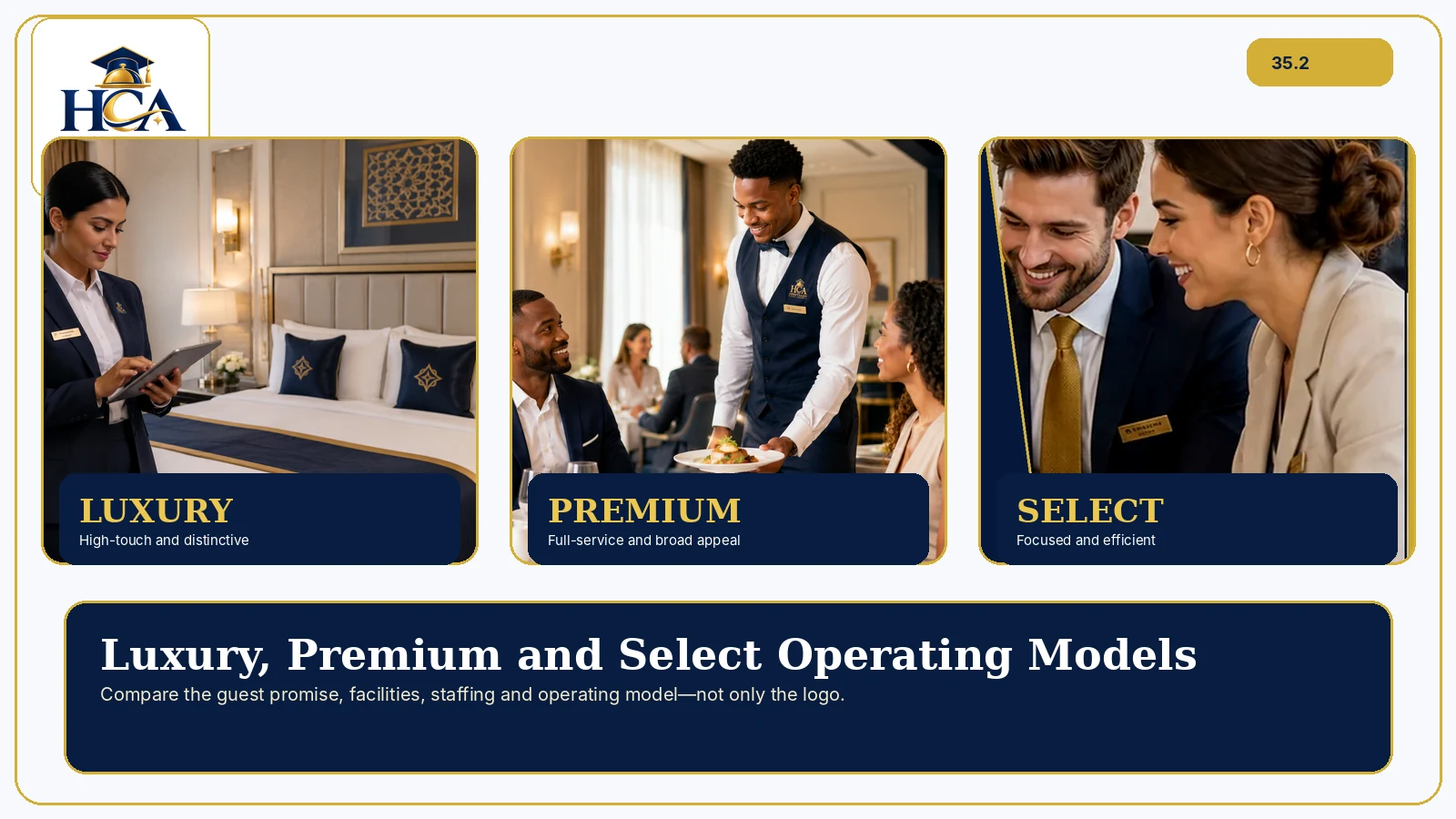
Marriott’s current consumer portfolio page organises offerings under broad groups including:
- Luxury and distinctive luxury;
- Premium;
- Select;
- Longer Stays;
- Collections.
The official site also includes accommodation or travel products that do not map perfectly to a traditional hotel-brand count. That is why the most useful question is not simply “How many brands are there?” but “Which category and operating model fit this guest or career goal?”
Why brand positioning matters
A hotel brand is more than a logo. It may influence:
- the typical guest purpose;
- service style and staffing levels;
- food and beverage operations;
- room design and amenities;
- meeting and event capability;
- loyalty benefits and participating-property rules;
- employee training and role breadth;
- owner and management operating standards.
Brand category does not guarantee that one individual property is “better” than another. Location, ownership, management, maintenance, renovation status and team execution all affect the real experience.
Luxury and distinctive luxury brands
Marriott’s official portfolio page presents luxury names such as The Ritz-Carlton, St. Regis and JW Marriott, and distinctive luxury brands such as Ritz-Carlton Reserve, The Luxury Collection, W Hotels and EDITION.
Typical guest expectation
Luxury guests often expect high personalisation, polished anticipation, strong destination knowledge, privacy and seamless coordination. The experience may include sophisticated dining, spa, residences, clubs, villas or destination-led programming.
What employees may need
- detailed guest-preference awareness;
- discreet and culturally intelligent communication;
- high product and destination knowledge;
- precise service recovery;
- coordination across many departments;
- confidence serving VIP, luxury leisure and high-value business guests;
- disciplined grooming and service language.
Career example
A front office employee in a luxury hotel may spend more time on pre-arrival planning, preference verification, suite orientation and coordination with concierge, butlers, housekeeping, transport and food and beverage.
Luxury should not be confused with “saying yes to everything.” Strong luxury service combines creativity with privacy, safety, feasibility and clear authority limits.
Premium brands
The official portfolio page groups brands such as Marriott Hotels, Sheraton, The Marriott Vacation Clubs, Delta Hotels by Marriott, Westin, Le Méridien, Renaissance Hotels and Gaylord Hotels in the Premium category.
Typical guest expectation
Premium hotels commonly offer broader facilities, including restaurants, bars, meeting space, fitness, lounges, banqueting and full front-office operations. They may serve business travellers, groups, conferences, families and leisure guests at the same property.
What employees may need
- strong interdepartmental coordination;
- group and event awareness;
- loyalty recognition;
- confident restaurant and lounge knowledge;
- ability to manage high arrival and departure volume;
- knowledge of meetings, room inventory and multiple guest segments.
Career example
A duty manager at a large premium hotel may coordinate a conference arrival, elite-member expectations, restaurant capacity, coach movements and room readiness during the same shift. This environment can build broad operational leadership skills.
Select brands
Marriott’s current Select portfolio includes brands such as Courtyard by Marriott, Four Points, SpringHill Suites, Fairfield by Marriott, AC Hotels, citizenM, Aloft Hotels, Moxy Hotels, Protea Hotels, City Express, Four Points Flex by Sheraton and Series by Marriott on the official portfolio page.
Typical guest expectation
Select-service hotels normally focus on reliable essentials, convenience, efficient design and a clearer or more limited service offer than a large full-service hotel. Some have strong social spaces, breakfast concepts, bars or compact food options, but the operating model varies.
What employees may need
- multi-skilling;
- speed and prioritisation;
- clear explanation of what is and is not available;
- confident use of systems and self-service tools;
- compact-team communication;
- local knowledge and practical problem-solving.
Career example
A receptionist in a select-service property may handle check-in, simple food-and-beverage support, guest requests, basic sales and shift administration. The role can build strong ownership because fewer hand-offs are available.
Do not describe select service as “low quality.” It is a different operating promise, often focused on efficient essentials and value.
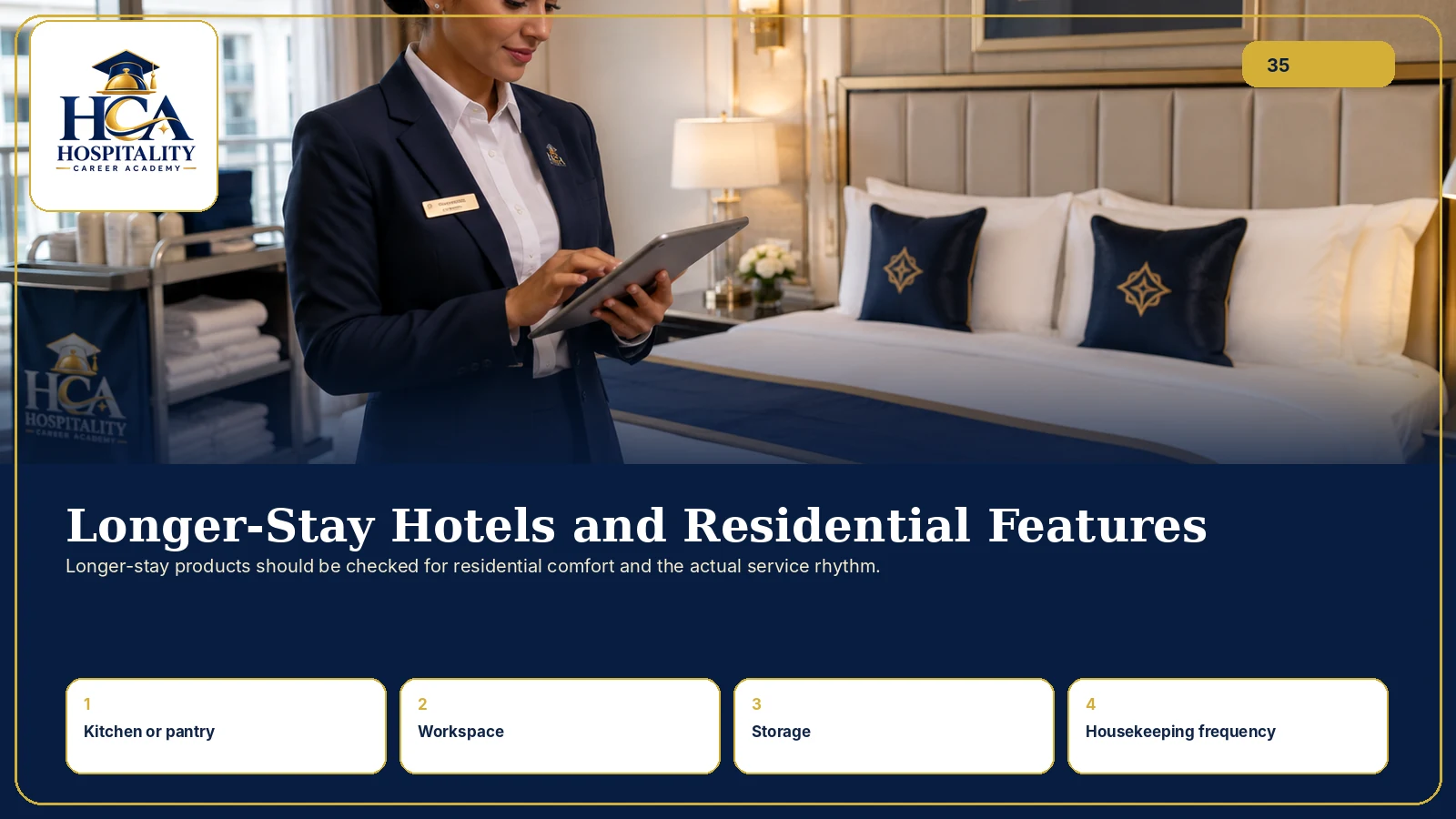
Longer-stay brands and products
The official portfolio page’s Longer Stays group includes Residence Inn, TownePlace Suites, Element Hotels, StudioRes, Homes & Villas by Marriott Bonvoy, Apartments by Marriott Bonvoy and Marriott Executive Apartments, among current offerings.
Typical guest expectation
Longer-stay guests may need more than a bed for one night. They often value:
- kitchen or kitchenette facilities;
- storage and laundry access;
- practical workspace;
- residential comfort;
- grocery, delivery and neighbourhood knowledge;
- consistent housekeeping schedules;
- support for families, relocation or project stays.
What employees may need
- relationship building over a longer guest journey;
- explanation of housekeeping frequency and residential services;
- familiarity with appliances, kitchens and maintenance issues;
- billing and long-stay account accuracy;
- community recommendations;
- sensitivity to guests who are temporarily living, not merely visiting.
Career example
An operations employee in an extended-stay property may coordinate weekly housekeeping, grocery delivery, maintenance, parcel handling and longer-term billing. This develops residential and hotel-service skills together.
Collections
Marriott’s official portfolio page places offerings such as Autograph Collection, Design Hotels, Tribute Portfolio, MGM Collection with Marriott Bonvoy and Outdoor Collection by Marriott Bonvoy within the Collections group.
Collections connect distinctive or independently styled properties to a wider platform while allowing more individual identity than a traditional uniform brand.
Typical guest expectation
Guests may choose a collection property for local character, unusual design, entertainment, heritage or a less standardised experience.
What employees may need
- strong property storytelling;
- destination and cultural knowledge;
- ability to explain what makes that hotel distinctive;
- balance between individual character and required platform standards;
- confidence handling guests who chose the property for a specific experience.
Career example
A guest-relations employee at a collection hotel may need to tell the story of the building, recommend local cultural experiences and explain unique facilities while still recognising loyalty status and using central systems correctly.
Current portfolio snapshot by category
The table below is a dated operational snapshot, not a permanent count.
| Category | Representative/current names shown on Marriott’s official portfolio page at review date | Common operating emphasis |
|---|---|---|
| Luxury | The Ritz-Carlton, St. Regis, JW Marriott | Personalisation, destination experience, privacy and elevated facilities |
| Distinctive luxury | Ritz-Carlton Reserve, The Luxury Collection, W Hotels, EDITION | Individual luxury positioning, design and experiential service |
| Premium | Marriott Hotels, Sheraton, The Marriott Vacation Clubs, Delta Hotels, Westin, Le Méridien, Renaissance, Gaylord | Full service, dining, meetings, groups and broader facilities |
| Select | Courtyard, Four Points, SpringHill Suites, Fairfield, AC Hotels, citizenM, Aloft, Moxy, Protea, City Express, Four Points Flex, Series by Marriott | Efficient essentials, focused concepts and compact operations |
| Longer Stays | Residence Inn, TownePlace Suites, Element, StudioRes, Homes & Villas, Apartments by Marriott Bonvoy, Marriott Executive Apartments | Residential features, kitchens, workspace and longer guest relationships |
| Collections | Autograph Collection, Design Hotels, Tribute Portfolio, MGM Collection, Outdoor Collection by Marriott Bonvoy | Distinctive independent identity connected to a wider platform |
The official portfolio can change after the review date. Some products, collections or accommodation platforms may be counted differently in corporate reports, consumer directories and hotel filters.
How travellers can choose the right category
Start with the trip purpose rather than the logo.
Business trip with meetings
Look for location, workspace, transport, breakfast timing, lounge or meeting facilities and a cancellation policy that fits the schedule. A Premium or Select property may both work, depending on the required services.
Family holiday
Check occupancy, bed configuration, connecting-room policy, children’s facilities, dining and location. A resort, premium hotel, villa or longer-stay apartment may fit different family needs.
Long project or relocation
Prioritise kitchen, laundry, storage, housekeeping frequency, workspace and transport. Longer-stay brands may be designed around these needs.
Luxury occasion
Consider privacy, suite layout, personalisation, dining, spa, airport support and destination programming—not only the brand category.
Local or design-led experience
A collection or distinctive lifestyle property may offer stronger individuality, but check the actual facilities and operating style.
A practical traveller comparison checklist
| Question | Why it matters |
|---|---|
| What is the purpose and length of the trip? | Separates short business, leisure, group and long-stay needs |
| Which services are essential? | Avoids paying for facilities that are not needed—or booking a concept that lacks them |
| What room layout and occupancy are required? | Brand category does not replace room-level verification |
| Is breakfast, lounge or parking included in this rate? | Benefits and packages vary |
| Does the property participate fully in the expected loyalty benefit? | Participation and exclusions may differ |
| What is the cancellation and payment rule? | Rate conditions can be more important than brand |
| When was the property last renovated or reviewed? | Individual property condition affects experience |
How hospitality applicants should use brand knowledge
Candidates often memorise a list of brands but cannot explain why the differences matter. A stronger interview answer connects the brand’s operating model to the role.
Front office candidate
“In a full-service premium hotel I would expect more group movement, outlets and interdepartmental coordination. In a select-service property I would expect a broader multi-skilled role and fewer hand-offs.”
Food and beverage candidate
“I would check whether the property has several restaurants and banqueting, a focused breakfast/bar concept or a residential long-stay model before describing the F&B career opportunity.”
Housekeeping candidate
“A luxury resort may emphasise high personalisation, villas and turndown, while an extended-stay property may use different cleaning frequencies and kitchen-related standards.”
Sales candidate
“I would segment demand by trip purpose and property facilities rather than assuming every hotel under the same parent company competes for the same business.”
Management trainee
“I want to understand staffing model, guest journey, owner priorities and service promise—not only brand recognition.”
Brand knowledge for hotel trainers and managers
A useful brand-orientation session should answer:
- Who is the primary guest and what trip purpose does the property serve?
- What are the non-negotiable service behaviours?
- Which facilities and experiences define the property?
- Which benefits or features vary by rate or status?
- What should employees never promise without checking?
- How does the hotel differ from nearby sister properties?
- What career skills can employees develop in this operating model?
Avoid training that consists only of logos, slogans and history. Employees need to understand how positioning changes daily decisions.
Why a fixed brand count becomes outdated
A portfolio can change because of:
- a new brand launch;
- an acquisition;
- a conversion platform;
- a regional brand joining the system;
- a collection or accommodation product being added;
- corporate reporting changes;
- a brand being renamed, repositioned or retired.
The historical URL of this HCA article includes “33 brands,” but the editorial content should not keep repeating a fixed number after the official portfolio changes. Preserve the valuable URL for continuity while using a dated current guide.
HCA portfolio fact-check routine
Review this article at least every 90 days—or sooner after a major Marriott announcement.
Check the following
- official consumer brand portfolio;
- Marriott’s latest annual or investor report;
- newly announced acquisitions or launches;
- renamed or retired brands;
- placement of brands by category;
- whether nontraditional products are being counted with hotel brands;
- internal links to the Bonvoy guide;
- title and meta description accuracy;
- review date beside the byline;
- Arabic content parity.
Record what changed rather than silently replacing the list.
Common Marriott brand misunderstandings
- Treating a historical brand count as permanent.
- Assuming every brand offers the same loyalty benefits.
- Believing Luxury, Premium and Select are simple quality scores.
- Expecting every hotel in a category to have identical facilities.
- Ignoring the individual property’s ownership, management and renovation status.
- Confusing collections, hotel brands and accommodation platforms.
- Applying for a job based only on the logo without understanding the operating model.
- Promising guests a facility because another property under the parent company has it.
Related HCA guides
- Marriott Bonvoy tiers and benefits
- HCA hospitality career training
- hospitality jobs
- more hospitality articles
Update references
- HCA Marriott brands article — Hospitality Career Academy
- Marriott Brands — Marriott International
- Annual Reports and Proxy Statements — Marriott International Investor Relations
- HCA Marriott Bonvoy guide — Hospitality Career Academy
Frequently asked questions
How many Marriott brands are there?
The answer depends on the date and what is being counted: traditional hotel brands, collections, longer-stay products or adjacent accommodation platforms. Use Marriott’s current official portfolio rather than relying on a historical number.
What is the difference between Luxury, Premium and Select?
They describe different positioning and operating models. Luxury generally emphasises high personalisation and elevated experiences; Premium often offers broad full-service facilities; Select focuses on efficient, more concentrated services. Individual properties still vary.
Are Autograph Collection and Tribute Portfolio traditional uniform brands?
They are collection platforms for distinctive properties, allowing more individual identity than a highly standardised traditional brand while connecting hotels to Marriott’s systems and loyalty platform.
Is Marriott Bonvoy the same as a hotel brand?
No. Marriott Bonvoy is the loyalty and travel programme. Many different brands and participating properties connect to it under varying rules.
Which Marriott category is best for a hospitality career?
There is no universal best category. Choose according to the skills you want: luxury personalisation, full-service complexity, select-service multi-skilling, long-stay relationship management or collection-property storytelling.
Final takeaway
Marriott’s portfolio is easier to understand when you stop treating it as one static list. Start with the category, then examine the individual brand, property, trip purpose and operating model.
For travellers, this leads to a better fit. For hospitality professionals, it creates stronger interview answers, training and career decisions. The brand name matters—but the actual service promise and property details matter more.
Official sources and review date
This independent HCA guide was checked against Marriott’s official brand portfolio on 2 September 2026. The portfolio may change after publication. Verify current brand categories and property details through Marriott’s official channels before relying on the list.
Frequently asked question
How many Marriott brands are there?
The answer depends on the date and what is being counted: traditional hotel brands, collections, longer-stay products or adjacent accommodation platforms. Use Marriott’s current official portfolio rather than relying on a historical number.
Explore HCA hospitality career training