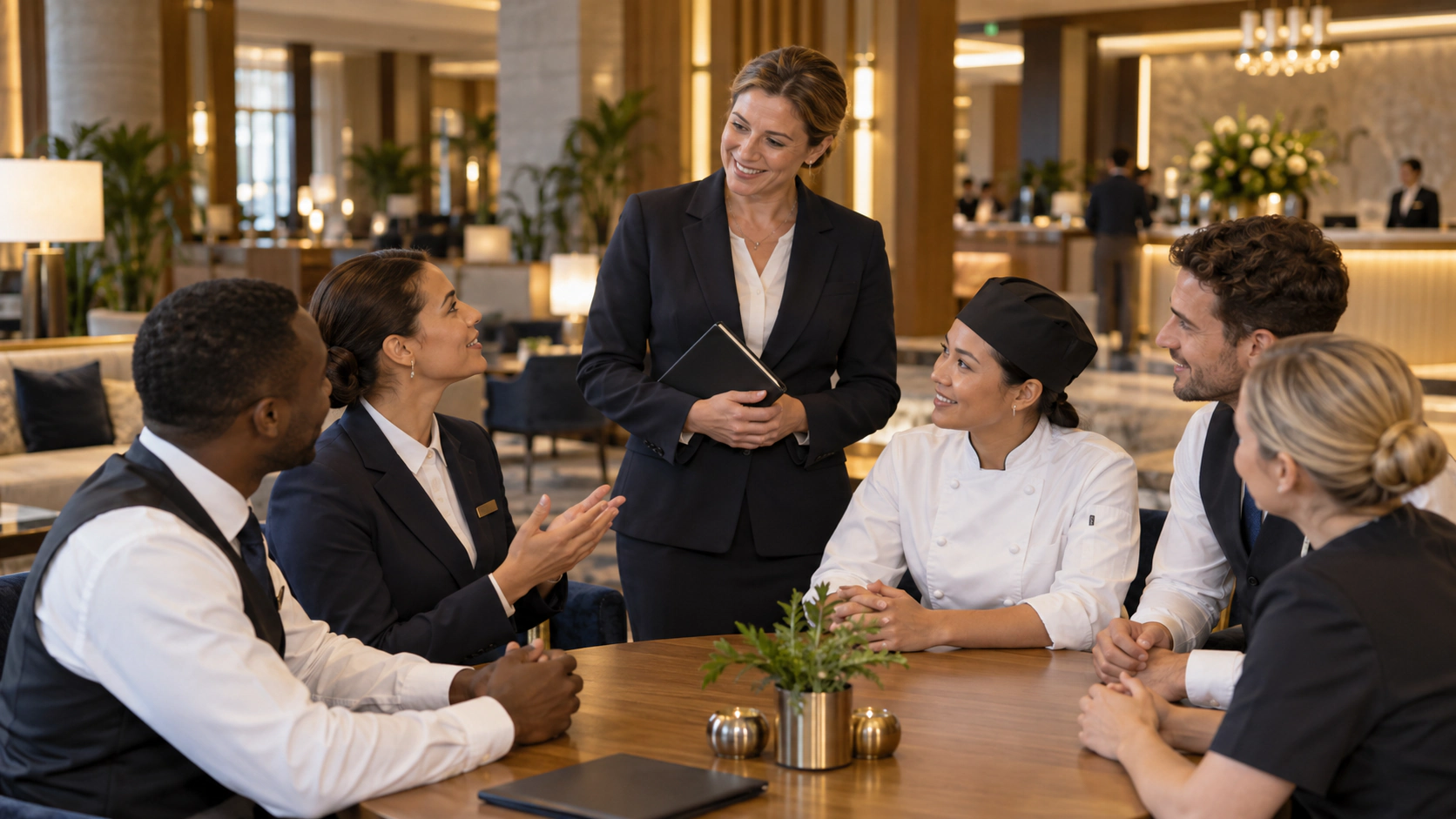
Winning in hospitality should not mean pushing people to work faster at any cost. A team wins when it delivers the promised guest experience, protects safety and quality, coordinates under pressure, learns from mistakes and achieves sustainable business results. A busy shift with high revenue but unsafe shortcuts, exhausted employees and unresolved complaints is not a complete win.
Team motivation becomes stronger when employees can see the goal, understand their role, influence the plan and review progress together. This guide shows hospitality leaders how to create a practical performance rhythm without turning the operation into a pressure contest.
Define what “winning” means for the operation
A useful team win includes several dimensions:
| Dimension | Example of a meaningful win |
|---|---|
| Guest | priority requests are owned and closed; complaints are followed up |
| Quality | rooms, orders or records meet the agreed standard |
| Safety and compliance | procedures are followed even during peak demand |
| Commercial | suitable upselling, cost control or productivity supports the business |
| Team | workload is coordinated, help is requested early and learning is shared |
A team should not be rewarded for one dimension while damaging another. For example, faster room cleaning is not a win if inspection defects rise. Higher restaurant sales are not a win if allergen controls are bypassed.
The HCA APER performance rhythm
HCA can use the following practical teaching cycle. It is not a universal industry standard.
A — Align
Define the result, reason, standard and measures. Make sure departments are working toward compatible priorities.
P — Prepare
Confirm staffing, skills, stock, information, equipment, authority and contingencies before demand arrives.
E — Execute and enable
Run the shift with short updates, visible ownership, coaching and support. Remove obstacles quickly.
R — Recover and review
Stabilise service failures, close guest and employee follow-up, then examine what should continue, change or stop.
The rhythm repeats. It turns motivation into an operating system rather than a one-time speech.
Step 1: Translate business goals into a shift win
Annual targets are too distant to guide the next two hours. Convert them into a result the team can influence.
Broad business goal:
Improve guest satisfaction and restaurant profitability.
Practical dinner-shift win:
Seat booked guests within the agreed window, verify allergens before order entry, keep course delays visible, recommend one suitable add-on without pressure and close every service-recovery case before the guest leaves where possible.
This gives several departments a shared definition of success.
A shift-win statement should include:
- the guest or business situation;
- two to four priorities;
- the standard that must not be compromised;
- owners and escalation;
- how progress will be reviewed.
Step 2: Use a balanced team scoreboard
A scoreboard should help decisions, not shame employees. Keep it small and within the team’s influence.
Example front office scoreboard:
- arrivals with registration defects;
- priority rooms updated on time;
- open guest requests beyond deadline;
- payment or folio exceptions;
- specific recognition received;
- one learning point from the shift.
Example housekeeping scoreboard:
- inspected rooms released on time;
- repeat defects by type;
- maintenance issues reported before room release;
- DND or privacy procedures followed;
- linen or amenity variance requiring action;
- safe workload exceptions.
Do not display personal performance publicly unless the purpose, measures and policy clearly support it. Public ranking can encourage gaming, rivalry or embarrassment.
Step 3: Clarify role ownership before pressure begins
Motivation drops when several people think someone else owns the task. Before the shift, confirm:
- who owns each area or guest journey stage;
- who acts as backup;
- what the owner may decide;
- which trigger requires help;
- how the task is handed over;
- who confirms closure.
A role brief might say:
Lina owns conference-arrival queue flow from 14:00 to 16:00. Ahmed is backup during breaks. Lina may move guests between the two check-in points and request a lobby host. Any room-status dispute goes to the duty manager. Waiting cases are handed over verbally and in the approved log.
Ownership should make support easier, not isolate the employee.
Step 4: Prepare the conditions for success
Leaders often try to motivate after the team has already entered a badly prepared shift. Preparation has a greater effect.
Check:
- forecast demand and arrival patterns;
- staffing and break cover;
- system and equipment status;
- stock, linen, ingredients or guest supplies;
- VIP, accessibility and recovery cases;
- room, menu, event or transport changes;
- language or skill needs;
- emergency and downtime procedures;
- interdepartmental dependencies.
If a known obstacle cannot be removed, explain the contingency and who will support the team. Hidden problems destroy confidence faster than difficult but honest plans.
Step 5: Run short performance huddles
A huddle is not another long meeting. It is a short control point during the operation.
A useful two-minute huddle answers:
- What is the current picture?
- What is off track?
- What matters in the next period?
- Who owns the adjustment?
- When is the next check?
Example:
We have six tables waiting for main courses and two new large parties arriving. Kitchen estimates 12 minutes to recover. Captain 1 will pause new seating for five minutes; Captain 2 will update affected tables. Host will call the next reservation if the wait exceeds ten minutes. Check again at 20:15.
The tone should be calm and factual. Panic is contagious, but so is composed coordination.
Step 6: Coach in the flow of work
Not every correction requires a formal meeting. A quick coaching intervention can protect the shift:
- name the specific behaviour;
- explain the immediate risk or result;
- give one clear adjustment;
- confirm understanding;
- observe the next attempt;
- follow up later if the gap continues.
Example:
Before you send the order, read the allergy note back to the guest and flag it to the captain. I will watch the next one with you.
Do not use sarcasm or correction in front of guests unless immediate safety requires intervention.
Step 7: Reinforce the behaviours behind the result
Teams repeat what leaders notice. Recognise behaviours that produced a responsible win:
- asking for help early;
- protecting safety under pressure;
- supporting another section;
- sharing accurate information;
- recovering a guest concern;
- finding a root cause;
- admitting and correcting an error;
- improving a process;
- developing another employee.
Celebrate the result and the method. If a target was achieved through an unsafe shortcut, address the shortcut rather than praising the number.
Step 8: Recover quickly when the shift goes off track
A motivated team is not a team that never struggles. It is a team that knows how to recover.
Use a five-part recovery response:
- Protect: safety, guest wellbeing and critical controls.
- Prioritise: decide what must happen now and what can wait.
- Reassign: move resources and clarify temporary ownership.
- Communicate: update guests, employees and departments honestly.
- Review: record causes and actions after stability returns.
Leaders should not blame during the active recovery. Accountability comes after facts are established.
Step 9: Use an after-action review
A short review turns the shift into learning. Ask:
- What were we trying to achieve?
- What actually happened?
- What helped?
- What created friction?
- What did we learn?
- What will we do differently next time?
- Who owns the action and deadline?
Keep the review focused on the system and controllable behaviour. If a serious conduct, safety or compliance issue appears, route it to the correct formal process.
Three practical scenarios
Front office: arrival peak
Goal: accurate, calm check-in for a group and regular guests at the same time.
Preparation: separate group key control, confirm room status, assign queue host and set escalation rules.
Huddle: every 15 minutes during the peak.
Win: no security shortcuts, waiting guests updated and open room issues handed over with owners.
Housekeeping: departure rush
Goal: release priority rooms without reducing inspection quality.
Preparation: verify departures, assign room sections, identify engineering dependencies and prepare linen.
Huddle: after the first inspection cycle.
Win: rooms released accurately, defects visible and employees receive support where workload exceeds plan.
Restaurant: full dinner service
Goal: controlled flow from welcome to farewell.
Preparation: reservation review, section plan, allergen brief, menu availability and POS readiness.
Huddle: before peak and at the first delay trigger.
Win: guests receive honest updates, courses are coordinated and recovery is closed.
A 30-day team-performance plan
Week 1: define the win
- choose one operational area;
- agree three to five balanced measures;
- explain why each measure matters;
- remove measures the team cannot influence.
Week 2: strengthen preparation and ownership
- clarify roles and backups;
- identify recurring obstacles;
- create escalation triggers;
- practise one downtime or pressure scenario.
Week 3: use huddles and coaching
- run short checkpoints;
- coach one priority behaviour;
- recognise responsible actions;
- record recovery decisions.
Week 4: review and improve
- compare evidence with the baseline;
- ask employees what helped or harmed performance;
- close action items;
- decide what to standardise and what to test next.
Motivation and competition
Friendly challenges can create energy, but they need controls. Never design a competition that encourages employees to:
- hide errors;
- pressure guests into purchases;
- avoid difficult customers;
- compete instead of helping;
- skip safety or quality steps;
- manipulate records;
- work through required breaks;
- embarrass lower performers.
Team-based improvement is often safer than a public individual leaderboard. Reward contribution to the shared outcome, including support and learning.
How to know whether the rhythm is working
Look for:
- fewer surprises during peak periods;
- clearer ownership;
- earlier requests for help;
- faster recovery without unsafe shortcuts;
- improved quality and guest follow-up;
- more useful employee ideas;
- completed after-action items;
- stable results rather than one exceptional day;
- reasonable workload and team wellbeing.
If results improve while turnover, fatigue or errors rise, the system is not yet sustainable.
Common mistakes
Avoid:
- defining winning only as revenue or speed;
- creating too many KPIs;
- changing priorities without explanation;
- ranking individuals publicly without a justified purpose;
- celebrating results achieved by shortcuts;
- using huddles as blame sessions;
- correcting every issue personally instead of building ownership;
- reviewing failures but not successful practices;
- keeping action items with no owner or deadline.
Frequently asked question
How can a hospitality manager motivate a team to achieve targets?
Translate the target into a balanced, controllable shift win; prepare the resources; clarify roles and authority; use short huddles; coach specific behaviours; recognise responsible contribution; recover calmly; and review evidence with the team.
Final takeaway
Hospitality teams win through clarity, preparation, ownership, support and learning—not pressure alone. Define a balanced result, make work visible, check progress briefly and treat every shift as a chance to improve the system.
Use the downloadable HCA team-win tracker to set the goal, assign owners, record huddles, monitor balanced measures and close after-action commitments.
Bilingual shift tool for balanced goals, owners, huddles, guest, quality, safety, commercial and team measures, recovery and review.
Download Hospitality Team-Win Scoreboard and Huddle Tracker (CSV)
Related HCA guides
- how to motivate a hospitality team
- delegation in hotel management
- restaurant shift delegation
- performance management in hospitality
- hotel departments and workflow
Update references
- Motivating Teams to Win — Hospitality Career Academy
- How to Motivate Your Team as a Leader — Center for Creative Leadership
- Employee engagement — CIPD
- Performance management — CIPD
- Management Standards — UK Health and Safety Executive
- Line managers in people professions — CIPD
- Coaching Others: Use Active Listening Skills — Center for Creative Leadership
Frequently asked question
How can a hospitality manager motivate a team to achieve targets?
Translate the target into a balanced, controllable shift win; prepare resources; clarify roles and authority; use short huddles; coach specific behaviours; recognise responsible contribution; recover calmly; and review evidence with the team.