A hotel front office manager leads the operation guests see at reception and coordinates the people, systems and departments behind it. The role covers arrivals, room control, guest accounts, service recovery, staff leadership, security, privacy, revenue awareness and handovers across a 24-hour operation.
The job is broader than “managing the front desk.” A capable front office manager makes sure the team can welcome guests warmly and complete every registration, key, payment, room-status and follow-up step accurately. They also turn repeated problems into operational improvements instead of solving the same issue shift after shift.
Front office manager role at a glance
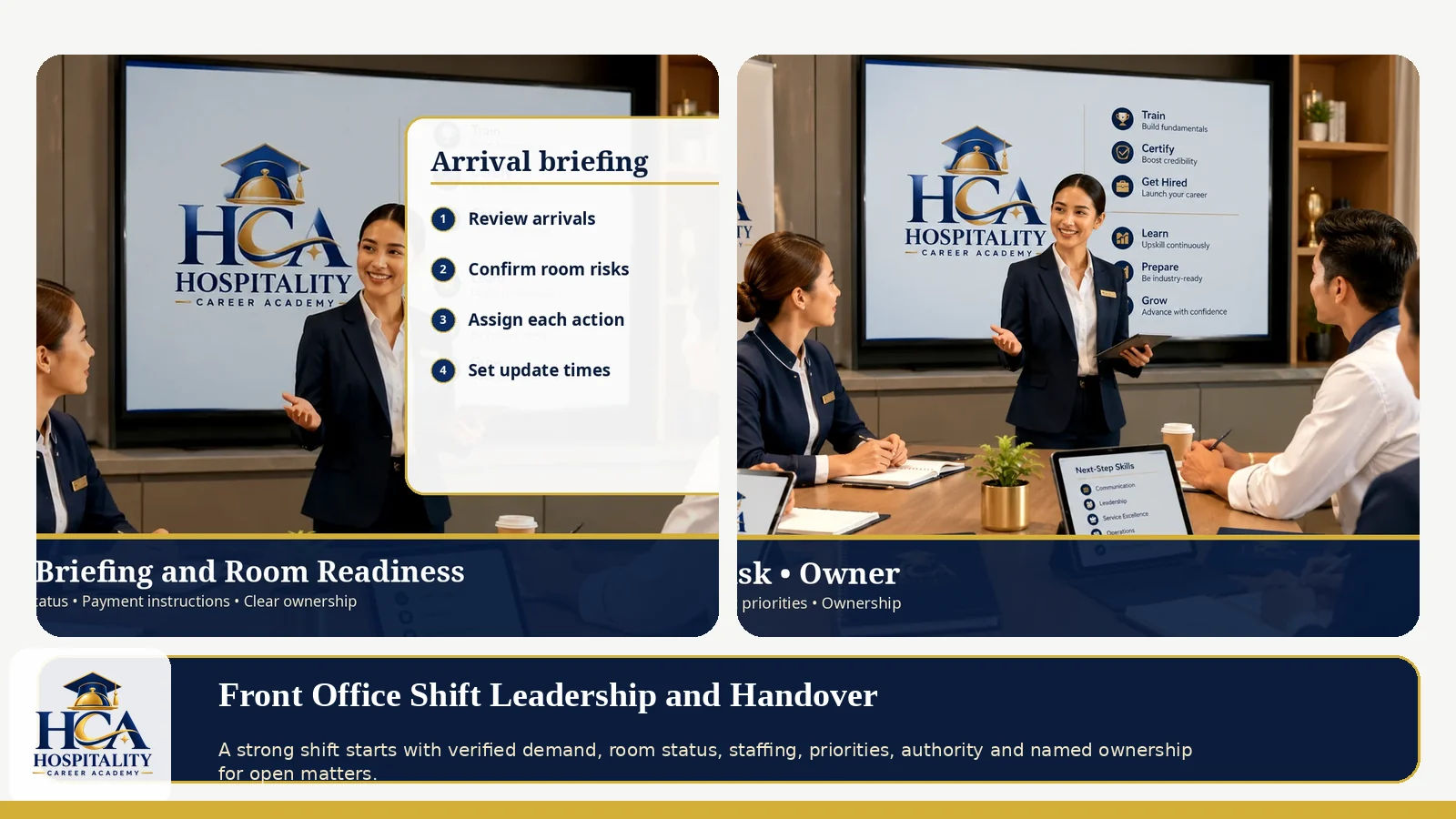
| Area | What the manager owns |
|---|---|
| Guest journey | Arrival, stay support, complaint ownership and departure standards |
| Rooms control | Room status, assignment, moves, oversell, upgrades and out-of-order coordination |
| People | Staffing, briefing, coaching, performance, delegation and succession |
| Systems and controls | PMS access, keys, payments, privacy, cash and downtime procedures |
| Commercial performance | Forecast awareness, suitable upselling, package accuracy and demand coordination |
| Cross-department work | Housekeeping, reservations, revenue, engineering, security, sales and F&B handovers |
Titles vary. Some hotels use front desk manager, guest services manager, front office director or rooms division manager for overlapping responsibilities. The correct job description should state the real reporting line, team size, shift coverage and decision authority rather than relying on the title alone.
Main duties and responsibilities
1. Lead the arrival, stay and departure experience
The front office manager sets and monitors the standards that shape the guest journey. This includes acknowledgement, registration, room assignment, key issue, information, account review, departure and farewell.
Key responsibilities include:
- reviewing VIP, group, accessible, early-arrival and special-request priorities;
- making sure promised arrangements are confirmed with the responsible department;
- supporting complex complaints and service recovery within approved authority;
- ensuring the guest receives realistic updates when a solution takes time;
- checking that unresolved matters have one named owner and a deadline;
- reviewing repeat-contact patterns to identify broken processes.
A strong manager does not take over every guest conversation. They prepare supervisors and receptionists to resolve normal situations confidently and step in when risk, authority or complexity requires it.
2. Control rooms and front-office systems
Room accuracy affects guest satisfaction, revenue and operational pressure. The manager should coordinate a common room-status process with housekeeping and engineering and ensure that system status reflects reality.
Typical controls include:
- arrivals, departures and occupancy review;
- room type and occupancy accuracy;
- room moves and connecting-room requests;
- out-of-order and out-of-service rooms;
- oversell and relocation procedures;
- key creation and access control;
- interface, posting and PMS exceptions;
- approved downtime and manual-operation procedures.
A room should not be promised simply because it appears available on one screen. Cleaning, inspection, defects, amenities and system release must agree.
3. Protect payment, cash and privacy controls
Front office handles sensitive guest, identity and payment information. The manager must enforce approved procedures without asking employees to copy confidential information into personal messages, informal spreadsheets or unapproved devices.
The manager normally reviews:
- deposits, authorisations and settlement;
- adjustments, refunds and corrections;
- cash floats, paid-outs and variances;
- credit limits and high-balance accounts;
- disputed charges and billing support;
- user access and separation of duties;
- secure identity and key-verification procedures.
Controls should prevent errors while still allowing respectful guest service. When an exception occurs, the first priorities are containment, accurate facts, the correct escalation and a documented resolution—not public blame.
4. Plan staffing and lead the team
Front office performance depends on the right number of people with the right skills at the right time. The manager translates forecast, arrival pattern, groups, events and operating risk into a workable roster and shift plan.
People responsibilities may include:
- workforce planning and recruitment;
- induction and system access;
- skills training and competency sign-off;
- daily briefings and task allocation;
- observation, coaching and recognition;
- performance and conduct follow-up;
- leave, breaks, shift balance and legal scheduling requirements;
- development plans for supervisors and future managers.
Fair leadership matters. Targets should consider demand, role complexity and factors employees can actually influence. The fastest receptionist is not necessarily the strongest if speed creates errors, weak communication or repeat visits.
5. Coordinate with hotel departments
Front office cannot deliver the guest promise alone. The manager builds reliable working routines with:
- Reservations: booking details, deposits, requests, packages and changes;
- Housekeeping: room readiness, priorities, inspections and discrepancies;
- Engineering: defects, access, room blocks and return-to-inventory decisions;
- Revenue: forecast, inventory, restrictions, room types and upgrade availability;
- Security: incidents, access, lost property, emergencies and investigations;
- Sales and events: groups, VIPs, billing, rooming lists and function changes;
- Food and beverage: inclusions, opening hours, guest recovery and posting issues.
Good coordination is visible in the handover. “Please follow up” is not enough. A useful handover states the verified facts, action taken, guest promise, owner, deadline and next escalation point.
A practical daily routine
Before the main arrival period
- Read night, incident and management handovers.
- Review occupancy, arrivals, departures, groups and room-status risks.
- Check staffing, breaks, transport, equipment and system health.
- Confirm room priorities with housekeeping and engineering.
- Review open guest recovery and high-balance or payment exceptions.
- Brief the team on what they need to know—without exposing unnecessary personal information.
During operation
- observe lobby flow and queue conditions;
- support employees without crowding every interaction;
- sample registration, key and account accuracy;
- monitor room-ready promises and guest updates;
- protect time for short coaching conversations;
- record patterns that require process correction.
At shift change
The incoming leader should understand every unresolved high-impact matter. The handover should identify what is complete, what remains, who owns it and when the next update is due.
After the peak
Review why problems happened. A late room may be caused by staffing, departure delay, inspection, maintenance, linen, inaccurate status or an unrealistic promise. Fixing the real cause is more valuable than assigning blame.
Front office manager authority matrix
Every hotel should define authority in writing. The example below is illustrative and must be adapted to policy.
| Decision | Receptionist | Supervisor | Front office manager | Senior leadership |
|---|---|---|---|---|
| Standard room assignment | Act within procedure | Support exceptions | Review patterns | — |
| Minor service recovery | Act within approved limit | Approve wider options | Monitor fairness and cost | — |
| High-value compensation | Recommend | Recommend | Approve within stated limit | Approve beyond limit |
| Room out of order | Report defect | Coordinate access | Confirm operational impact | Approve major inventory strategy if required |
| Payment adjustment | Follow controlled process | Review evidence | Approve within policy | Approve exceptional exposure |
| Emergency action | Follow emergency plan | Lead assigned area | Coordinate front-office response | Property incident command |
Delegation without authority creates delay. Authority without limits creates risk. Employees need both the freedom to act and a clear point for escalation.
Skills a front office manager needs
Operational skills
- PMS, room status and reservations knowledge;
- registration, account and payment control;
- shift planning and handover discipline;
- complaint handling and service recovery;
- safety, privacy and access awareness;
- basic revenue, forecast and room-inventory understanding.
Leadership skills
- clear communication;
- calm prioritisation under pressure;
- delegation with defined outcomes;
- coaching and fair feedback;
- conflict management;
- decision-making based on evidence;
- cross-department influence.
Commercial skills
The manager should understand how availability, room type, package terms, channel conditions and guest needs affect suitable offers. Upselling must be transparent, available and operationally deliverable.
Copyable front office manager competency matrix
The matrix below can be copied into a development plan, promotion review or structured interview. Replace the suggested evidence with the hotel’s actual systems, SOPs and authority levels.
| Competency | What competent performance looks like | Evidence to collect | Suggested assessment |
|---|---|---|---|
| Guest journey leadership | Coordinates arrival, stay, recovery and departure without losing ownership | Shift example, guest feedback, recovery record | Scenario and supervisor observation |
| PMS and room control | Protects room status, assignment, profile, note and handover accuracy | Transaction sample, room-status audit | System work sample |
| Account and payment control | Reviews postings, deposits, adjustments and exceptions within policy | Exception log, cashier audit, approval trail | Case exercise |
| Privacy, keys and access | Uses approved verification and escalates sensitive situations | Key audit, privacy scenario, incident record | Role-play and knowledge check |
| Shift leadership | Plans deployment, briefs clearly and adapts to demand | Roster, briefing note, peak-period example | Live observation |
| Coaching and feedback | Gives specific, fair feedback and verifies improvement | Coaching record, training sign-off | Coaching role-play |
| Service recovery | Diagnoses impact, acts within authority and closes the loop | Resolved case with follow-up | Complaint scenario |
| Cross-department coordination | Clarifies ownership, deadlines and confirmation with partner teams | Handover or action log | Operational case study |
| Commercial awareness | Makes suitable offers and interprets demand, availability and contribution | Upgrade result, forecast discussion | Data interpretation task |
| Improvement and reporting | Finds repeated causes, tests action and reports an honest result | Mini-project, KPI trend, lessons learned | Presentation and evidence review |
A competency should not be signed off only because the person attended training. The employee should demonstrate the task accurately, explain the control or risk and repeat the standard in realistic conditions.
Front office KPIs that need context
| Indicator | Useful management question |
|---|---|
| Queue or acknowledgement time | Is staffing aligned to arrival demand, and are guests kept informed? |
| Registration and account accuracy | Where are errors created, detected and corrected? |
| Room-ready promise accuracy | Do front office and housekeeping use one verified status? |
| Complaint closure | Was the guest updated and the root cause assigned? |
| Repeat contact | Did the first interaction resolve or clearly own the request? |
| Upgrade contribution | Was the offer suitable and delivered correctly after cost? |
| Cash and payment exceptions | Are controls working, and are anomalies investigated fairly? |
| Training sign-off | Can employees demonstrate the task safely and accurately? |
| Turnover, absence and overtime | Do workload, scheduling or leadership risks require action? |
Avoid ranking employees using one number. Quality, complexity, privacy, accessibility and recovery work must be considered.
Career path to front office manager
A common progression is:
- Master a front-line role. Become reliable in registration, accounts, rooms, requests and safe procedures.
- Broaden your exposure. Learn reservations, night operations, guest relations, concierge, housekeeping coordination and revenue basics.
- Own a shift. Lead briefing, allocate work, make authorised decisions and close the handover.
- Coach others. Demonstrate a task, observe performance, give specific feedback and verify improvement.
- Lead an operational project. Reduce a recurring queue, room-status, billing or communication failure with evidence.
- Build interview examples. Be ready to explain the situation, decision, risk, team involvement and result.
Years of service alone do not prove readiness. Strong evidence includes shift ownership, reliable controls, team development and measurable cross-department improvement.
First 90 days in the role
Days 1–30: listen and control risk
- meet every shift and key partner department;
- map arrival, room status, key, payment and recovery controls;
- review staffing, vacancies, skills and mandatory training;
- sample guest and financial exceptions before changing targets.
Days 31–60: stabilise and coach
- clarify standards, authority and handover ownership;
- fix one frequent process defect;
- introduce short observation and coaching routines;
- align the dashboard with outcomes the team can influence.
Days 61–90: improve and develop
- build a cross-department plan for the next priorities;
- create development steps for supervisors and receptionists;
- review staffing and demand patterns;
- report results, remaining risk and the next improvement test.
Interview evidence to prepare
A candidate should prepare examples for questions such as:
- Describe a difficult recovery and how you closed the loop.
- How did you resolve a room-status disagreement at peak arrival?
- How did you coach a strong employee with an accuracy problem?
- What action did you take after a payment-control exception?
- How did you build a fair roster for changing demand?
- Which front-office KPI did you improve, and what changed operationally?
Use real examples. Explain your authority, the evidence available, the people involved and what you learned.
Final checklist
A promotion-ready front office manager can:
- lead the complete guest journey;
- protect room, account, key and payment accuracy;
- create clear briefings and handovers;
- delegate within defined authority;
- coach employees fairly;
- coordinate with hotel departments;
- interpret KPIs instead of chasing isolated numbers;
- turn repeated incidents into process improvements.
Frequently asked question
What does a hotel front office manager do?

A front office manager leads reception and guest-service operations, controls room and account accuracy, manages staff and service recovery, protects approved payment and privacy procedures, and coordinates arrivals and departures with the wider hotel.
Sources and update note
This guide preserves the existing HCA topic and uses current occupational descriptions from O*NET and the U.S. Bureau of Labor Statistics as general references. Job scope, salary, working hours, legal duties, system access and decision authority vary by country and property. Always use the employer’s current job description and approved local procedures.
Bilingual competency matrix for development reviews, succession planning and structured front-office-manager assessment.
Related HCA guides
- front office manager interview guide
- hotel front desk training checklist
- how to become a hotel receptionist
- hotel departments and workflow
Update references
- Front Office Manager: Job Description, Duties, Skills and Career Path — Hospitality Career Academy
- Lodging Managers — O*NET OnLine, U.S. Department of Labor
- Lodging Managers — Occupational Outlook Handbook — U.S. Bureau of Labor Statistics
- Hotel, Motel, and Resort Desk Clerks — O*NET OnLine, U.S. Department of Labor
Frequently asked question
What does a hotel front office manager do?
A front office manager leads reception and guest-service operations, controls room and account accuracy, manages staff and service recovery, protects approved payment and privacy procedures, and coordinates arrivals and departures with the wider hotel.
Explore HCA front-office training