Hospitality is one of the few industries where people can grow quickly if they combine the right attitude with the right skills. Many successful hotel managers, restaurant leaders, housekeeping supervisors and front office professionals started in entry-level roles. What helped them move forward was not luck alone. It was consistent performance, continuous learning, strong workplace relationships and clear career direction.
If you want to progress in hospitality, it helps to think beyond your current job title. Your goal is not only to do today’s tasks well. Your goal is to become ready for the next responsibility before it is officially given to you. The five methods below are practical, realistic and suitable for hospitality professionals across hotels, restaurants, cafés, resorts and serviced residences.
1. Invest in training that matches your next role

Training becomes most useful when it is connected to the job you want next. A room attendant who wants to become a housekeeping supervisor should not study random topics. They should focus on inspection standards, task planning, stock control, team communication and guest-room quality. A waiter who wants to become a restaurant captain should strengthen menu knowledge, sequence of service, complaint handling and upselling.
Choose training in three layers:
- Core role skills such as service standards, grooming, hygiene, reservations, room operations or café service.
- Growth skills such as communication, leadership, problem-solving and time management.
- System knowledge such as PMS, POS, reporting tools or digital customer-service platforms.
The best training plan is simple. Pick one skill gap, learn it properly, practise it at work and ask for feedback. When your training is visible in your daily performance, managers notice the difference.
2. Build a reputation for reliability and service quality
Career growth in hospitality is strongly linked to trust. Managers promote people they can depend on during busy shifts, guest complaints, staffing shortages and operational pressure. If you want to be seen as promotion-ready, focus on dependable performance every day.
This includes:
- arriving prepared and on time
- following SOPs consistently
- communicating clearly during handover
- responding calmly under pressure
- maintaining professional grooming and conduct
- finishing tasks with attention to detail
In hospitality, consistency matters more than occasional brilliance. A team member who delivers strong results every week is more likely to be developed than someone who performs well only when closely supervised.
3. Learn from mentors, supervisors and strong colleagues
You do not need to wait for a formal mentoring programme to learn from others. In many hospitality workplaces, some of the best lessons come from observing experienced colleagues. Watch how a strong receptionist manages queue pressure. Notice how a restaurant supervisor leads briefing, handles a dissatisfied guest and keeps the team calm. Observe how a housekeeping leader inspects rooms and follows up on maintenance issues.
To learn faster:
- Ask thoughtful questions.
- Request feedback after important shifts or tasks.
- Accept correction professionally.
- Copy good habits, not only technical skills.
- Stay open to learning from different departments.
A mentor does not only help you do your current job better. A good mentor helps you understand how to think at the next level.
4. Increase your value by becoming multi-skilled
Hospitality businesses appreciate employees who understand more than one part of the operation. This does not mean doing everybody’s job. It means being able to support the wider guest journey and speak the language of the operation.
For example:
- A front office employee who understands reservations and room status works more effectively.
- A waiter who understands cashiering, allergen awareness and guest recovery becomes more valuable.
- A housekeeping supervisor who can coordinate with engineering and front office solves problems faster.
- A café employee who can prepare drinks, explain products and handle service recovery supports the business better.
Multi-skilling improves confidence, flexibility and promotion readiness. It also helps you decide which path suits you best in the long term.
5. Create a clear 90-day career plan

Many people say they want to grow, but they never define what growth means. A clear plan makes your development visible and measurable. Start by answering four questions:
- What role do I want next?
- What skills does that role require?
- Which of those skills do I already have?
- What must I improve within the next 90 days?
A simple 90-day plan may include:
Month 1: Assess and learn
- Ask your supervisor for honest feedback.
- Identify two skill gaps.
- Start one relevant course or learning resource.
- Observe a high-performing colleague.
Month 2: Practise and show progress
- Apply the new skill during shifts.
- Volunteer for added responsibility when appropriate.
- Record examples of good performance, guest praise or successful problem-solving.
- Improve one communication habit, such as clearer shift handovers.
Month 3: Review and prepare for the next step
- Ask for a development conversation.
- Share what you improved.
- Request new responsibilities, cross-training or a pathway discussion.
- Set the next 90-day goal.
Common mistakes that slow career growth
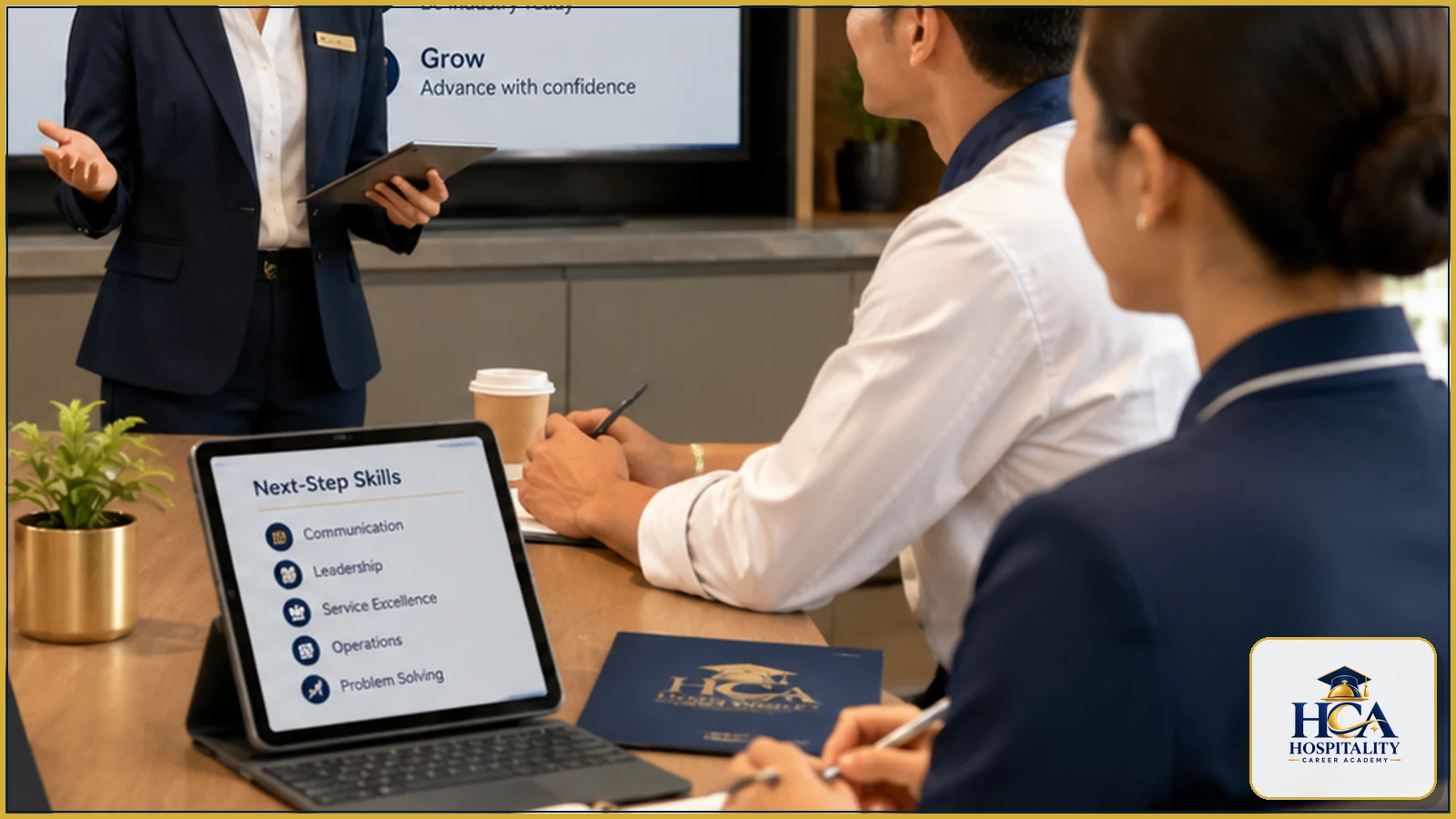
Some hospitality professionals work hard but still feel stuck because they repeat the same mistakes. Common examples include:
- waiting for promotion without asking for feedback
- taking training but not applying it on the job
- focusing only on technical tasks and ignoring communication
- reacting defensively when corrected
- changing jobs too often without developing stronger skills
Growth is not only about working harder. It is about working with direction.
Final takeaway
Advancing in hospitality is realistic when you combine training, reliability, mentoring, multi-skilling and clear planning. You do not need to master everything at once. Start with one improvement area, build evidence through your daily work and stay intentional about your direction.
The professionals who move ahead are usually the ones who make themselves ready before the opportunity appears. If you begin now, even a simple 90-day plan can move your hospitality career noticeably forward.
Related HCA guides
Frequently asked question
What is the fastest way to grow in hospitality?
The fastest growth usually comes from combining strong daily performance with targeted training, good communication, and visibility to supervisors through reliable results.
Explore HCA hospitality training