A hotel receptionist does far more than greet guests and issue keys. The role connects reservations, room status, payments, guest requests, complaints, local information, security controls and communication with almost every hotel department. A strong receptionist therefore needs a balanced combination of service skills, operational knowledge and sound judgement.
This guide turns the receptionist role into observable competencies. It is designed for beginners, front desk agents, supervisors and trainers who want to understand what competent performance looks like in real hotel operations.
What makes a hotel receptionist effective?
An effective receptionist can welcome a guest warmly while protecting accuracy and privacy. They remain calm when the lobby becomes busy, use the property-management system correctly, explain policies clearly and know when a request must be escalated.
The job requires more than confidence. It requires repeatable performance across normal, busy and difficult situations.
1. Professional welcome and guest recognition
The front desk is a visible service point. Receptionists should acknowledge guests promptly, create a professional first impression and adapt their communication to the situation.
Competent performance includes:
- maintaining appropriate grooming and posture;
- making natural eye contact;
- acknowledging waiting guests without interrupting the current interaction;
- using respectful names or titles where appropriate;
- recognising accompanying guests without ignoring the main contact;
- adjusting the amount of conversation to the guest’s time and mood;
- keeping private conversations discreet.
A scripted greeting can support consistency, but the employee should not sound robotic. The objective is a clear and genuine welcome.
2. Active listening and needs clarification
Guests do not always describe the real need in the first sentence. “I need another room” may mean noise, accessibility, bedding, temperature or a maintenance issue. Good receptionists listen, ask focused questions and confirm their understanding before taking action.
A useful pattern is:
- Let the guest explain without unnecessary interruption.
- Confirm the key fact and impact.
- Ask only the questions needed to choose the next action.
- Repeat the agreed request or solution.
- Record it accurately.
Example:
To make sure I arrange the right solution, may I ask whether the noise is coming from inside the room, the corridor or outside the hotel?
3. Property-management system competence
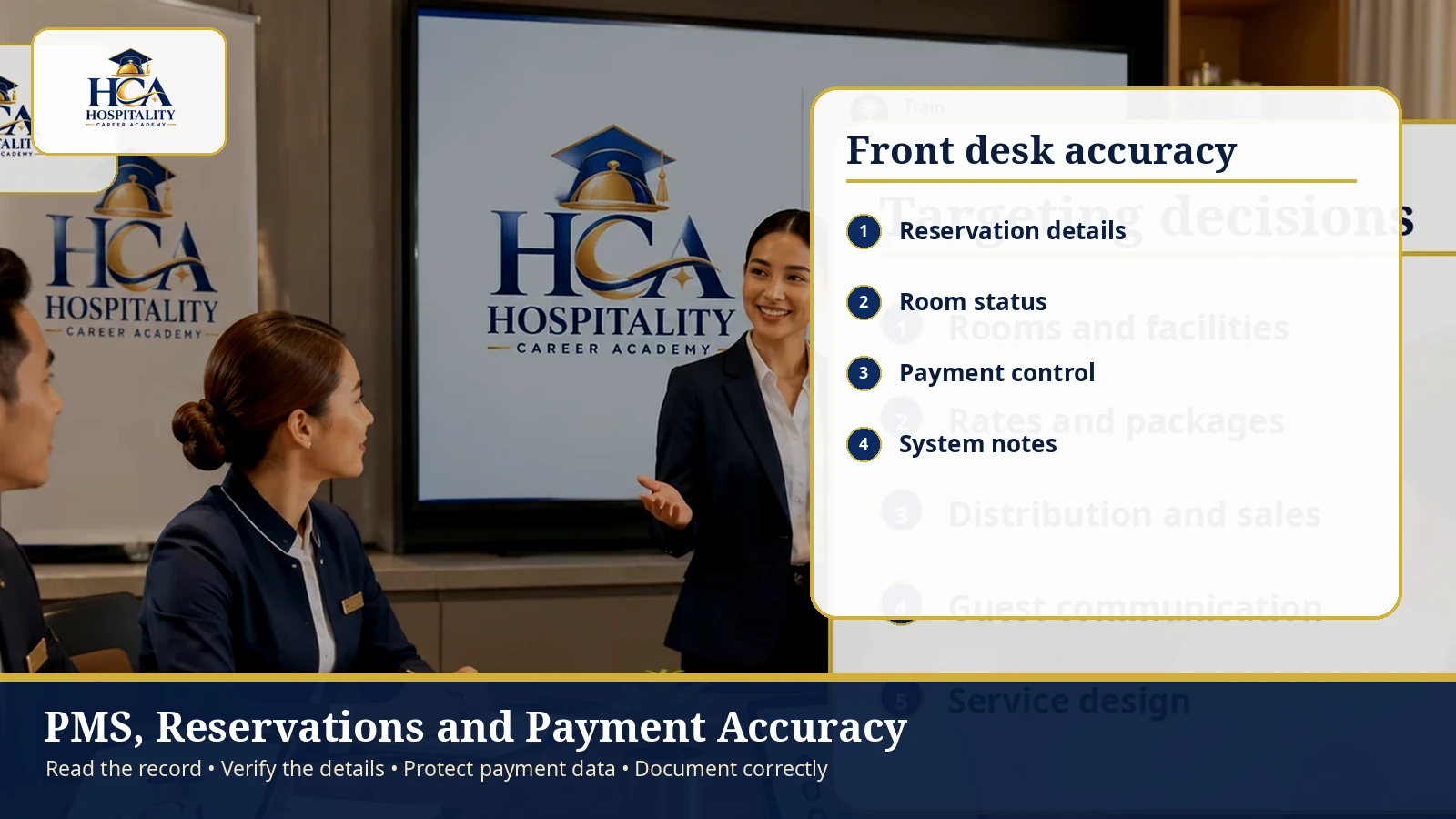
The PMS is central to front desk work, but competence is not measured by speed alone. The receptionist must understand the operational purpose of each action.
A competent receptionist can usually perform or support tasks such as:
- locating the correct reservation;
- checking names, dates, occupancy and room type;
- reading alerts, traces and special requests;
- completing registration fields;
- assigning or changing a room within authority;
- posting or routing approved charges;
- recording deposits and payment authorisations;
- issuing or replacing access credentials securely;
- updating room or guest status where required;
- adding clear notes and handover information;
- preparing or reviewing basic front desk reports.
Every property has different system permissions and procedures. Employees should never copy a transaction from another hotel without confirming the local SOP.
System assessment idea
Give the trainee a sample booking containing three errors and two special requests. Ask them to complete the arrival, explain every control point and show how they verified the final result.
4. Reservation and room knowledge
Receptionists should understand the reservation they are handling. This includes rates, room types, occupancy rules, inclusions, restrictions and the difference between a guest request and a guarantee.
They should be able to explain:
- room-category differences without exaggeration;
- confirmed dates and number of guests;
- included meals or benefits;
- cancellation or guarantee information available to the front desk;
- early arrival and late departure as availability-based unless confirmed;
- linked or shared reservations;
- how a change may affect rate or availability.
Strong room knowledge also supports responsible upselling. A receptionist should recommend an option because it suits the guest, not because it is simply more expensive.
5. Check-in and check-out accuracy
Arrival and departure combine service, finance and security controls. The receptionist must follow the required sequence even when the guest is in a hurry.
Check-in competencies
- confirms the correct guest and reservation;
- verifies identification and registration requirements;
- handles payment or deposit requirements discreetly;
- confirms room readiness and assignment;
- protects room-number and access information;
- explains essential services and policies concisely;
- records unresolved matters and follow-up ownership.
Check-out competencies
- confirms the correct room and guest account;
- reviews charges clearly;
- investigates a disputed item instead of dismissing it;
- completes payment and receipt requirements;
- asks for feedback naturally;
- records any unresolved complaint or promised follow-up;
- ends the interaction with a professional farewell.
6. Payment, cashiering and basic financial control
Receptionists may work with cash, cards, deposits, city ledgers, company arrangements or other property-approved methods. Mistakes can create financial loss and guest distrust.
Core skills include:
- explaining a deposit or authorisation clearly;
- selecting the correct payment type;
- checking approval before completing the transaction;
- following cash-float and shift-closing procedures;
- protecting card and personal data;
- obtaining the required approval for refunds, rebates or corrections;
- reporting a discrepancy immediately;
- never sharing login credentials or using another person’s cashier access.
The receptionist does not need to sound like an accountant. They need to explain the guest-facing part in simple language while following controls precisely.
7. Complaint handling and service recovery
Because the front desk is easy to reach, receptionists receive complaints from every part of the stay. Their first task is to stabilise the interaction and understand the issue, not to defend the hotel.
A practical recovery sequence is:
- listen;
- acknowledge the impact;
- apologise appropriately for the experience;
- confirm facts;
- offer an authorised response;
- give a realistic update time;
- document ownership;
- follow up and close the loop.
A receptionist must also know the limits of their authority. Compensation, room moves, security matters, medical situations and serious allegations may require immediate escalation.
Example response
I understand that the repeated noise has affected your rest, and I am sorry. I will check the available room options and contact the duty manager now. I will update you within ten minutes, even if I am still arranging the final solution.
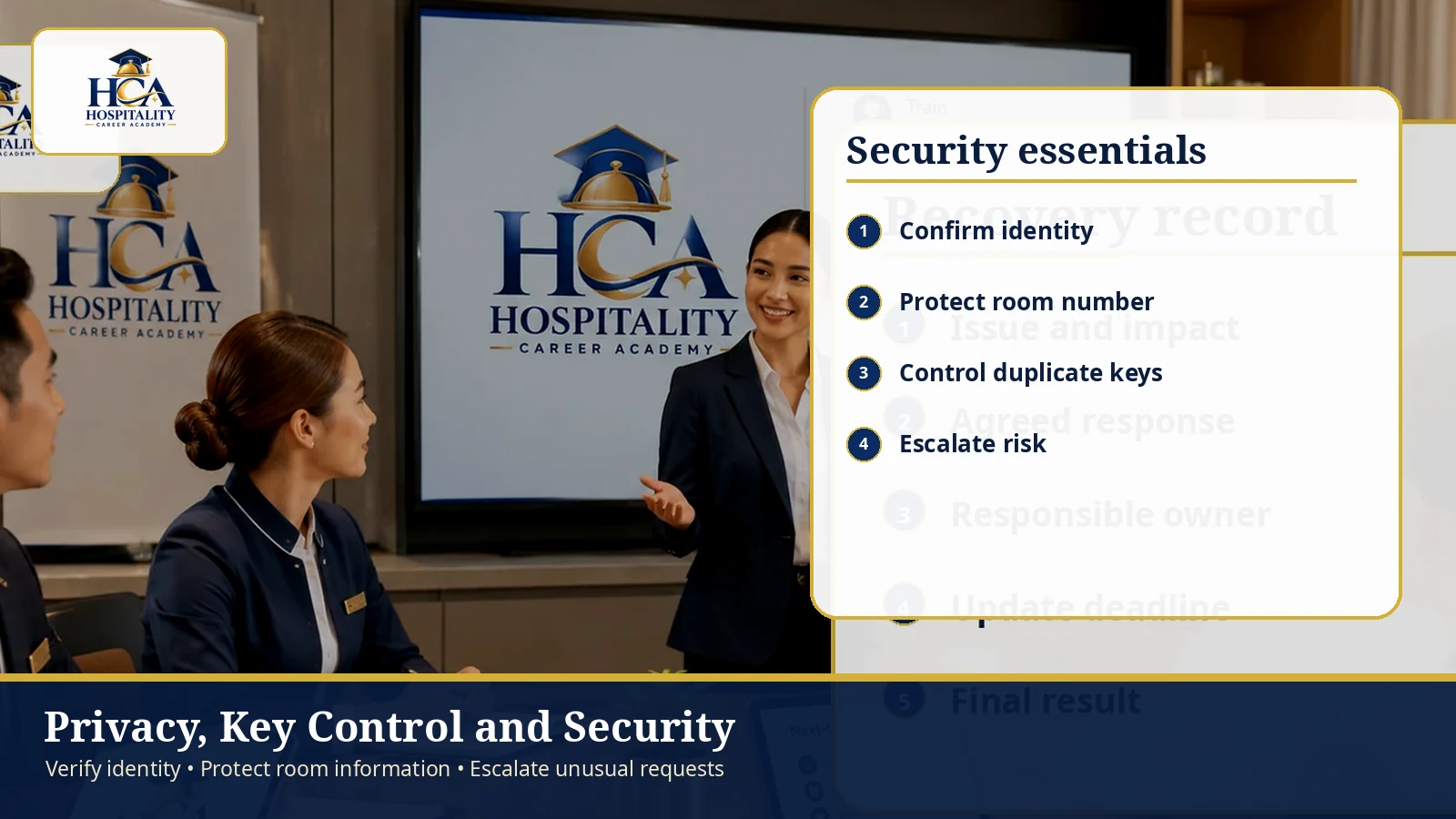
8. Privacy, safety and access control
Receptionists hold sensitive information and control access to guest areas. Helpful service must never override security.
Competent behaviour includes:
- not confirming whether a person is staying without approved verification;
- not saying room numbers loudly;
- verifying identity before issuing replacement keys;
- following visitor and delivery procedures;
- protecting printed registration records and screens;
- recognising suspicious access requests;
- escalating welfare, safety or security concerns promptly;
- avoiding discussion of guest information with unauthorised people.
Privacy training should use scenarios. Rules are easier to apply when employees practise what to say to a caller, visitor, relative, driver or person claiming to know the guest.
9. Telephone, email and digital communication
Front desk service continues across several channels. A receptionist may answer calls, send emails, reply through a guest-messaging platform or coordinate a written handover.
Good digital communication is:
- accurate;
- concise;
- polite;
- correctly addressed;
- free from unnecessary personal data;
- recorded in the approved system;
- clear about the action, owner and response time.
Example email structure:
- Greeting using the correct name.
- Direct acknowledgement of the request.
- Confirmed information or next step.
- Any condition that needs clarification.
- Professional closing and contact route.
10. Local and property knowledge
Guests expect the front desk to know the hotel and provide reliable guidance. Receptionists should understand:
- outlets and operating hours;
- hotel facilities and access rules;
- transport options approved by the property;
- nearby essential services;
- emergency information;
- common destination questions;
- current closures or changes communicated by management.
Never guess. When information is uncertain, say that you will verify it. A confident wrong answer is worse than a short accurate delay.
11. Organisation, prioritisation and handover
Front desk work includes calls, queues, messages, room changes, cash control and follow-up. The receptionist must protect urgent matters while keeping records complete.
A reliable handover states:
- what happened;
- which guest or room is affected;
- what has already been done;
- what is still required;
- who owns the action;
- the promised update or deadline;
- where supporting information is recorded.
Avoid vague notes such as “guest upset—please check.” A useful note allows the next colleague to act without forcing the guest to repeat the story.
12. Responsible upselling and commercial awareness
Receptionists influence revenue through room upgrades, late checkout, breakfast, transport or other relevant services. Selling should be honest, permission-based and connected to the guest’s needs.
Example:
Since you mentioned that you will be working from the room, we have a larger category with a separate desk and lounge area. The additional rate is AED __ per night. May I explain the difference?
Do not hide conditions, create false urgency or promise benefits that are not confirmed.
Receptionist competency matrix
| Competency | Developing | Competent | Strong |
|---|---|---|---|
| Welcome | Uses basic greeting but needs reminders | Welcomes naturally and manages waiting guests | Adapts confidently during pressure and supports others |
| PMS | Completes simple tasks with guidance | Completes normal transactions accurately | Handles complex cases within authority and spots errors |
| Payment | Understands basic steps | Follows approved payment and cashier controls | Explains complex arrangements clearly and identifies risk |
| Privacy | Knows key rules | Applies verification consistently | Recognises unusual requests and coaches safe responses |
| Recovery | Uses a script but may miss ownership | Resolves normal issues and follows up | Stabilises difficult cases and escalates correctly |
| Handover | Records partial notes | Gives complete action-based handover | Prioritises, audits and improves team handover quality |
A practical skills assessment
A fair assessment should include more than questions. Use at least four methods:
- Knowledge check: policies, room types, payments and privacy.
- System task: one arrival, one change and one departure transaction.
- Role-play: delayed room, disputed charge or replacement-key request.
- Live observation: normal guest interaction with a signed evidence record.
The assessor should record the exact behaviour observed, not only a score. If the trainee is not yet competent, assign a specific practice task and a review date.
Common receptionist mistakes

- speaking quickly without checking understanding;
- focusing on the screen and ignoring the guest;
- treating requests as guaranteed promises;
- using weak or incomplete handover notes;
- discussing another department’s mistake in front of the guest;
- issuing access before proper verification;
- promising a time without confirming operational reality;
- using “multitasking” as a reason for errors;
- recommending products without understanding the guest’s need;
- failing to follow up after handing a problem to another department.
Final takeaway
Excellent hotel receptionist skills combine warm service with operational discipline. A strong receptionist communicates clearly, uses the PMS accurately, protects privacy, follows payment controls, manages complaints, coordinates across departments and closes every promise.
These competencies can be learned and assessed. The goal is not a receptionist who performs well only when the lobby is quiet. It is a professional who remains accurate, calm and guest-focused when real hotel pressure begins.
Related HCA guides
- guest-arrival receptionist training
- LEARN model for guest complaints
- Hotel Front Desk Training Checklist
- HCA hospitality courses
Update references
- Hotel, Motel, and Resort Desk Clerks — O*NET OnLine — U.S. Department of Labor
- PCI Security Standards — PCI Security Standards Council
- ISO 22483:2020 — Hotels — Service requirements — International Organization for Standardization
- LEARN Model in Hospitality — Hospitality Career Academy
Frequently asked question
What skills does a hotel receptionist need?
A receptionist needs professional communication, PMS and reservation competence, payment accuracy, privacy and key control, telephone and digital etiquette, problem-solving, complaint handling, product knowledge, cultural awareness and strong handovers.
Explore HCA front office learning