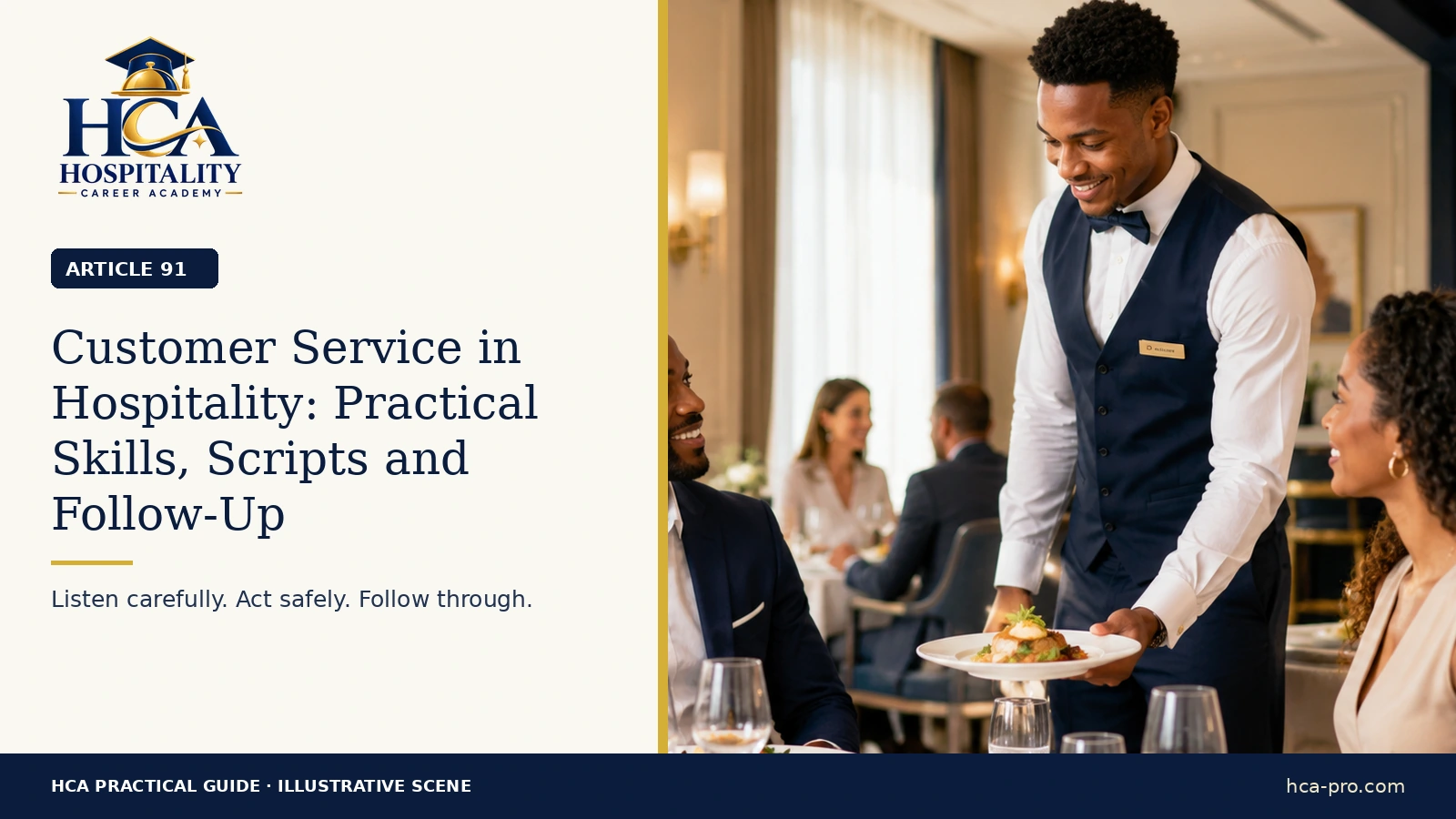
Good hospitality service means helping a guest achieve a reasonable outcome accurately, respectfully and safely. A warm greeting matters, but so do correct information, clear ownership and completing what you promised. An employee who smiles, sends a request to another department and never checks the result has not finished the service.
This guide is for new hotel, restaurant, café and serviced-residence employees. It follows an everyday request from first contact to completion, with practice scenarios for Egypt and the GCC. The scripts and training checklist are HCA teaching suggestions, not a hotel brand’s official standard. Follow your property’s approved procedures and authority limits.
Start with the guest’s actual need

Listen before deciding what the guest wants. “I need a quiet room” could mean avoiding a connecting door, daytime construction, lift noise or a late-night function. Ask one useful question rather than making assumptions: “Is there a particular noise concern you would like us to check?” Then verify available options.
The same principle applies in restaurants. A request for a quick meal is not permission to rush every course. Ask when the guest needs to leave, check realistic preparation times and recommend suitable options. Do not guarantee timing that the kitchen has not confirmed.
US occupational descriptions identify reservations, guest enquiries, record accuracy and coordination with other departments as parts of front-desk work. They provide useful role context, not a universal hotel SOP. [1]
Use a five-part service conversation
Acknowledge, clarify, confirm, act and close is a practical way to remember the work. It is a teaching sequence, not a certification or proprietary industry model.
| Stage | What to do | Example phrase |
|---|---|---|
| Acknowledge | Give the guest your attention without interrupting an urgent task unsafely | “Good afternoon. How may I help?” |
| Clarify | Establish the need, urgency and relevant constraints | “Do you need the transfer for an arrival or a departure?” |
| Confirm | Repeat essential details and explain the next step | “That is a departure tomorrow morning for two passengers.” |
| Act | Complete the authorised task or obtain an accepted handover | “I’ll confirm the vehicle and send you the booking details.” |
| Close | Check the outcome and update the record | “The transfer is confirmed. Have the details reached you?” |
Make the wording natural. A guest should not feel that you are reading a checklist. The checklist supports your thinking; it should not replace listening.
Give a reliable update, not a guessed completion time
Separate two promises: when the job should finish and when you will next update the guest. You may not control an engineering repair, but you can normally control a callback.
For example: “Engineering is assessing the air conditioning. I cannot confirm the repair time yet, but I will update you by 4:15.” Record that commitment and set the property’s approved reminder. Contact the guest before the deadline even when there is no new technical information. Explain what has been checked and the next decision.
When your shift ends, transfer the update commitment to a named colleague who accepts it. A note in a system is not the same as an accepted handover.
Know when to act and when to escalate
Managers should provide a simple authority guide. Employees need to know which requests they may complete, which options require approval and which situations require immediate specialist response.
| Situation | Appropriate boundary |
|---|---|
| Extra towels or directions | Fulfil through the approved process and verify delivery when needed |
| A disputed charge or refund | Check the record and refer to the authorised decision-maker |
| A replacement room key | Follow identity and access procedures; familiarity is not enough |
| A food allergy question | Check approved ingredient information and involve the responsible food-service colleague |
| An injury, threat or serious safety concern | Activate the property’s emergency or security procedure promptly |
| Harassment or discriminatory behaviour | Escalate through the designated reporting route; do not require an employee to tolerate abuse |
Never improvise medication advice, disclose a room number to an unverified visitor, invent an allergen answer or promise an upgrade simply to end a difficult conversation. Escalation can be good service when it brings in the right authority without abandoning the guest.
Practise service recovery without promising everything
A complaint combines a practical problem and its effect on the guest. Acknowledge both. “I understand you have been waiting” is better than arguing about whether the delay was technically acceptable.
ISO’s public description of complaints-handling guidance emphasises an accessible process, resolving complaints and learning from them. HCA’s examples below apply that general principle; they do not reproduce the standard or imply certification. [2]
Illustrative scenario: a room is not ready.
Guest: “You said I could check in, and now I’m waiting.”
Employee: “I’m sorry for the conflicting information. Let me check the room status and the arrival arrangement before I promise a time.”
After checking: “The room is still being inspected. I can arrange luggage storage now and ask the duty manager about the available waiting options. I will return with an update in ten minutes.”
The ten minutes here is a training example, not a mandatory service target. Choose an update time you can meet. If the guest rejects the options, summarise the concern for the duty manager and remain involved until the handover is accepted.
For the detailed complaint-handling sequence, use HCA’s LEARN model guide. This article focuses on everyday service execution, not on replacing that specialist resource.
Make personalisation useful and discreet
Ask permission before arranging an unexpected celebration, entering a room to decorate or using personal details in a public greeting. Confirm preferences directly when appropriate. A request made by one person does not automatically authorise sharing another person’s information.
Record operational facts, not judgements. “Prefers written confirmation” is useful; “difficult guest” is not. Use approved systems and collect only information required for the task. Do not photograph identity documents, payment cards or guest messages with a personal phone.
A returning guest may appreciate recognition but not an announcement about their previous stay. Use names naturally and quietly. Avoid assumptions about relationships, nationality, spending power or preferred language.
Communicate accessibly
Ask how the guest would prefer to communicate. Depending on the situation, a written summary, clearer directions, more time or an approved interpretation service may help. Speak to the guest directly, not automatically to a companion.
The US Department of Justice’s effective-communication guidance illustrates how communication support should respond to the person and the interaction. It is a US legal reference; local obligations and the property’s accessibility procedures govern your workplace. [3]
Do not insist on eye contact, a handshake or one fixed greeting style. Check understanding respectfully: “Would it help if I write the departure time here?” is more useful than repeatedly asking, “Do you understand?”
Keep the request record usable
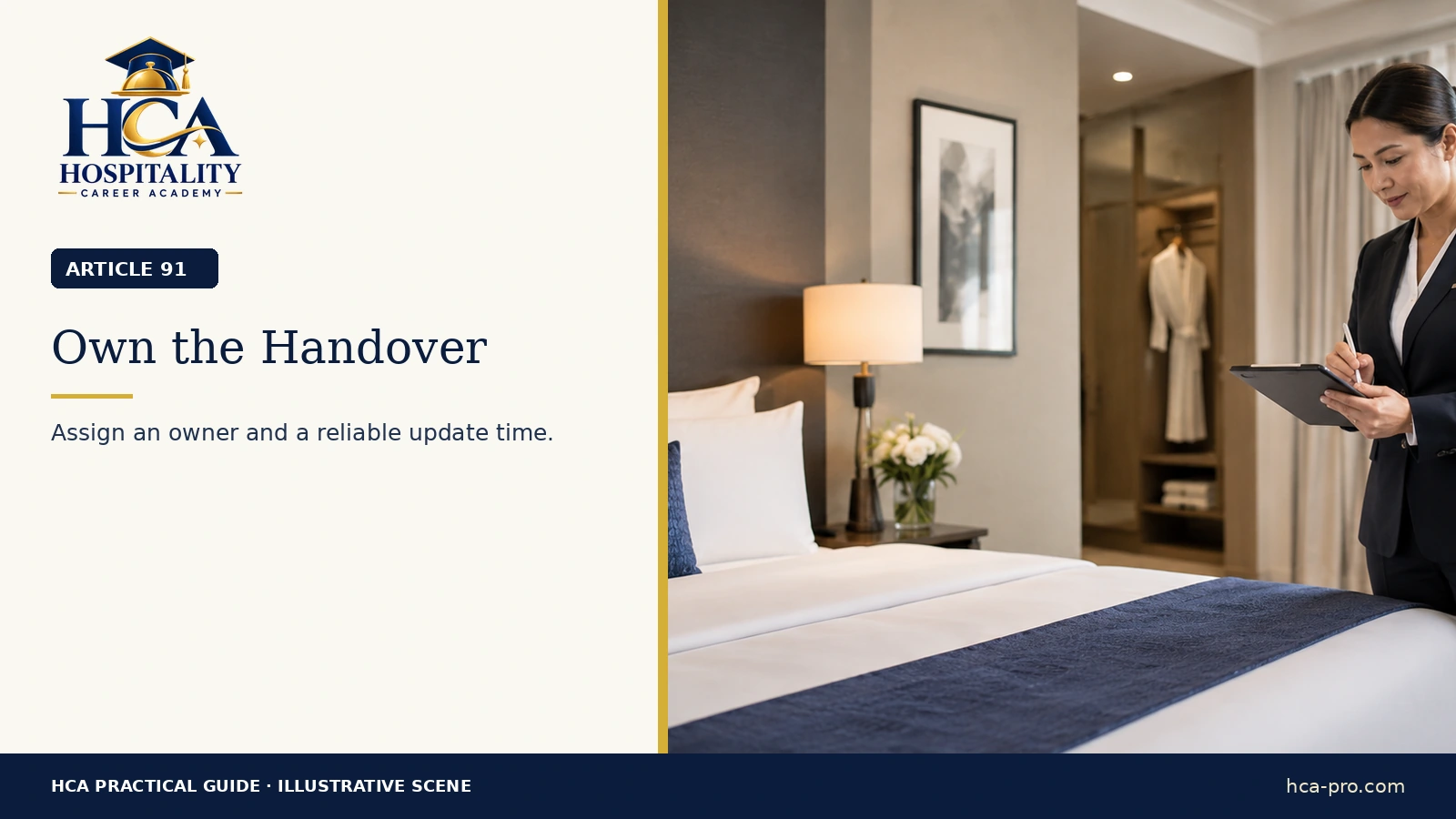
Use the downloadable practice log to capture a case reference, request, action owner, next-update time, action taken, outcome and closure evidence. Use fictional guest details for training.
A useful handover reads: “Case S-014: guest requested a quiet-room option. Duty manager reviewing available inspected rooms. Guest expects a call by 17:00. No move or compensation promised.” It explains what is needed, who owns it and what remains undecided.
A poor handover reads: “Guest unhappy—please follow up.” The next employee must start again, and the guest may need to repeat the story. Review unresolved requests during the shift handover, especially those involving departures, suppliers or a time-sensitive promise.
Run three short practice exercises
Restaurant timing: A guest has forty minutes before a meeting. The learner clarifies the deadline, checks realistic choices with the kitchen, confirms the order and monitors progress. Passing behaviour is accurate coordination, not promising the fastest service in the city.
Residence delivery: A visitor asks whether a named resident is home. The learner protects occupancy information and follows the approved contact procedure. Courtesy does not override privacy.
Late towel request: A request crosses a shift change. The learner obtains acceptance from the next owner and checks delivery. The trainer changes one detail midway to test whether the learner updates the record rather than relying on memory.
Use a simple observation scale: not demonstrated, demonstrated with support, demonstrated independently. Assess listening, accuracy, privacy, authority, ownership and closure separately. A high overall score must not cancel a serious safety or access-control error.
Build the habit over four weeks
In week one, practise greeting, clarification and accurate repeat-back. In week two, handle routine requests with supervision and review incomplete handovers. In week three, practise complaints and escalation using fictional cases. In week four, demonstrate a complete request cycle and agree one improvement with the supervisor.
The supervisor should distinguish a training gap from a system gap. An employee cannot give accurate availability when the inventory is wrong, or reliably deliver amenities that are out of stock. Record the process problem and assign it to management rather than labelling every failure as poor attitude.
Review service quality without misleading targets
Track commitments kept, cases requiring repeated contact, incomplete handovers and a sample of guest feedback. Define each measure before using it. A low complaint count may mean fewer problems, but it can also mean guests do not know how to report them.
Use feedback to choose an action: clarify a policy, improve a handover field, adjust stock or coach a specific behaviour. Never offer a benefit in exchange for a positive review or pressure a guest to remove a truthful complaint.
Practical HCA working resource supplied with this article.
Download Hospitality Service Observation and Follow-Up Log (CSV)
Related HCA guides
Update references
- Mastering Customer Service: A Guide for Aspiring Hospitality Professionals — Hospitality Career Academy
- Hotel, Motel, and Resort Desk Clerks — O*NET OnLine
- ISO 10002:2018 public scope — ISO
- Effective Communication — US Department of Justice
Frequently asked questions
Should I always offer compensation when a guest complains?
No. First understand the problem and its impact, then offer actions within your authority. Compensation requires the property’s approval rules and should not replace fixing the underlying issue.
How can a beginner practise without handling real guest data?
Use fictional bookings, mock messages and role-plays. Demonstrate the service steps and record quality without copying real guest, payment or identity information.
Put the guide into practice

Use the accompanying service observation and follow-up log for one practice case per shift. For related learning, explore the front desk training checklist and hospitality greetings guide.
Sources and scope
[1] O*NET: Hotel, Motel, and Resort Desk Clerks. Occupational context, not a property-specific procedure.
[2] ISO 10002:2018 public scope. Complaints handling and organisational learning; full standard not reproduced.
[3] US Department of Justice: Effective Communication. US jurisdictional reference. All dialogues, observation tools and practice plans are illustrative HCA editorial material.
Frequently asked question
Should I always offer compensation when a guest complains?
No. First understand the problem and its impact, then offer actions within your authority. Compensation requires the property’s approval rules and should not replace fixing the underlying issue.
Hospitality Service Observation and Follow-Up Log