
A “dream job” in hospitality is not simply the most famous hotel or the most impressive title. It is the next role that matches your skills, gives you room to grow and moves you toward the career you actually want. For one person, that may be a first receptionist position. For another, it may be a restaurant supervisor role, a move into reservations or a management opportunity in another country.
The challenge is that many candidates search without a clear target. They send the same CV everywhere, prepare only after receiving an interview and judge opportunities mainly by the property name. A stronger approach is to treat the job search like a hospitality operation: define the guest—in this case, the employer—understand the need, prepare the right evidence and follow up professionally.
This guide gives hospitality students, entry-level applicants and experienced professionals a practical system they can use across hotels, resorts, restaurants, cafés, serviced residences and other guest-service businesses.
1. Define the exact role you are targeting
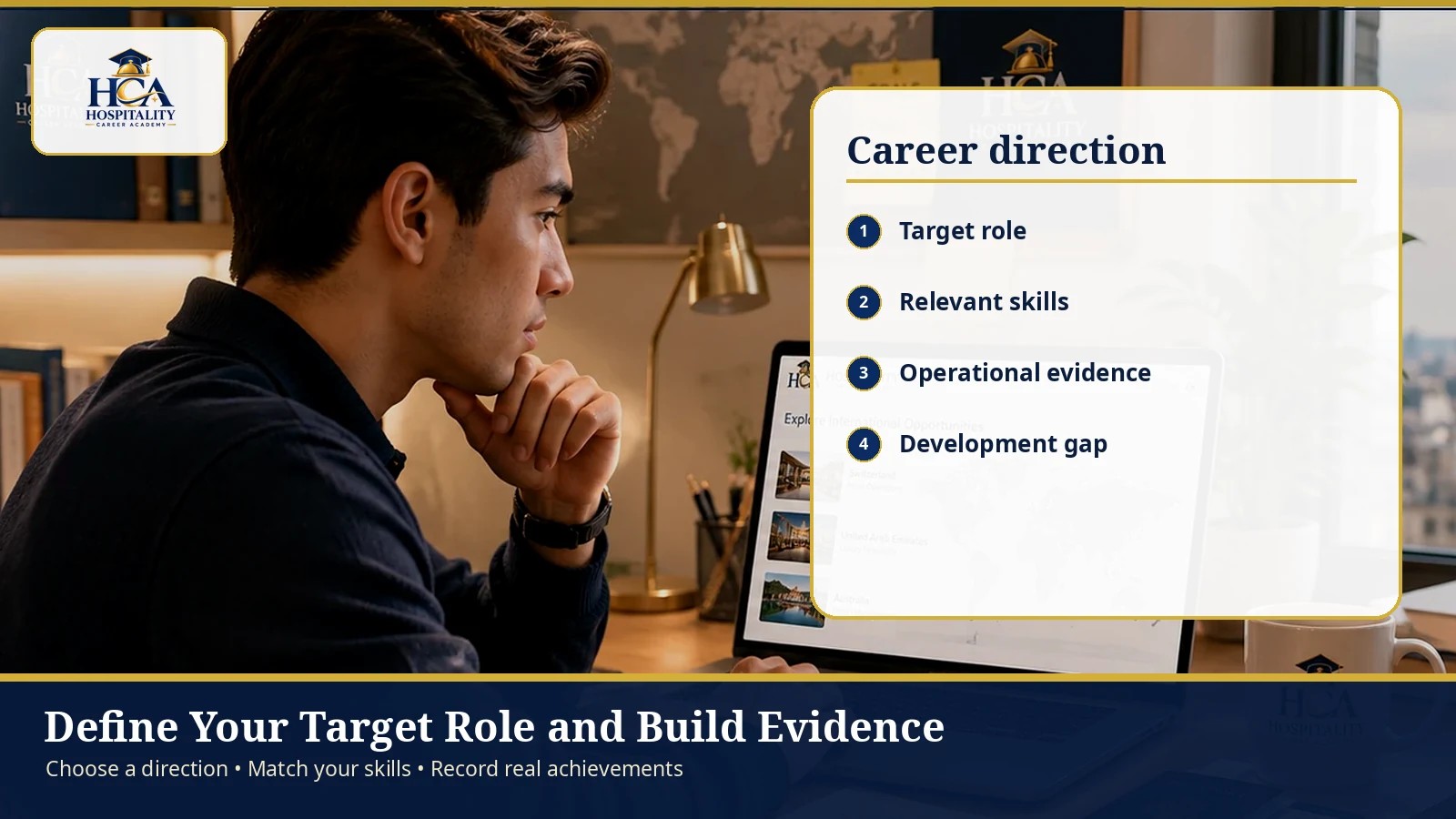
Before updating your CV, decide what you are applying for. “Any job in a hotel” is too broad. A recruiter cannot clearly understand your value if you cannot explain your direction.
Write a simple target statement covering:
- the department you want to join;
- the level that matches your current experience;
- the type of property or operation you prefer;
- the location or market you can realistically work in;
- the systems, languages or technical skills you can offer;
- the next skill you want to develop.
For example:
I am targeting a front desk agent role in a full-service hotel in Dubai or Abu Dhabi where I can use my guest-service experience, English and Arabic communication, and Opera PMS knowledge while developing stronger cashiering and upselling skills.
This statement is not meant to appear exactly as written in every application. It is your internal filter. It helps you choose suitable vacancies and prevents you from applying randomly.
2. Build a hospitality CV based on evidence
A strong hospitality CV should answer three questions quickly:
- What type of role are you suited for?
- What have you already done well?
- What operational value can you bring?
Keep the layout clean and easy to scan. Use clear headings, consistent dates and simple formatting. Decorative design is less important than readable evidence.
What to include
- Professional profile: Two or three lines connecting your experience, department and target role.
- Core hospitality skills: Only skills you can genuinely demonstrate.
- Employment history: Responsibilities plus evidence of results or trusted duties.
- Systems: PMS, POS, reservations, reporting or communication tools you have used.
- Languages: State your realistic level.
- Training and certificates: Include relevant, current learning.
- Achievements: Guest recognition, audit results, promotions, training contributions or measurable improvements.
Turn duties into evidence
Weak CV statement:
Responsible for checking guests in and out.
Stronger CV statement:
Managed guest check-in and check-out, verified payment and registration requirements, coordinated room-status issues and supported service recovery during high-occupancy shifts.
The stronger version does not invent a percentage. It shows operational range and responsibility.
Use numbers only when you can explain where they came from. Do not claim to have increased guest satisfaction by 30% unless you can identify the measurement and your contribution. Honest evidence is more credible than dramatic but unsupported claims.
3. Match every application to the vacancy
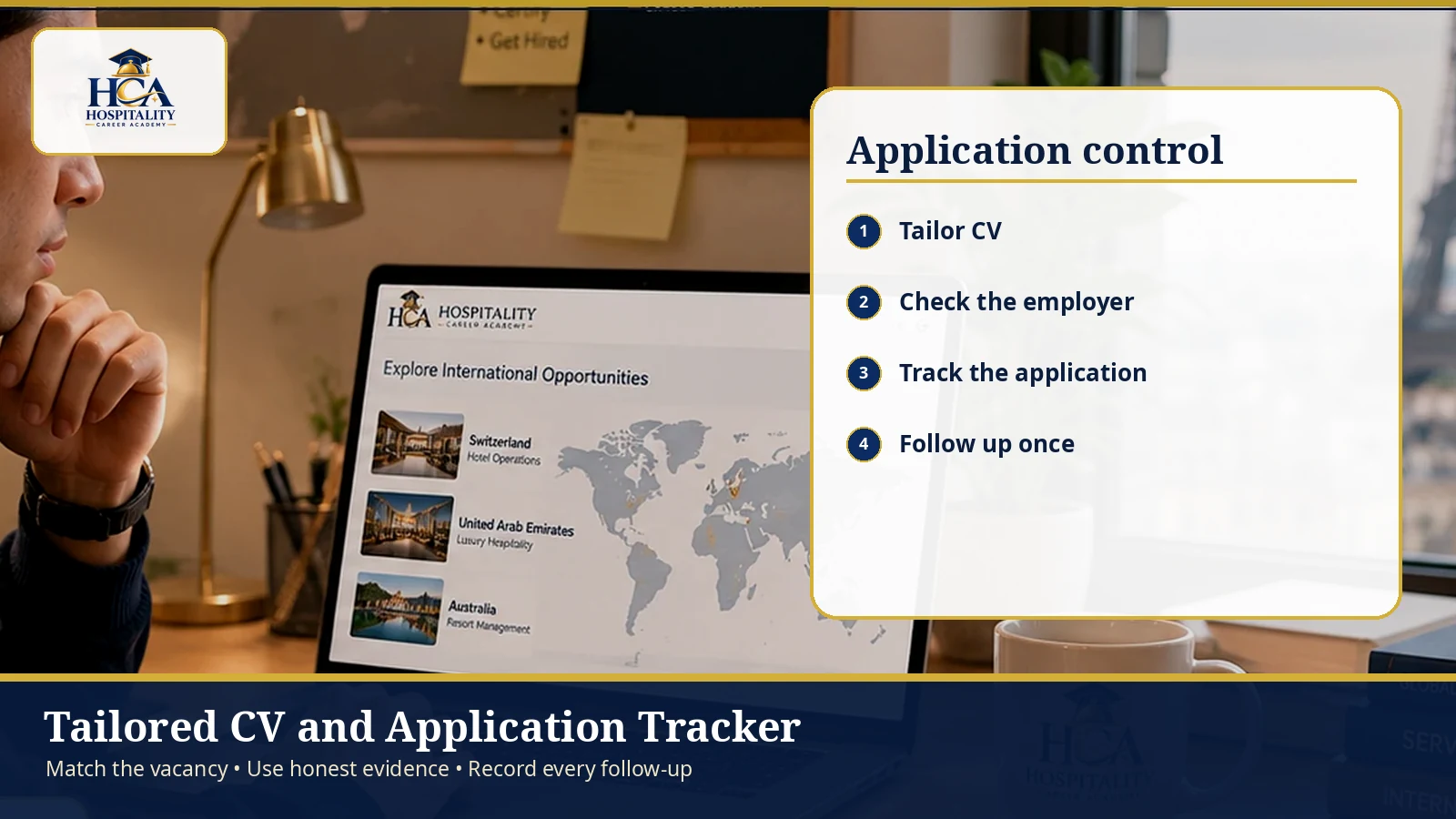
Sending one generic CV to every employer usually weakens the application. The role description tells you what the employer considers important. Read it carefully and compare it with your experience.
Create a simple matching table:
| Employer requirement | Your relevant evidence |
|---|---|
| Opera PMS experience | Used Opera Cloud for check-in, room moves and cashiering |
| Complaint handling | Resolved guest concerns and followed cases through shift handover |
| Upselling | Presented room or dining options using benefit-led language |
| Teamwork | Coordinated with housekeeping, reservations and engineering |
Use the employer’s terminology when it is accurate, but never copy requirements you do not meet. If a vacancy asks for supervisory experience and you have only supported briefing or training, describe that truthfully rather than changing your title.
A short application message should include:
- the exact role you are applying for;
- one or two reasons you match it;
- your availability or location where relevant;
- a professional closing and correct contact details.
4. Search through several channels
Hospitality vacancies are found in different places. Relying on one job site limits your opportunities.
Use a balanced search that includes:
- hotel and restaurant career pages;
- the HCA hospitality jobs platform;
- reputable recruitment platforms;
- professional networking sites;
- referrals from trusted colleagues;
- career fairs and hospitality events;
- direct applications where the employer accepts them.
Track every application. A basic spreadsheet or notebook can include:
- employer and property;
- job title;
- application date;
- source of vacancy;
- contact person if known;
- interview status;
- follow-up date;
- final outcome;
- lesson learned.
Without a tracker, candidates often apply twice, forget follow-up dates or fail to recognise which CV version is producing interviews.
5. Build a bank of interview stories
Hospitality interviews frequently test behaviour, not only knowledge. Employers want to know how you act with guests, colleagues and pressure.
Prepare six short stories before the interview:
- A guest complaint you helped resolve.
- A busy shift or difficult operational period.
- A teamwork or cross-department example.
- A mistake you learned from.
- A time you sold, recommended or improved something.
- A moment when you took responsibility without waiting to be told.
Use the STAR-L structure:
- Situation: What was happening?
- Task: What were you responsible for?
- Action: What did you personally do?
- Result: What happened next?
- Learning: What would you repeat or improve?
Keep each story focused. Do not spend two minutes explaining the background and ten seconds explaining your action. The interviewer is assessing your judgement and contribution.
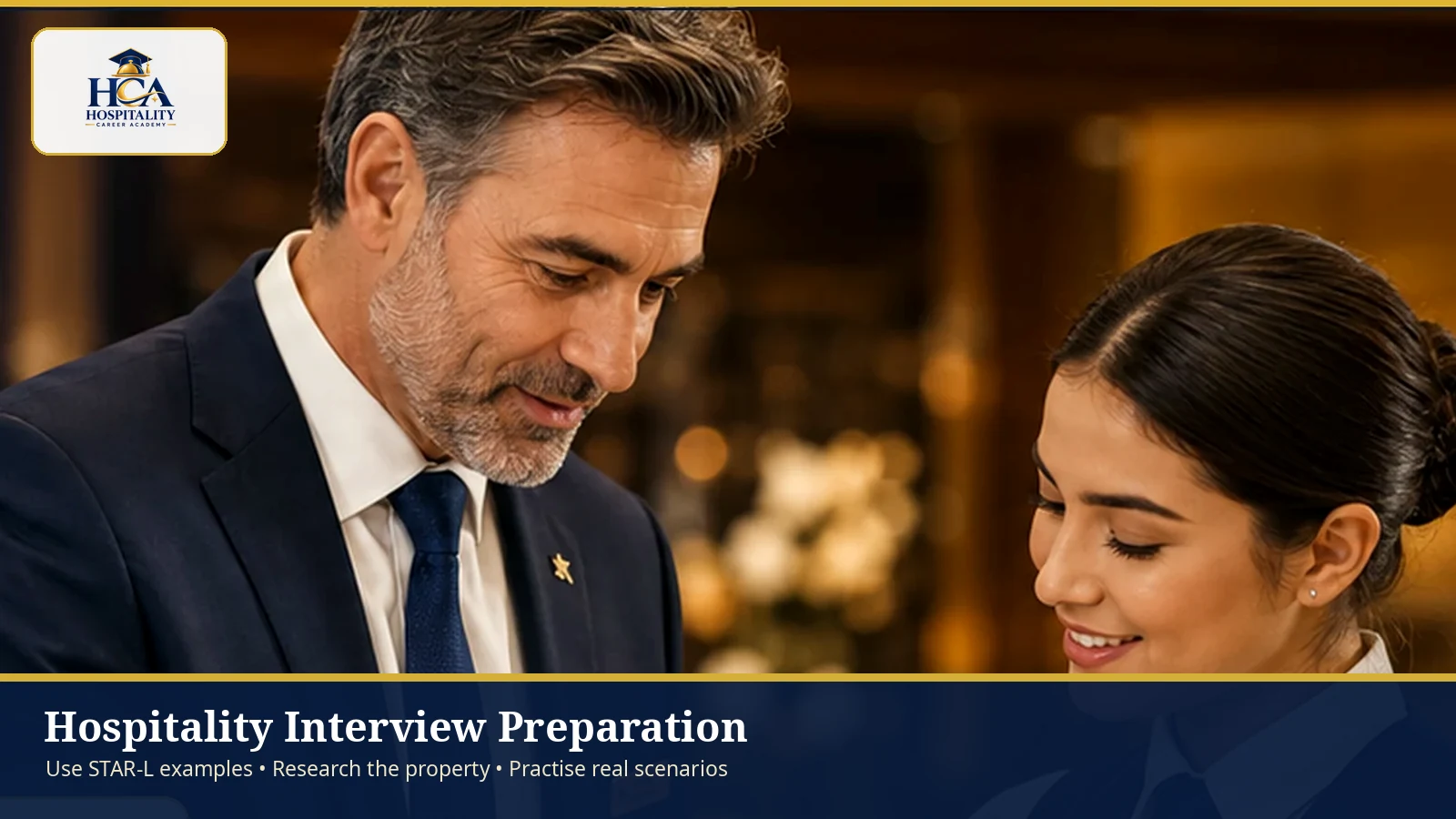
6. Treat the interview as a service moment
A hospitality interview begins before the first question. Your punctuality, grooming, greeting, eye contact and preparation all communicate how you may behave with guests.
Before attending:
- research the property, brand, location and main services;
- read the vacancy again;
- prepare examples connected to the role;
- confirm the interview time and format;
- plan your journey and arrive with a safe time margin;
- bring copies of your CV and relevant documents if requested.
During the interview:
- answer the question directly before adding detail;
- use real examples rather than general promises;
- avoid criticising previous employers;
- show curiosity about standards, training and team structure;
- ask thoughtful questions at the end.
Useful questions include:
- What does strong performance look like during the first three months?
- Which systems and standards are most important in this role?
- What training or cross-exposure is available?
- What are the busiest operational challenges for this team?
7. Prepare for practical assessments
Many hospitality employers use practical tests because guest-facing work cannot be judged from a CV alone.
Examples may include:
- a mock check-in or complaint-handling scenario;
- carrying a tray or explaining a menu item;
- making a room or identifying housekeeping defects;
- entering a reservation into a system;
- writing a guest email;
- completing a basic cashiering or calculation exercise;
- leading a short briefing for a supervisory role.
Ask what to expect if the employer provides an opportunity to clarify. Then practise the process, not a memorised performance. Assessors usually notice when a candidate understands the standard rather than repeating a script without judgement.
8. Follow up professionally
After an interview, send a short thank-you message within a reasonable period. Mention the role, thank the interviewer and briefly confirm your interest. Do not send repeated daily messages.
If the employer gives a decision date, wait until that date passes before following up. A professional follow-up can be simple:
Thank you again for meeting with me regarding the Front Desk Agent position. I appreciated learning more about the team and the property’s arrival standards. I remain very interested in the opportunity and would be grateful for any update when convenient.
If the answer is no, ask politely whether the recruiter can share one development point. Not every employer will respond, but useful feedback can improve your next application.
9. Evaluate the offer—not only the title
A job offer should be reviewed carefully. Confirm the official terms through the employer’s approved process. Look beyond the job title and consider:
- actual duties and reporting line;
- salary and benefits stated in writing;
- working hours and days off;
- location and transport impact;
- accommodation or meals where applicable;
- probation and notice terms;
- learning, exposure and promotion potential;
- visa or work-authorisation arrangements;
- the reputation and legitimacy of the employer.
Be cautious if someone asks for unofficial recruitment fees, requests sensitive documents through an unverified account or promises a role without a credible selection process. Verify the company and communication channel before sharing personal information or making any payment.
A practical 30-day hospitality job-search plan
Days 1–5: Choose and prepare
- Define one primary target role and one realistic alternative.
- Audit your CV and remove vague or unsupported claims.
- Prepare a professional profile and skills section.
- Update your contact details and online profile.
Days 6–10: Build evidence
- Write six STAR-L interview stories.
- Collect certificates and proof of systems or training experience.
- Prepare role-specific CV versions.
- Create your application tracker.
Days 11–20: Apply with quality
- Search several channels each day.
- Apply only where there is a reasonable match.
- Tailor the application message and key CV wording.
- Contact trusted professional connections respectfully.
Days 21–25: Practise interviews
- Record yourself answering common questions.
- Practise one operational role-play.
- Review grooming, body language and speaking pace.
- Research each employer before the interview.
Days 26–30: Review and improve
- Check which applications generated responses.
- Improve weak sections of your CV or interview stories.
- Follow up on applications at the correct time.
- Set the next month’s target based on evidence.
Final application checklist
Before pressing send, confirm:
- The role matches my realistic experience and direction.
- The company and vacancy appear genuine.
- My CV is tailored and free from spelling or date errors.
- My achievements are honest and explainable.
- My contact details are correct.
- The attached filename is professional.
- My application message is brief and specific.
- I recorded the application and follow-up date.
Final takeaway
Landing the right hospitality job requires more than sending many applications. It requires direction, evidence, preparation and professional follow-up. Define the role you want, show what you can genuinely do, practise real examples and review every opportunity carefully.
The strongest candidate is not always the person with the longest experience. Often, it is the person who understands the role, communicates clearly and makes it easy for the employer to see how they can contribute from the first shift.
Related HCA guides
- free HCA hotel CV builder
- current hospitality jobs
- five ways to advance your hospitality career
- ten essential hospitality skills
Update references
- Hotel, Motel, and Resort Desk Clerks — O*NET OnLine — U.S. Department of Labor
- Lodging Managers — O*NET OnLine — U.S. Department of Labor
- Job Scams — U.S. Federal Trade Commission
- HCA Free Hotel CV Builder — Hospitality Career Academy
- HCA Hospitality Jobs — Hospitality Career Academy
Frequently asked question
How can I improve my chances of getting a hospitality job?
Choose a clear target role, tailor your CV to the vacancy, use honest examples of operational value, apply through verified channels, practise role-specific interview scenarios and follow up professionally.
Create your free hospitality CV