Luxury service is not simply formal language, expensive surroundings or saying yes to every request. It is the disciplined ability to make service feel effortless while protecting privacy, accuracy, safety and the guest’s freedom to choose.
In a luxury hotel, resort or residence, guests may expect faster recognition, stronger product knowledge, discreet coordination and thoughtful personalisation. Those expectations should never encourage employees to guess, intrude or promise what the operation cannot deliver. Effective luxury-service training therefore combines warmth with judgement and attention to detail with reliable follow-through.
This guide gives trainers and hospitality leaders a practical framework for teaching, practising and assessing luxury service.
Define luxury service as a set of behaviours
Words such as exceptional, personalised and five-star are too vague to train on their own. Convert them into observable standards.
Luxury service can be recognised when an employee:
- prepares before the guest needs to repeat information;
- acknowledges the guest without creating a public display;
- listens carefully and notices relevant cues;
- offers choices instead of making assumptions;
- explains products with confidence and honesty;
- coordinates across departments without exposing internal complexity;
- protects privacy and personal data;
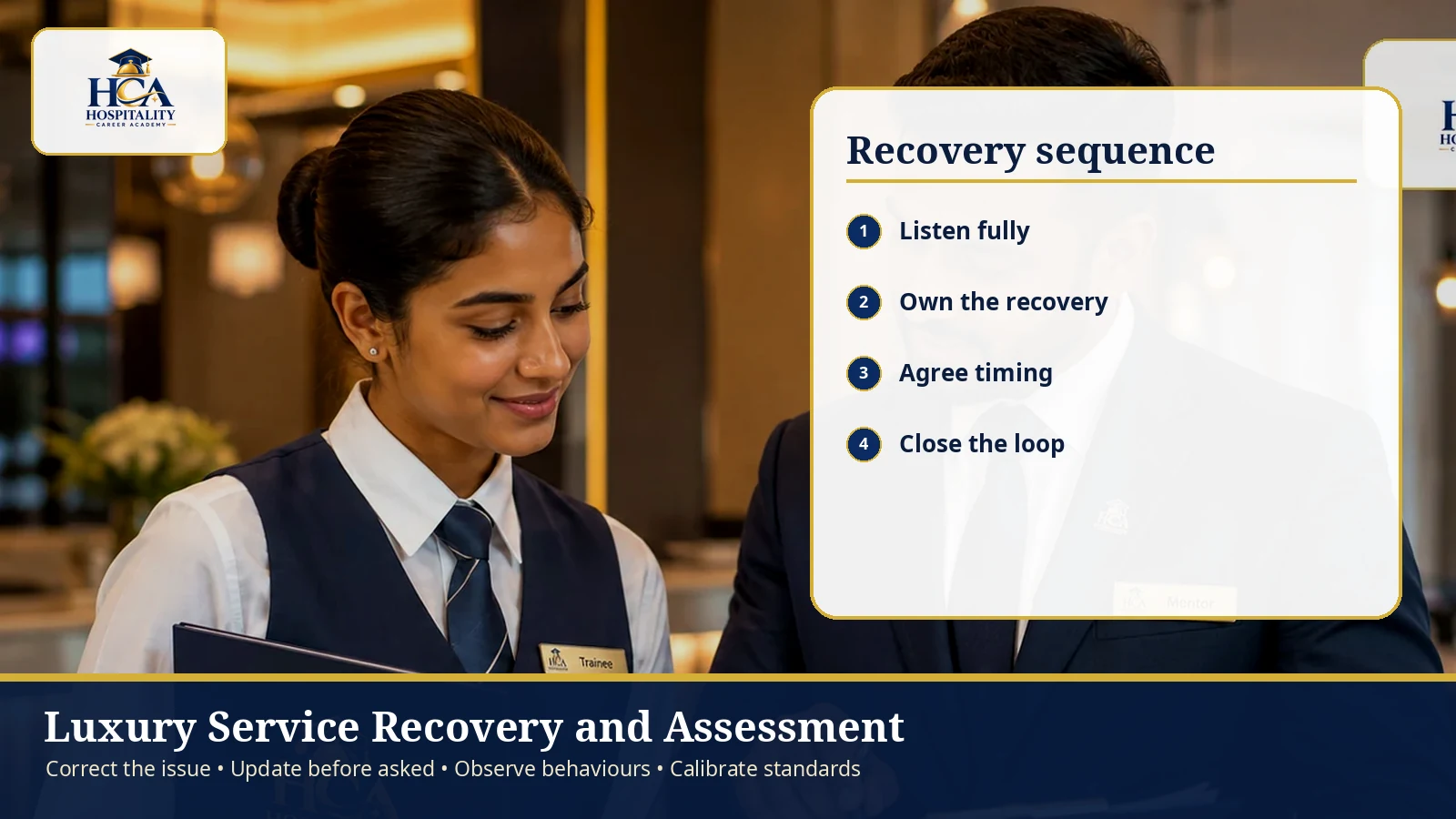
- owns the next step and gives a realistic update;
- closes the loop after delivery;
- remembers approved preferences without becoming intrusive.
The result should feel natural to the guest even though the operation behind it is highly organised.
1. Begin with presence, grooming and controlled body language
Luxury service starts before the employee speaks. Uniform condition, grooming, posture, movement and awareness communicate respect for the guest and the environment.
Training should cover:
- complete, clean and correctly fitted uniform;
- discreet name badge and accessories;
- polished but natural grooming;
- calm walking pace and controlled gestures;
- professional distance;
- correct way to guide rather than point;
- awareness of doors, luggage, seating and guest movement;
- avoiding private conversations or personal phone use in guest areas.
This is not about creating identical personalities. Employees can remain genuine while meeting the property’s professional presentation standard.
Practice exercise
Record a thirty-second welcome from the moment the employee notices the guest. Review posture, facial expression, hand movement, distance, voice and whether the employee recognised companions appropriately.
2. Teach discreet recognition—not performance
Recognition should make the guest feel known, not watched. Train employees to use available, approved information carefully.
Appropriate recognition may include:
- welcoming a returning guest by name when privacy allows;
- acknowledging a confirmed occasion;
- recalling a documented preference relevant to the current stay;
- recognising the guest’s time pressure;
- coordinating a requested arrangement before arrival.
Avoid:
- loudly announcing VIP status;
- mentioning private stay history in front of others;
- revealing who is accompanying the guest;
- referring to information obtained from personal social media;
- surprising the guest with something that could expose a private occasion;
- acting as if every preference is permanently valid.
Use permission-based language:
We have noted your previous preference for a quiet table. Would you like us to arrange the same this evening, subject to availability?
The guest remains in control.
3. Build deep product and destination knowledge
Luxury guests expect confident guidance. Employees should know more than opening hours. They should understand differences, benefits, limitations and which questions to ask before recommending something.
Knowledge training may include:
- room and suite features;
- dining concepts and signature dishes;
- ingredients, dietary information and allergens;
- spa treatments and suitability boundaries;
- transport options and timing;
- local cultural, shopping and destination information;
- family, business and accessibility services;
- booking conditions, availability and cancellation requirements;
- alternative options when the first choice is unavailable.
A recommendation should connect to the guest’s stated need.
Weak recommendation:
This is our most expensive suite and our best option.
Stronger recommendation:
Since you need a private area for two short meetings, the executive suite provides a separate living room and guest washroom. May I explain the rate and availability?
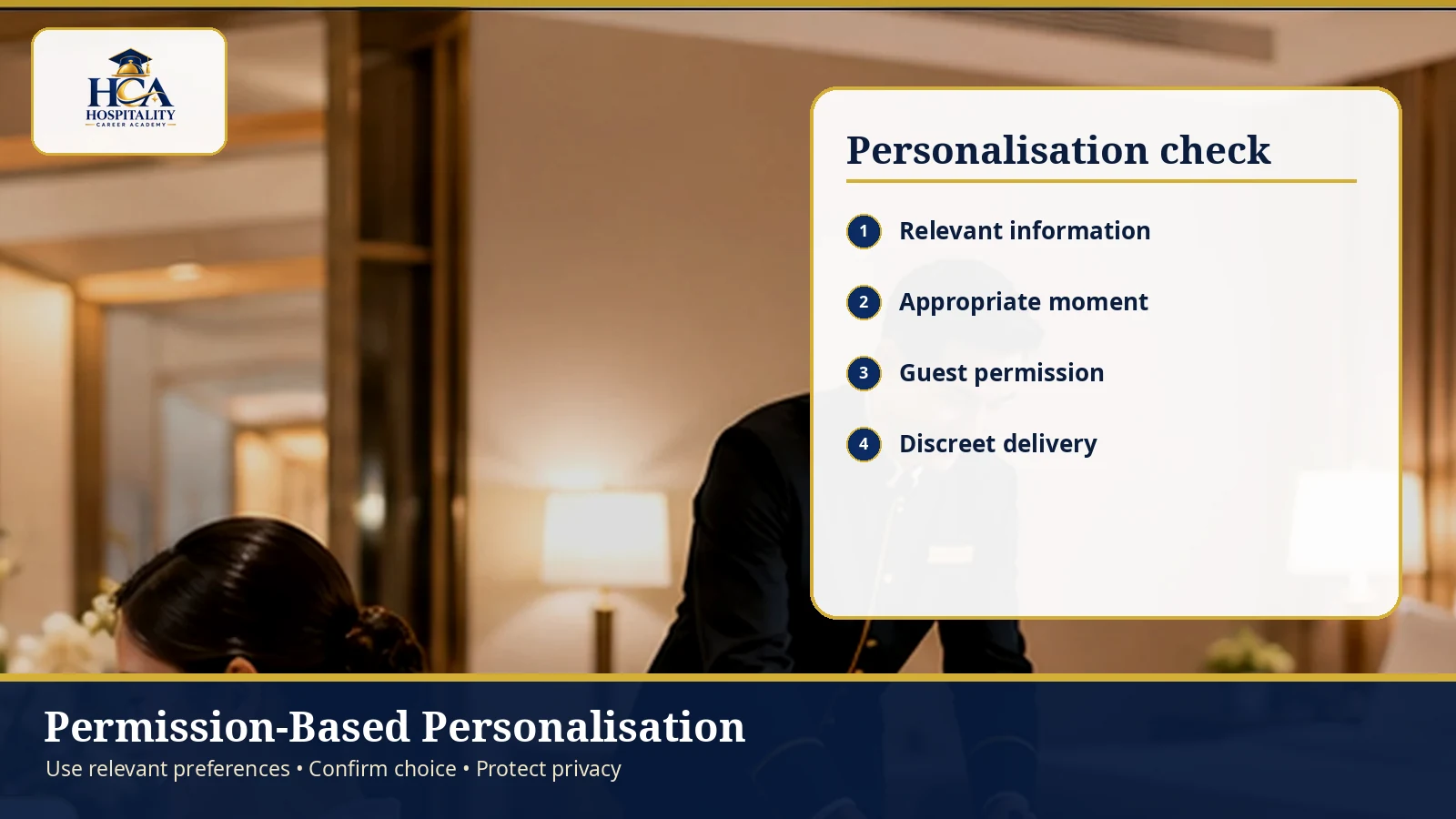
4. Train permission-based personalisation
Personalisation is useful when it reduces effort or creates relevance. It becomes intrusive when the employee assumes preferences, collects unnecessary information or draws attention to something private.
A safe personalisation sequence is:
- Observe or receive an approved preference.
- Confirm that it is relevant to the current interaction.
- Ask permission where appropriate.
- Record only necessary information in the approved system.
- Share it only with colleagues who need it for delivery.
- Confirm whether the preference should continue.
Examples:
- offering a previously requested pillow type rather than placing it without confirmation;
- asking whether the guest would like the same transfer arrangement;
- confirming dietary needs for the current event;
- offering a quiet seating option after the guest says they need a private conversation.
Luxury is not knowing everything about the guest. It is using the right information respectfully.
5. Practise anticipation without guessing
Anticipatory service means preparing for a likely need using reliable cues. It is not mind-reading.
Appropriate anticipation may include:
- offering luggage assistance when the guest is carrying several items;
- arranging water while a guest waits after a long journey;
- confirming a car before a time-sensitive departure;
- preparing a child-friendly option after the family requests it;
- checking accessibility requirements before assigning a route or table.
Inappropriate anticipation includes assuming religion, marital status, health, diet, wealth, tipping behaviour or reason for travel.
Teach employees to convert observation into a respectful question:
I can see you have a departure shortly. Would you like me to confirm the car and travel time now?
6. Make invisible coordination visible to the team
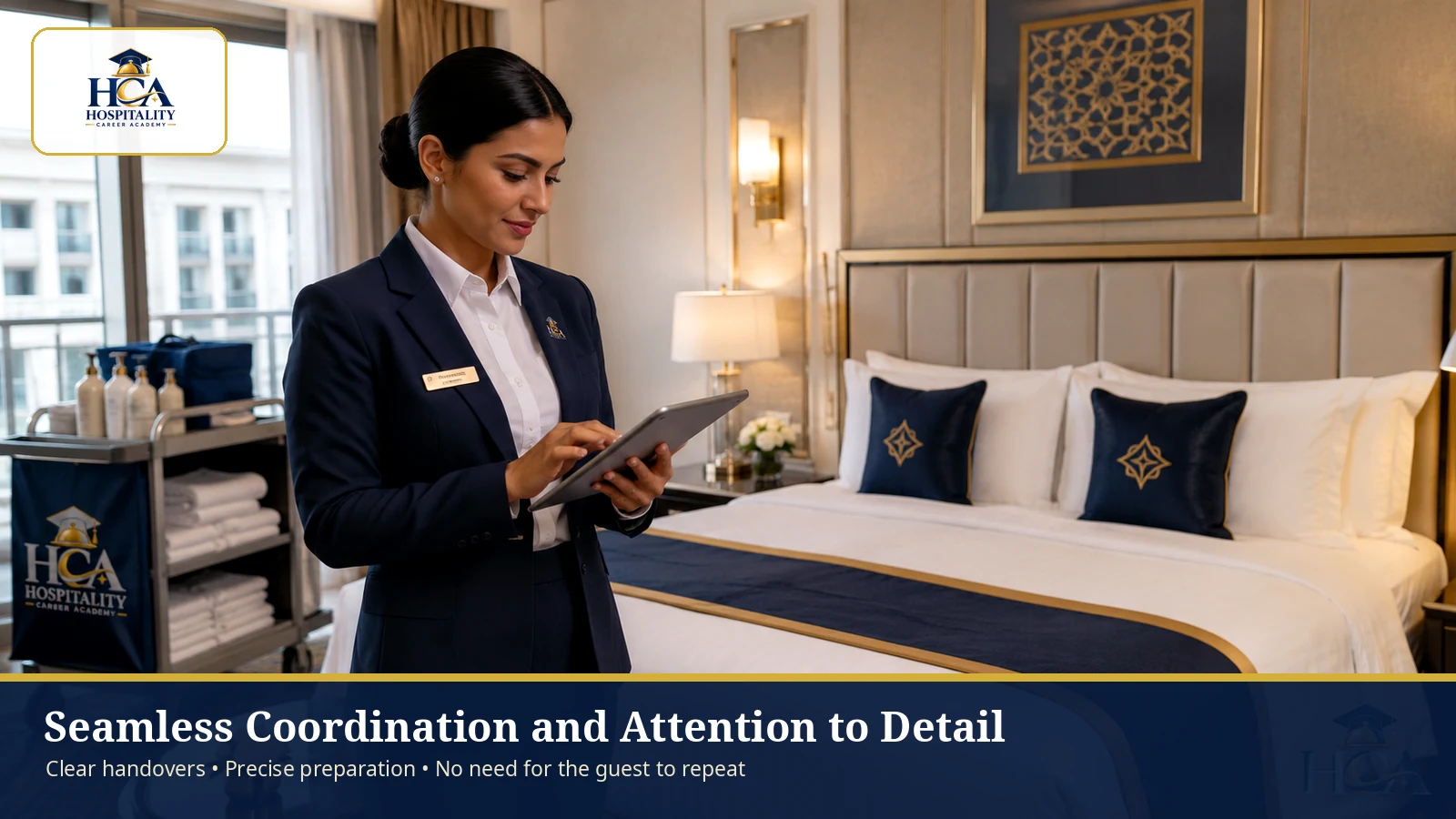
The guest should not have to manage the hotel’s departments. Luxury service depends on complete handovers and clear ownership behind the scenes.
A strong internal handover includes:
- guest or reservation identifier;
- confirmed request;
- relevant preference or restriction;
- agreed delivery time;
- responsible department and individual;
- contingency if the first option fails;
- final confirmation requirement.
Poor internal message:
VIP needs something special tonight.
Useful internal message:
Suite 1204 requested a quiet two-person dinner at 8:30 pm, no shellfish, with minimal interruption. Restaurant supervisor has confirmed table 14. Concierge will call transport at 10:15 pm. F&B supervisor owns final confirmation by 7:30 pm.
Only necessary information should be shared, and always through approved channels.
7. Train language that is polished and natural
Luxury language should be respectful, clear and confident. It should not sound old-fashioned, overly submissive or artificial.
Replace negative or uncertain wording
Instead of:
I don’t know.
Use:
I will verify that and return with an accurate answer by 4:15 pm.
Instead of:
That’s not my department.
Use:
I will connect you with the colleague responsible and make sure the request is handed over completely.
Instead of:
You have to wait.
Use:
The final preparation will take approximately fifteen minutes. May I arrange a comfortable place for you while I monitor it?
Do not hide facts behind elegant language. If something is unavailable, say so clearly and present realistic alternatives.
8. Give employees a recovery authority matrix
Luxury service failures can feel more serious because expectations and prices may be higher. Employees need to know what they can do immediately, what requires approval and what must be escalated.
The authority matrix may define:
- service gestures available by role;
- room-change authority;
- food replacement or removal authority;
- transport or amenity alternatives;
- financial limits for rebates or recovery;
- mandatory escalation for safety, security, privacy, discrimination, medical issues or serious allegations;
- documentation and follow-up requirements.
A luxury employee should not promise an upgrade, refund or complimentary service merely to end the conversation. The response must be appropriate, authorised and deliverable.
Recovery script
I am sorry the private transfer did not arrive at the confirmed time. I understand that this has affected your appointment. I am arranging the fastest approved alternative now and have involved the duty manager. I will update you within five minutes and remain your point of contact until the transport is confirmed.
9. Respect cultural intelligence without stereotyping
Luxury hotels welcome guests from many cultures. Cultural intelligence means being observant, respectful and willing to ask—not using stereotypes.
Training should cover:
- correct pronunciation and titles where possible;
- awareness of personal space and communication preferences;
- religious and cultural requirements only when relevant and confirmed;
- respectful service for families, solo travellers, business guests and people with disabilities;
- gender-sensitive service where the property and guest request require it;
- avoiding jokes or assumptions based on nationality, accent or appearance.
A safe phrase is:
Is there any service preference or arrangement you would like us to consider during your stay?
10. Protect privacy as part of the luxury promise
Discretion is a service standard and a security control. Employees must understand that curiosity is not hospitality.
Luxury privacy training should include:
- not confirming a guest’s presence without verification;
- protecting room numbers, itineraries and visitor details;
- using approved communication channels;
- limiting access to preference records;
- not photographing guests or belongings;
- handling celebrities or public figures using the same security principles;
- avoiding discussion of guests with friends, colleagues without a need to know or on social media;
- reporting suspected privacy breaches immediately.
11. Design realistic luxury-service scenarios
Scenario A: The unavailable suite preference
A returning guest expects a specific suite, but it is occupied. The employee must recognise the preference, explain the reality, offer the best alternatives and arrange follow-up without blaming inventory or another colleague.
Scenario B: The private celebration
A companion has arranged a surprise anniversary, but the employee is unsure whether the other guest knows. The trainee must protect discretion, verify the organiser and coordinate without revealing the occasion.
Scenario C: The influential guest
A well-known person arrives while other guests are present. The employee must provide the same secure, discreet recognition without creating a crowd or special public attention.
Scenario D: The impossible request
The guest asks for a sold-out restaurant at a specific time. The trainee must avoid a false promise, explore alternatives and take ownership of the next step.
Scenario E: The failed transport promise
A confirmed car is late. The trainee must assess time pressure, arrange an authorised alternative, communicate the impact and follow through.
Scenario F: The preference conflict
A recorded preference does not match what the guest asks for today. The trainee must follow the current request and update the record appropriately rather than insisting that the old information is correct.
12. Assess luxury service with observable standards
| Competency | Observable evidence |
|---|---|
| Presence | Grooming, posture, movement and tone meet property standards |
| Recognition | Uses name and approved information discreetly |
| Discovery | Asks relevant questions and confirms the real need |
| Product knowledge | Explains differences, conditions and alternatives accurately |
| Personalisation | Uses consent and records only necessary preferences |
| Anticipation | Acts on reliable cues without stereotyping |
| Coordination | Gives complete handovers with owner and deadline |
| Recovery | Recognises impact, uses authority correctly and follows up |
| Privacy | Protects guest information and access consistently |
| Closure | Confirms delivery and checks the final result |
A trainee should be assessed through role-play, system or documentation tasks and live observation. One elegant greeting is not enough to demonstrate luxury-service competence.
A 21-day luxury-service training plan
Days 1–5: Brand promise and fundamentals
- Translate the property’s luxury promise into observable behaviours.
- Review grooming, presence, privacy and communication standards.
- Learn products, facilities and key destination information.
Days 6–10: Discovery and personalisation
- Practise open and focused questions.
- Use permission-based recommendations.
- Complete preference-recording exercises.
- Review examples of helpful and intrusive personalisation.
Days 11–15: Coordination and recovery
- Practise cross-department handovers.
- Learn the authority matrix.
- Complete delayed-room, unavailable-request and transport-failure scenarios.
Days 16–18: Cultural intelligence and discretion
- Practise culturally respectful language.
- Review privacy and visitor scenarios.
- Discuss assumptions and how to replace them with questions.
Days 19–21: Live observation and sign-off
- Deliver service under supervision.
- Receive specific coaching.
- Repeat weak scenarios.
- Complete the luxury-service competency scorecard.
Common luxury-service training mistakes
- teaching formality without operational accuracy;
- encouraging staff to promise anything the guest asks for;
- using the word VIP without defining a different service action;
- collecting personal preferences without a clear purpose;
- confusing anticipation with assumption;
- relying on memory instead of documented ownership;
- giving employees recovery expectations without authority limits;
- focusing only on guest-facing language and ignoring internal coordination;
- assessing attitude without observable evidence;
- treating luxury as decoration rather than consistency.
Final takeaway
Luxury hospitality service is disciplined, discreet and human. It anticipates responsibly, personalises with permission, protects privacy, coordinates invisibly and follows every promise through to completion.
The strongest luxury-service training does not ask employees to act theatrical or agree to everything. It gives them the knowledge, judgement, language and authority needed to create a highly personalised experience without sacrificing honesty, safety or operational control.
Related HCA guides
- LEARN model for guest complaints
- hospitality leadership and team management
- ten essential hospitality skills
- HCA hospitality courses
Update references
- ISO 22483:2020 — Hotels — Service requirements — International Organization for Standardization
- Luxury Hospitality Standards and Training Certification — Forbes Travel Guide
- Responsible Hospitality — Forbes Travel Guide
- Best Practices — Forbes Travel Guide
- LEARN Model in Hospitality — Hospitality Career Academy
Frequently asked question
What should luxury service training focus on?
It should focus on reliable delivery, deep product knowledge, discreet and permission-based personalisation, relevant anticipation, clear ownership, privacy, empowerment boundaries, seamless handovers, recovery and observable assessment.
Explore HCA service-excellence training