“Hotel type” sounds like a simple label, but hotels can be classified in several different ways. A property may be a city hotel by location, an upscale hotel by service level, a boutique hotel by experience, a convention hotel by demand purpose and an independent hotel by affiliation—all at the same time.
Confusion begins when one dimension is treated as the whole identity. For example, “boutique” does not automatically mean independent, and “airport hotel” does not mean every guest is an airline passenger. A useful classification should help the hotel make decisions about product, staffing, sales, pricing, distribution and service design—not force every property into one narrow box.
This guide separates four important ideas:
- Property format — what kind of accommodation and facilities are offered?
- Service level and operating model — how much service and which facilities are delivered?
- Location and stay pattern — where is the hotel, and how do guests typically use it?
- Target market and guest segment — which guests and trip purposes does the hotel prioritise?
Hotel type versus target market
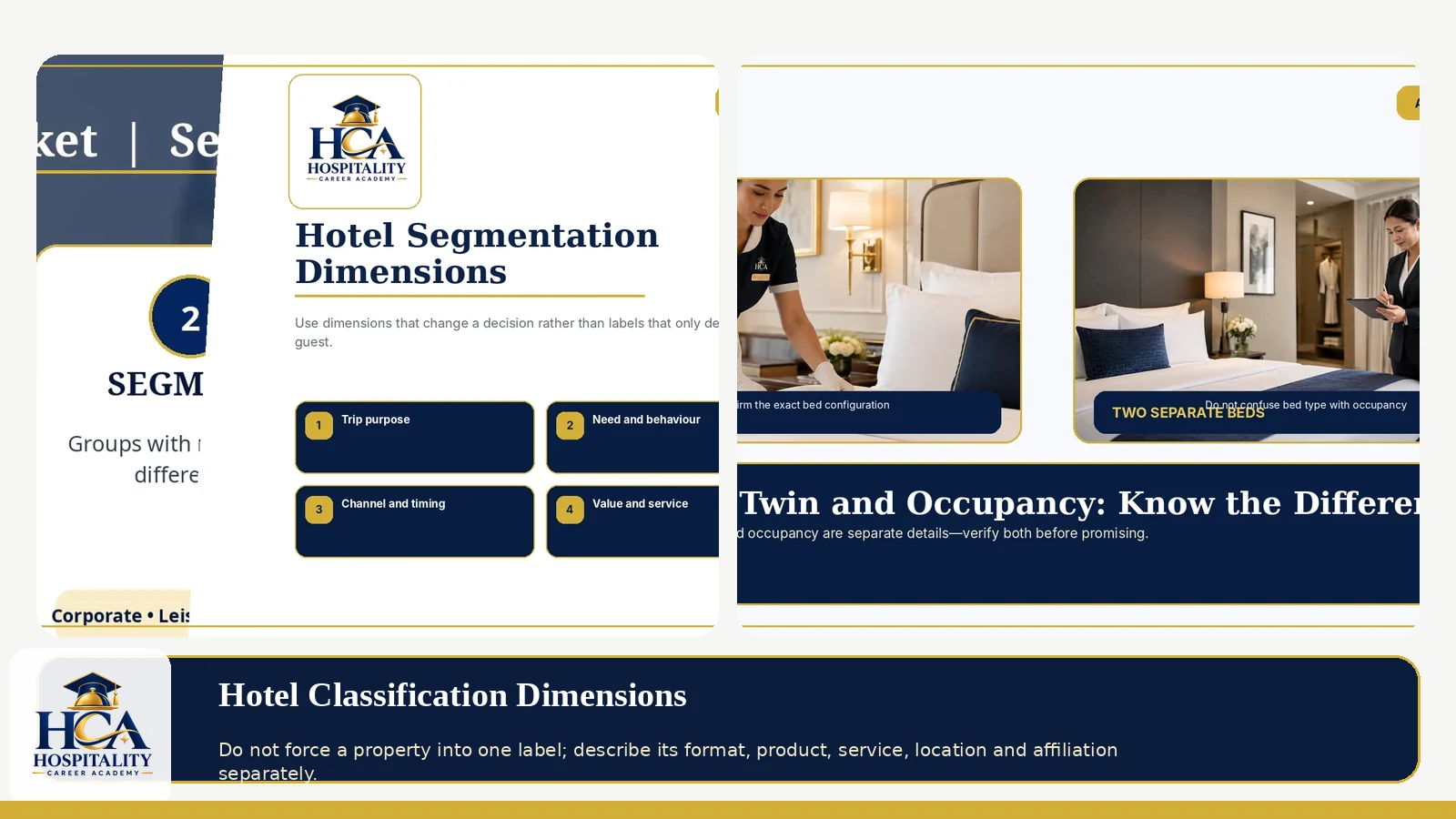
A hotel type describes the property or operating concept. A target market is the broader group of customers the hotel chooses to serve. A market segment is a smaller, meaningful group within that market with similar needs or booking behaviour.
For example:
- Property type: extended-stay hotel
- Target market: travellers needing temporary accommodation for several weeks
- Segments: project employees, relocating families, medical companions and long-stay corporate guests
The property type influences what the hotel can deliver. The target market guides where the hotel focuses. The segment helps the team design a specific offer, message, rate and service journey.
Four dimensions for classifying a hotel
1. Property format and accommodation product
This dimension describes the physical lodging product and key facilities.
Common formats include:
- traditional guestrooms and suites;
- serviced apartments or residences;
- resort accommodation;
- villas, chalets or lodges;
- hostels or shared accommodation;
- capsule or micro-room concepts;
- aparthotels and extended-stay properties;
- convention or conference hotels;
- wellness retreats;
- heritage or adaptive-reuse properties.
The format affects room layout, storage, kitchen facilities, housekeeping frequency, guest privacy, public areas and staffing.
2. Service level and facility model
Service level is not the same as quality. A limited-service hotel can deliver excellent quality within a focused promise, while a full-service hotel can fail if its many facilities are poorly managed.
A practical service classification may include:
- limited or focused service — essential accommodation with a selected service range;
- select service — rooms plus several high-value facilities, often with simplified operations;
- full service — broader food and beverage, meeting, leisure and guest-service functions;
- luxury service — highly personalised service, strong design and product detail, but still dependent on the property concept;
- self-service or technology-led concepts — reduced traditional contact with carefully designed digital support.
Star or official classifications may also exist, but their criteria vary by jurisdiction. Do not present one country’s rating system as universal.
3. Location and stay pattern
Location strongly influences demand but does not define every guest.
Examples include:
- city-centre or urban hotel;
- airport or transit hotel;
- suburban hotel;
- highway or roadside hotel;
- resort or destination hotel;
- business-district hotel;
- convention-centre hotel;
- hospital, university or industrial-area hotel;
- pilgrimage or religious-destination hotel;
- remote lodge or eco-destination property.
Stay pattern adds another useful layer:
- overnight or short transit;
- weekday corporate stay;
- weekend leisure break;
- long stay or relocation;
- group and event stay;
- seasonal resort stay;
- day use;
- mixed-use residence and hotel stay.
4. Ownership, affiliation and brand structure
A hotel may be:
- independently owned and operated;
- franchised under a brand;
- managed by an external hotel company;
- owner-operated under a soft brand or collection;
- part of a domestic or international chain;
- embedded in a mixed-use development;
- linked to branded residences.
This dimension influences systems, standards, distribution, loyalty, fees and decision rights. It does not by itself determine whether the hotel is boutique, luxury, business-focused or resort-based.
Practical hotel-type and target-market matrix
The matrix below shows common alignments. It is a planning tool, not a rulebook.
| Hotel type or context | Typical priority needs | Possible target segments | Important operating implications |
|---|---|---|---|
| City business hotel | Location, reliable Wi-Fi, efficient arrival, workspace, breakfast timing | Corporate travellers, consultants, project teams, meeting attendees | Fast check-in, invoice accuracy, weekday demand management, corporate agreements |
| Airport or transit hotel | Transfer reliability, flexible timing, rest, clear directions | Short-stop travellers, airline crews, disrupted passengers, nearby business visitors | 24-hour operations, transport coordination, irregular arrival waves, day-use controls |
| Resort | Recreation, destination experience, family or couple needs, length-of-stay value | Leisure couples, families, groups, destination celebrations, wellness guests | Activity planning, weather contingencies, outlet capacity, transport, seasonal staffing |
| Convention or conference hotel | Meeting capacity, room blocks, technology, banquet execution | Associations, companies, exhibitions, government groups, social events | Function-space control, group cut-off dates, banquet forecasting, cross-department event handovers |
| Extended-stay hotel or serviced residence | Storage, laundry, kitchen, privacy, routine, community support | Relocating families, project employees, medical stays, long-stay corporate guests | Different housekeeping frequency, utility rules, resident communication, longer account control |
| Boutique or lifestyle hotel | Distinctive design, story, local character, personal recognition | Experience-led leisure, creative or design-oriented guests, selected corporate travellers | Strong concept consistency, personalised communication, local partnerships, careful expectation setting |
| Limited-service or economy hotel | Clean room, safety, value, simple booking and essential convenience | Price-conscious travellers, short stays, contractors, road travellers, small groups | Lean staffing, standardisation, strong preventive maintenance, clear inclusions |
| Wellness retreat or spa-led property | Quiet, privacy, programme credibility, nutrition or treatment information | Wellness travellers, recovery or retreat guests, couples, small groups | Qualified practitioners, programme boundaries, dietary coordination, consent and privacy controls |
| Heritage hotel | Place, story, architecture and authentic interpretation | Cultural travellers, domestic leisure, special-interest groups, events | Conservation limits, accessibility explanation, storytelling accuracy, unusual-room expectation management |
| Mixed hotel and residence | Hotel service plus ownership or long-stay needs | Short-stay guests, owners, tenants, corporate residents | Separate entitlements, access, billing, community rules and communication channels |
Do not assume that every segment behaves the same way. “Business traveller” can include a one-night salesperson, a month-long project engineer, a conference delegate and an executive travelling with family. Use data and direct guest understanding to refine the segment.
1. City and business hotels
City hotels often serve a mixed market: corporate travellers, leisure visitors, event delegates, government business, airline-related demand, local weekend guests and residents using restaurants or meetings.
Useful product questions include:
- Is the location easy to explain from business districts, airports and attractions?
- Does the room support work and rest?
- Can the hotel deliver early breakfast, transport or invoice requirements?
- Are meeting spaces and food outlets aligned to local demand?
- Does weekend demand require a different package or message?
A city hotel should avoid positioning itself as “for business only” if leisure or local demand is commercially important.
2. Airport and transit hotels
Airport hotels compete on more than distance. Guests may need clear transfer instructions, flexible meal times, sound control, rapid check-in, day use, luggage assistance and accurate wake-up calls.
Potential segments include:
- passengers with planned stopovers;
- delayed or disrupted passengers;
- airline crews under contract;
- airport and logistics employees;
- exhibitors or corporate travellers near the airport area;
- local guests using meetings or restaurants.
The hotel must communicate transfer terms carefully. “Airport shuttle” should state route, schedule, reservation requirement, capacity and any charge.
3. Resorts and destination hotels
A resort’s target market depends on destination, climate, access, activity mix, room product and season. It may focus on families, couples, wellness, golf, beach, ski, adventure, weddings, groups or a blend.
Important design and operating questions:
- What can guests do each day and in poor weather?
- Which facilities have age, height, health or supervision rules?
- Is transport to the destination clear?
- Can restaurants handle peak occupancy and family timing?
- Are connecting rooms, villas or suites matched to actual party needs?
- Does the hotel explain what is included versus separately charged?
Do not advertise every resort as ideal for every audience. Clear positioning can improve satisfaction even when it narrows the message.
4. Convention and event hotels
Convention hotels are designed to handle significant meeting and event demand, but may also serve business, leisure and local food-and-beverage markets.
Priority features can include:
- flexible meeting rooms;
- pre-function and loading areas;
- audiovisual and connectivity support;
- banquet kitchens and service routes;
- room blocks and group reservation controls;
- organiser office and registration space;
- security and crowd-flow planning.
The target market should be defined by event size, industry, geography, lead time and total-value opportunity—not simply “groups.”
5. Extended-stay hotels and serviced residences
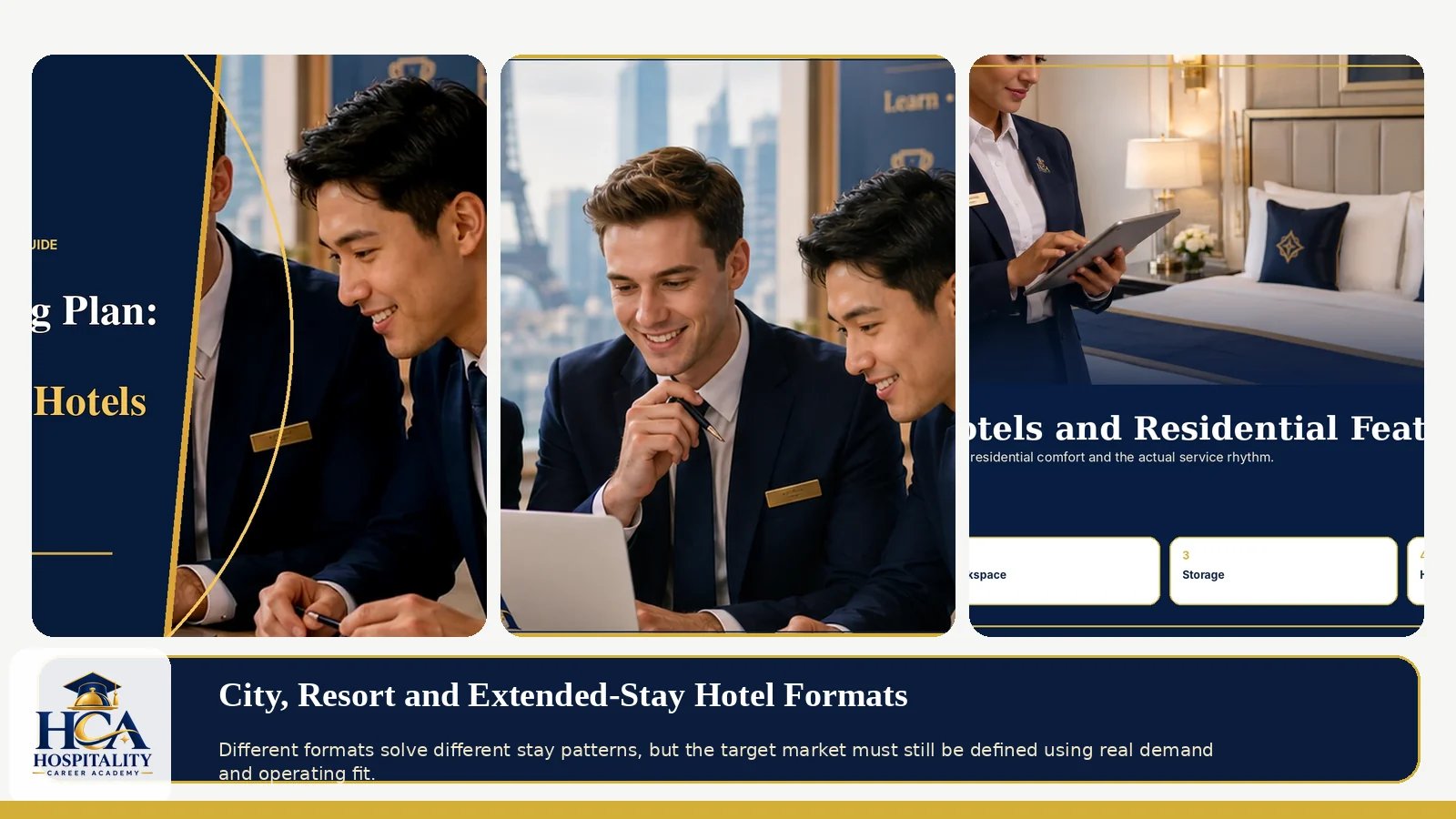
Longer-stay guests have different needs from one-night guests. Storage, laundry, kitchen equipment, mail, deliveries, parking, privacy, maintenance access and account management become more important.
Potential segments include:
- corporate project teams;
- relocating employees and families;
- people waiting for permanent housing;
- medical patients or companions;
- long-stay government or diplomatic guests;
- owners and tenants in branded residences.
Service frequency should be explained clearly. Daily housekeeping should not be promised if the product uses a scheduled service model. The hotel also needs rules for visitors, access, utilities, resident benefits and long-term maintenance.
6. Boutique and lifestyle hotels
Boutique describes a distinctive, usually smaller-scale experience centred on design, identity or local character. It does not necessarily mean independent. A boutique hotel may belong to a chain, soft brand or management group.
The target market is not simply “young travellers.” It can include couples, design-conscious business guests, cultural travellers, local staycation guests and small creative groups. The right segment depends on evidence.
Operational success requires:
- consistent concept from website to room and service;
- staff who can explain the story naturally;
- local recommendations that are current and responsible;
- clear communication about unusual layouts or heritage limitations;
- personal recognition without invading privacy.
7. Limited-service and economy hotels
These hotels focus on essential value. Their target market may include short-stay travellers, contractors, road travellers, budget-conscious families, groups and employees on controlled travel allowances.
The operating model depends on:
- clean, functional rooms;
- straightforward booking and cancellation;
- safe access and reliable maintenance;
- clear breakfast, parking and housekeeping inclusions;
- efficient staffing and self-service where appropriate;
- rapid recovery when an essential feature fails.
Lower price does not justify weak hygiene, unsafe equipment or misleading information.
How to define the target market for a hotel
Use evidence from several sources:
- stayed reservations by purpose, geography, channel and length of stay;
- search and website behaviour;
- sales enquiries and lost-business reasons;
- guest interviews and recurring questions;
- reviews and service requests;
- local demand generators;
- competitor positioning and capacity;
- profitability after channel and service cost;
- seasonal patterns and event calendars.
Then define the segment in operational language:
“UAE-based families seeking a two- to four-night school-break resort stay, requiring connected accommodation, children’s activity information, flexible dining and clear total package price.”
This is more useful than “families” because it guides product, content, staffing and measurement.
Hotel-type and market-fit worksheet
The Codex package includes hotel-type-market-fit-worksheet.csv. Use one row per priority segment.
| Field | Planning question |
|---|---|
| Property format | What accommodation and facilities exist? |
| Service model | What is included, optional or unavailable? |
| Location and access | What demand generators and access limits shape the stay? |
| Priority segment | Which specific guest group are we choosing to serve? |
| Job to be done | What is the guest trying to achieve on this trip? |
| Need and pain point | What matters most, and what can go wrong? |
| Product fit | Which rooms, facilities and services solve the need? |
| Offer and message | What should we package and explain? |
| Channel | Where can this segment be reached efficiently? |
| Operational implication | What must the team prepare or change? |
| Measurement | How will we know the segment is valuable and satisfied? |
Common classification mistakes
- treating star rating as the only hotel type;
- assuming boutique always means independent;
- using “business” or “leisure” as if each were one uniform segment;
- confusing room types with hotel types;
- describing the target market only by age or nationality;
- copying competitor labels without checking product fit;
- promising facilities or service levels the property cannot deliver;
- ignoring local residents, day visitors or non-room revenue;
- using stereotypes instead of stayed data and guest research;
- choosing too many priority segments for the operation to serve well.
Final takeaway
A hotel can have several valid classifications at the same time. The useful question is not “Which single box does this property belong to?” It is “Which combination of format, service level, location, affiliation and target demand best explains the product and guides decisions?”
Separate hotel type from target market and segment. Use evidence to define the guests the property can serve well and profitably. Then align the room product, facilities, rates, channels, staffing and service journey to that choice. A clear classification becomes a management tool—not merely a label on a website.
Bilingual worksheet for matching property format, service model and location with priority guest segments and operating implications.
Related HCA guides
- hotel market segmentation guide
- hotel target market versus market segment
- hotel room types explained
- hotel marketing plan
Update references
- Hotel Types Based on Their Target Markets — Hospitality Career Academy
- Glossary of tourism terms — UN Tourism
- Tourist accommodation establishment — glossary — Eurostat, European Commission
- Hotel Market Segmentation: How to Define and Use Guest Segments — Hospitality Career Academy
Frequently asked questions
What are the main types of hotels?
Common types include city, airport, resort, convention, extended-stay, serviced residence, boutique, limited-service, wellness and heritage hotels. A property may fit more than one category.
Is a boutique hotel always independent?
No. Boutique describes a distinctive experience or concept; the hotel may be independent, franchised, managed or part of a soft brand or chain.
What is the difference between a hotel type and a target market?
The hotel type describes the property or operating concept. The target market is the broader customer group the hotel prioritises, while segments are smaller groups with similar needs or behaviour.
How should a hotel choose its target market?
Use stayed demand, profitability, guest needs, local generators, sales evidence, search behaviour and the property’s ability to deliver a strong experience.
Can one hotel target several markets?
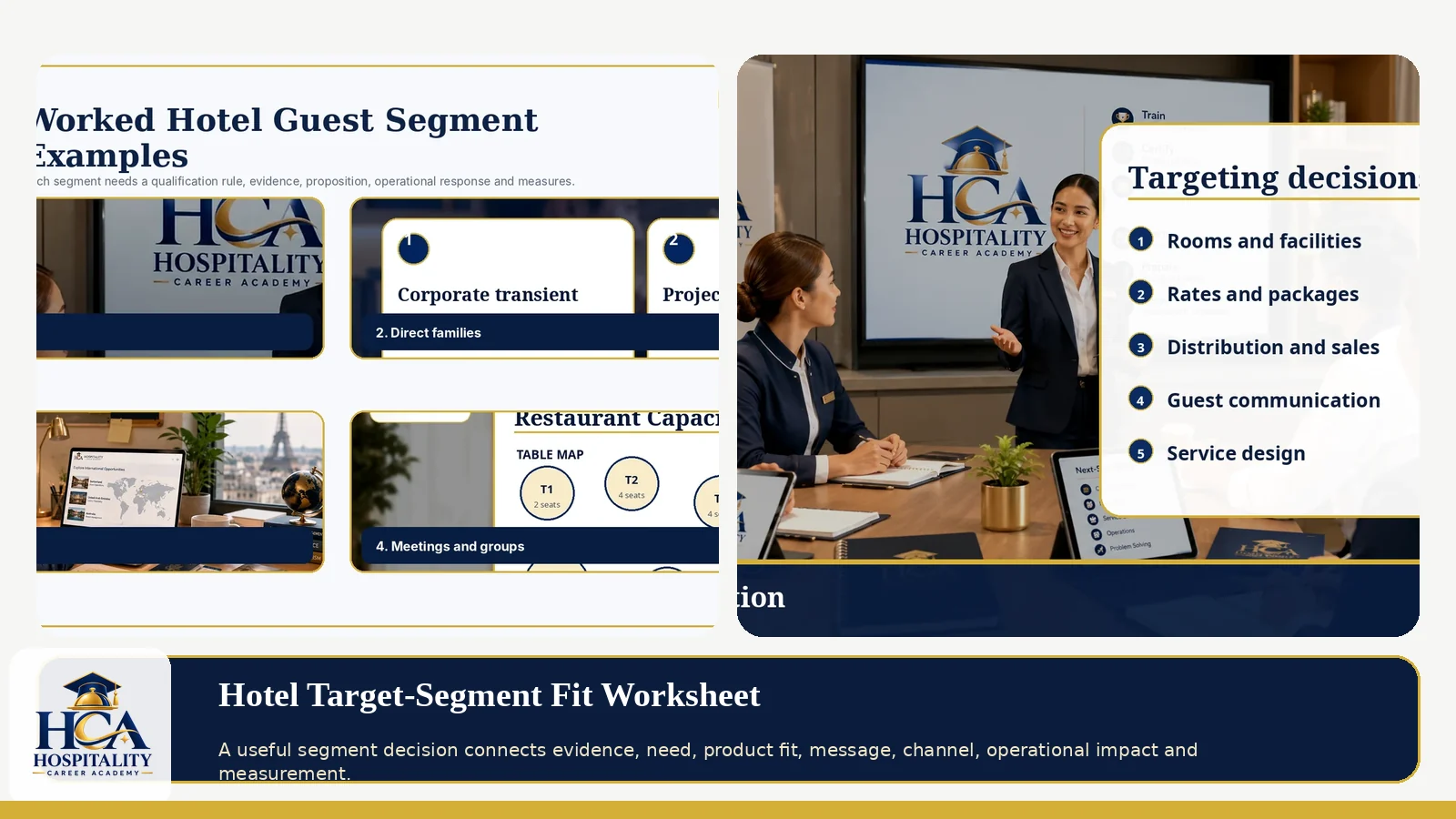
Yes, but priorities should be clear by day, season, product and channel. Too many unfocused targets can create confusing offers and inconsistent operations.
Sources and update note
This guide refreshes the existing HCA hotel-types article using practical hospitality segmentation and operating principles. Official rating systems, legal accommodation categories and licensing definitions vary by country; verify the current local requirements before using a classification for regulatory or commercial claims.
Frequently asked question
What are the main types of hotels?
Common types include city, airport, resort, convention, extended-stay, serviced residence, boutique, limited-service, wellness and heritage hotels. A property may fit more than one category.
Explore HCA hotel marketing and operations training