A reservation is a promise recorded in the hotel’s systems. If the dates, room type, rate, occupancy, policy, contact details or requests are wrong, the problem often appears later—at arrival, during billing or when the hotel is full and has fewer options to recover.
Good reservation training therefore teaches more than how to click New Reservation. It develops listening, product knowledge, commercial awareness, accurate system work, clear confirmation and safe handling of guest and payment information. The trainee should learn to create, modify and cancel bookings under supervision before working independently.
This framework can be adapted to phone, email, website enquiries, walk-ins, central reservations and direct messaging channels. The exact screens, rate rules and approvals must follow the property’s system and policy.
Training outcomes for a reservation agent
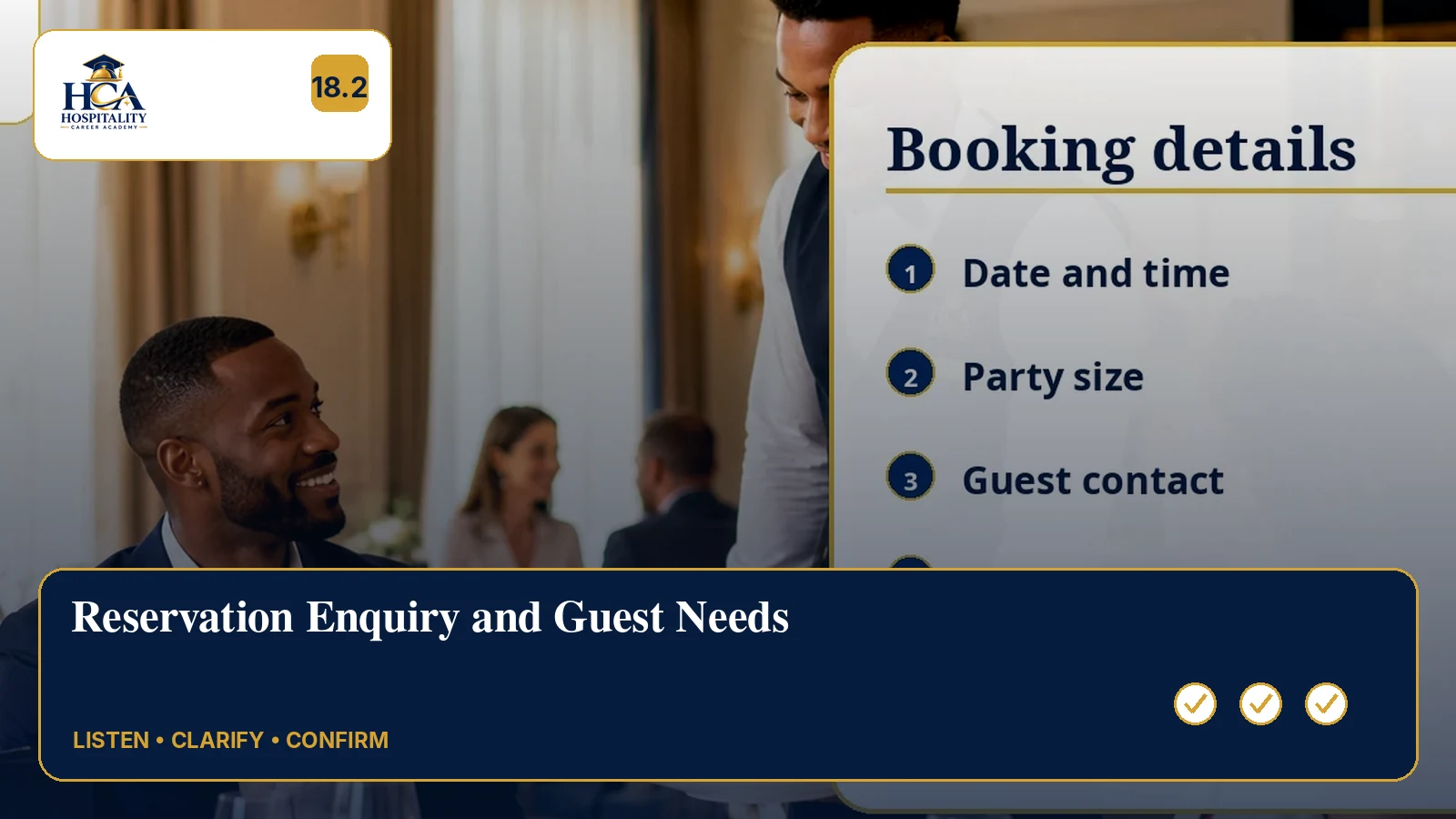
By the end of training, the agent should be able to:
- identify the guest’s stay requirements without making assumptions;
- search availability using the correct dates, occupancy and room needs;
- explain room types, inclusions, restrictions and alternatives accurately;
- quote a complete rate and read back the essential policy;
- distinguish a request from a guaranteed feature;
- create a clean guest profile and reservation without avoidable duplication;
- use only approved payment channels;
- send a clear confirmation;
- modify or cancel the booking with the correct policy and record;
- hand over unresolved actions;
- protect privacy and escalate risk;
- meet quality standards in role-play and supervised live work.
Product knowledge before system knowledge
An agent cannot recommend confidently if they do not understand what the hotel sells. Training should cover:
- room and suite categories;
- bed type, maximum occupancy and connecting-room possibilities;
- accessible-room features and the approved way to discuss them;
- views, floors, balconies and smoking policy where applicable;
- included meals, lounge access, parking, transfers and packages;
- check-in and check-out times;
- child and extra-bed rules;
- deposit, guarantee, cancellation and no-show terms;
- taxes, fees and whether they are included in the quoted amount;
- renovation, facility closure or other information approved for disclosure.
Use a product comparison sheet, property tour and scenario quiz. Do not teach employees to promise a room number, floor, view or connection unless the hotel can genuinely guarantee it.
Understand the booking source and ownership
The agent should identify whether the enquiry or booking is:
- direct by phone, email or hotel website;
- through a corporate account or travel arranger;
- through an online travel agency;
- part of a group, event or negotiated allocation;
- a loyalty, package, promotional or wholesale booking;
- an amendment to an existing record.
This matters because the hotel may not control every price, payment, change or cancellation. When a third party owns the booking, explain the correct route instead of pretending the hotel can change something it cannot.
The professional booking sequence
1. Open and identify the purpose
Use a professional greeting, identify the hotel or department and ask how you can help. Confirm whether the guest wants a new booking, information or a change to an existing reservation.
2. Qualify the stay
Collect only the information needed for the search and booking:
- arrival and departure dates;
- number of rooms;
- adults and children, including ages when the policy requires them;
- preferred room or bed type;
- purpose or priorities relevant to the recommendation;
- accessibility or practical needs;
- contact method and language preference.
Repeat the dates clearly, especially when the conversation crosses midnight, time zones or date formats.
3. Search availability correctly
Enter the full occupancy and stay pattern. Review available room types and rate plans, not just the first result. Check restrictions such as minimum stay, advance purchase, package conditions, occupancy limits or closed arrival/departure controls according to the system.
If the preferred option is unavailable, offer honest alternatives: another room category, adjusted dates, separate rooms, waitlist procedure or an authorised sister property. Do not invent availability.
4. Recommend and quote
Explain the option in guest-focused language:
- room type and relevant features;
- rate per night or package basis;
- currency;
- inclusions and exclusions;
- taxes or fees;
- total or estimated stay value where the system permits;
- deposit or guarantee requirement;
- cancellation deadline and no-show consequence;
- important restrictions.
Avoid quoting only a headline number and leaving the guest to discover conditions later.
5. Confirm the guest and profile
Search before creating a duplicate profile. Verify spelling, title, contact details and authorised preferences. Collect the minimum information required and follow privacy rules. Never add subjective or disrespectful comments to the profile or notes.
6. Record requests accurately
Use clear, operational wording. Distinguish:
- confirmed booking elements, such as booked room category and dates;
- requests, such as high floor, early arrival or nearby rooms;
- guaranteed arrangements, only where authorised and recorded;
- internal actions or traces, with owner and deadline.
Say: “I have added your high-floor preference as a request, subject to availability,” rather than “You will definitely have a high floor.”
7. Use the approved payment route
Follow the hotel’s authorised payment and card-data process. Do not copy payment details into free-text notes, chat, personal messaging, email or an unapproved document. Do not ask the guest to send a photograph of a card. If the secure route is unavailable, escalate or offer an approved alternative; convenience does not override security.
8. Read back before saving
A complete read-back may include:
- guest name;
- property;
- arrival and departure;
- nights;
- room category and occupancy;
- rate, currency and inclusions;
- tax or fee treatment;
- cancellation or deposit condition;
- requests and whether they are guaranteed;
- contact details;
- next step.
Ask the guest to confirm that the summary is correct.
9. Save, check and confirm
After saving, re-open or review the reservation summary. Check that the system reflects what was agreed. Send confirmation through the approved channel and explain what the guest should do if they need to amend the booking.
Rate and policy language trainees should practise
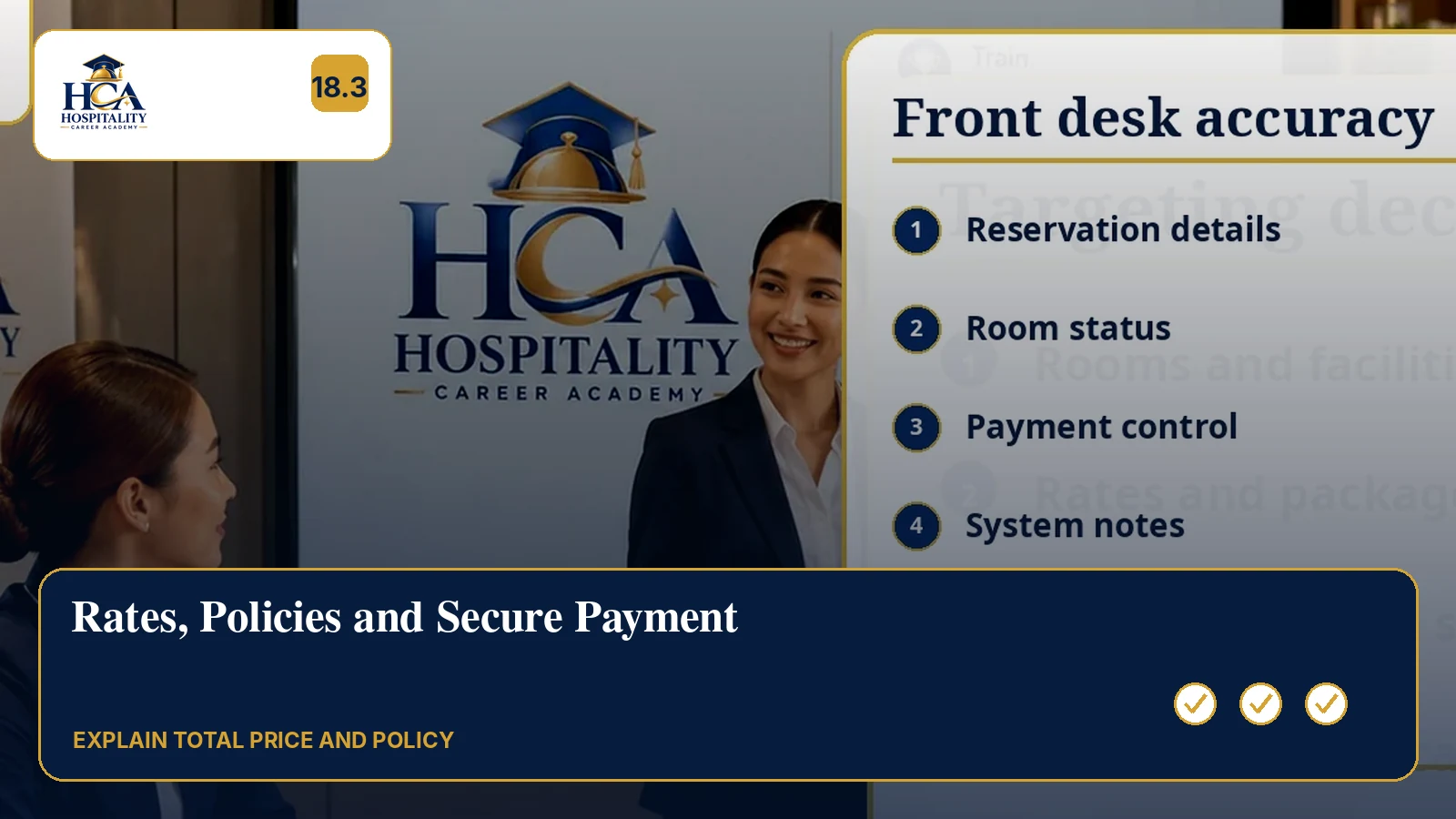
Weak wording creates disputes. Practise complete statements such as:
“The flexible rate is AED 850 per room per night, excluding the stated taxes and fees, with breakfast for two. Cancellation is permitted without charge until 6:00 p.m. hotel local time two days before arrival. After that deadline, the stated charge applies.”
Every property must replace the example with its real policy. The training point is the structure: price, basis, inclusion, tax treatment, deadline, time zone and consequence.
For non-refundable rates, explain the restriction before taking the booking, not after. For packages, confirm the exact inclusions, eligible dates and redemption conditions.
Payment security and privacy boundaries
Reservation agents handle valuable personal information. Training should make the boundaries explicit:
- Access only records needed for your work.
- Verify identity using the property’s approved method before discussing or changing a booking.
- Do not disclose stay details, room numbers or guest contacts to an unverified caller.
- Never store sensitive payment information in free text.
- Use role-based access and log out or lock the screen when leaving the workstation.
- Avoid reading guest details aloud where unauthorised people can hear.
- Escalate suspicious booking patterns, social-engineering attempts or payment failures.
A helpful employee is not one who bypasses controls. A helpful employee protects the guest while finding an authorised solution.
PMS practice: what the trainee should demonstrate
Use a training property, sandbox or fictional profiles wherever possible. The trainee should practise:
- searching availability with different occupancies;
- creating and finding a guest profile;
- selecting the correct room and rate code;
- adding source, market, preferences and approved notes;
- recording requests and action traces;
- adding the approved guarantee or payment instruction;
- sending or reproducing confirmation;
- modifying dates, occupancy and room type;
- applying a cancellation with reason and policy;
- finding duplicates and correcting errors under supervision;
- reading the change history or audit trail available to the role;
- handing over an incomplete action.
Assessment should verify both the final record and the employee’s reasoning. A correct screen reached by guessing is not yet reliable competence.
Modifications, cancellations and no-shows
Modification
Verify the caller or requester, open the correct record, confirm what is changing and recheck availability and price. A date or occupancy change may reprice the stay. Read back the new terms and send an updated confirmation.
Cancellation
Verify authority, explain the applicable policy, record the reason and provide the cancellation reference or written confirmation. Do not promise a waiver unless you have approval.
No-show
Follow the property’s no-show process and payment authority. Do not manually cancel or reinstate a record to hide an error. Escalate disputes and document the approved action.
Ethical upselling during reservations
Upselling should improve fit, not pressure the guest. Ask a relevant question, offer one or two suitable choices and explain the value. Examples include more space for a family, lounge access for a business traveller or a refundable rate for uncertain plans.
Do not:
- hide a cheaper suitable option;
- describe a standard room as unacceptable;
- promise unavailable benefits;
- continue pushing after a clear decline;
- add a product without explicit agreement.
Record the booked product accurately and confirm the final total.
Practice scenarios and competence sign-off
Use role-plays that reflect real risk:
- A family asks for connecting rooms that cannot be guaranteed.
- A guest wants an early arrival during high occupancy.
- A third party calls to change a booking but cannot be verified.
- A non-refundable booking needs different dates.
- The preferred room is sold out and the guest is frustrated.
- A guest sends payment information through an unapproved channel.
- The PMS rate differs from the price in an old email.
- An accessible-room request needs accurate follow-up.
Score the trainee on listening, search accuracy, product knowledge, policy explanation, privacy, system record, confirmation and escalation. Require supervised re-practice after a critical error.
A four-week training plan
Week 1: product and communication
Property tour, room comparison, rates, policies, phone and email standards, date and occupancy exercises.
Week 2: system fundamentals
Profiles, availability, reservation creation, requests, traces, confirmation and duplicate prevention in a safe environment.
Week 3: changes and commercial skills
Modifications, cancellations, no-shows, third-party bookings, packages, ethical upselling and difficult conversations.
Week 4: assessment and supervised work
Timed scenarios, quality review, controlled live bookings, coaching, re-assessment and formal sign-off.
Common reservation-training mistakes
- Teaching clicks without explaining the rate or business rule.
- Collecting card details through an unsafe route.
- Failing to read back the complete booking.
- Confusing a guest request with a guarantee.
- Using live guest profiles for unsupervised practice.
- Measuring only booking speed and not accuracy.
- Ignoring email, modification and cancellation scenarios.
- Allowing independent work before critical controls are demonstrated.
Final takeaway
Hotel reservation training should create a record that the guest, hotel and operating team can trust. The agent must understand the product, qualify the stay, quote completely, explain the policy, protect data, record requests honestly and confirm every essential detail.
The best trainee is not the person who completes the screen fastest. It is the person who creates the right booking, explains it clearly and leaves a reliable record for every department that will serve the guest next.
Related HCA guides
Update references
- HCA original article — Hospitality Career Academy
- Creating a Reservation — Oracle Hospitality OPERA Cloud documentation
- Can unencrypted PANs be sent over e-mail, instant messaging, SMS, or chat? — PCI Security Standards Council
- Hotel Reservations and Revenue Basics course — Hospitality Career Academy
Frequently asked question
What should hotel reservation training include?
It should include hotel product knowledge, room and rate rules, a complete booking sequence, secure payment boundaries, PMS practice, modifications, cancellations, upselling and observed competence sign-off.
Learn hotel reservations and revenue basics