Hospitality training should change what employees can do during a real shift. It should help a receptionist complete an accurate arrival, a room attendant prepare a guest-ready room, a waiter manage service confidently, a reservation agent protect rate and policy accuracy, or a supervisor lead a clear briefing and follow-up.
A course may be informative and still fail operationally if employees cannot apply it. Effective hospitality training therefore begins with the role, the standard and the work environment—not with a long presentation. It combines clear explanation, demonstration, practice, feedback, assessment and workplace reinforcement.
This guide explains how hotels, resorts, restaurants, cafés, serviced residences and training centres can build role-based learning that transfers into safer, more consistent service.
What effective hospitality training looks like
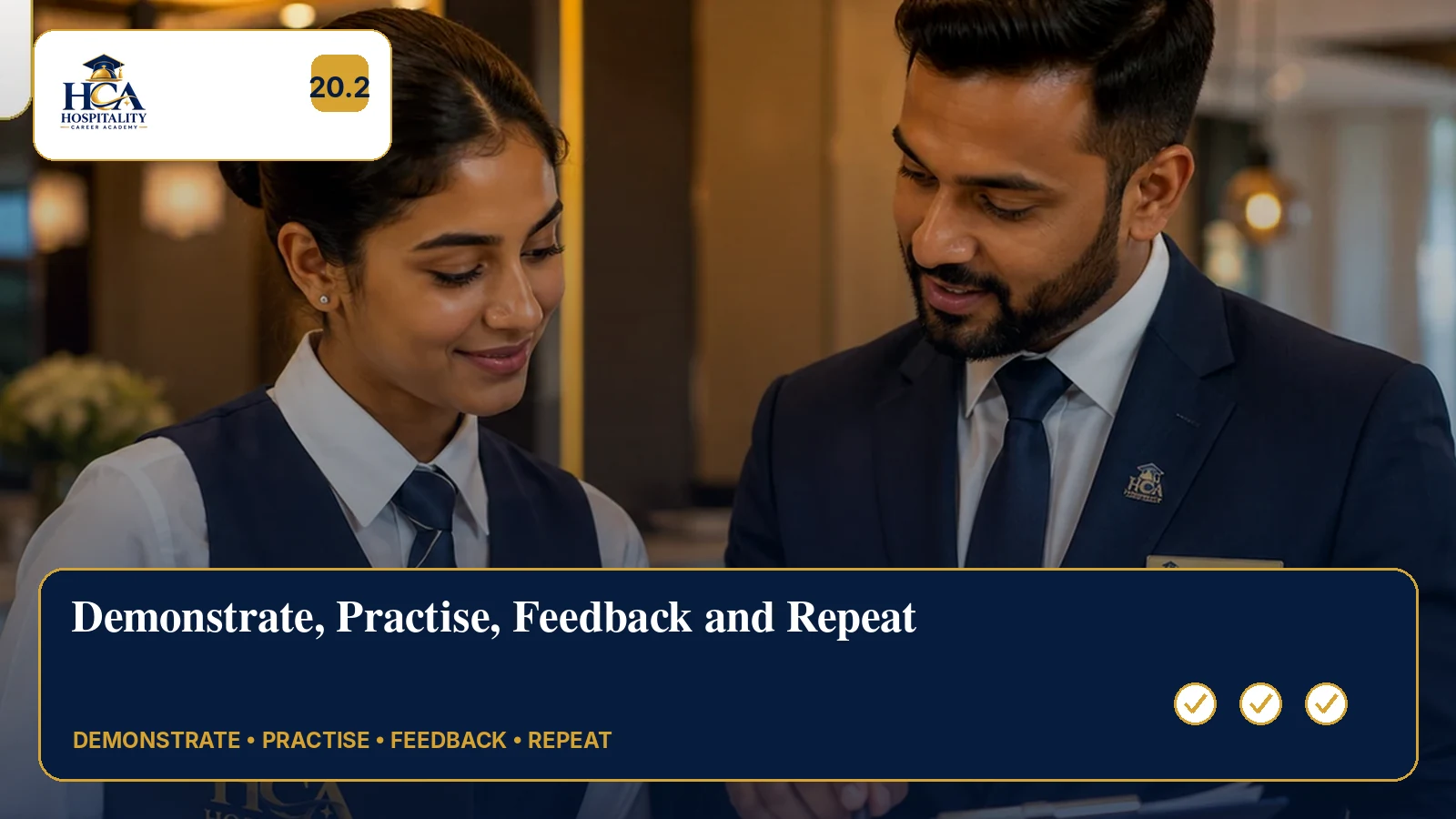
Good hospitality training is:
- Role-based: connected to the tasks and decisions of a specific job.
- Observable: built around behaviour a trainer or supervisor can see.
- Practical: includes demonstration, rehearsal and supervised application.
- Relevant: uses the property’s products, systems, guests and operating conditions.
- Safe: explains privacy, security, hygiene, payment and authority boundaries.
- Accessible: employees understand the standard, not merely the training language.
- Assessed: competence is demonstrated rather than assumed from attendance.
- Reinforced: supervisors follow up after the learning event.
Training is not complete because a participant watched a video, signed an attendance sheet or passed a memory quiz. Those can support learning, but the final question is whether the person can perform correctly at work.
The eight-stage hospitality training cycle
1. Diagnose the operational need
Begin with evidence. Ask what result needs to improve and why the current gap exists. Use observation, audits, guest feedback, system reports, incidents, interviews and practical checks.
Examples:
- Front desk agents understand the welcome script but make errors in identity or payment verification.
- Room attendants clean well but report defects too late.
- Waiters know menu names but cannot explain allergens safely.
- Supervisors attend leadership workshops but still conduct unclear handovers.
A training needs analysis should also test non-training causes such as tools, staffing, systems, unclear policies or inconsistent management. Do not design a course for a problem that training cannot solve.
2. Define observable performance outcomes
Replace broad aims with clear workplace outcomes.
Weak outcome:
Understand excellent customer service.
Stronger outcome:
During a guest complaint role-play, the employee listens without interruption, acknowledges the impact, explains one authorised next step, records the case and states when the guest will receive an update.
A useful outcome states:
- the task or decision;
- the conditions;
- the expected standard;
- the evidence of success.
3. Design the learning path—not only the session
A learning path is the sequence through which the employee becomes competent. It may include:
- pre-reading or short digital orientation;
- trainer explanation;
- live demonstration;
- guided practice;
- role-play or simulation;
- supervised workplace application;
- assessment and sign-off;
- reinforcement or refresher activity.
The path should match the risk and complexity of the task. A brief update may be sufficient for a small menu change. Handling payment data, allergens, room access or emergency procedures requires stronger controls and practical verification.
4. Prepare the trainer, materials and work environment
Even a good course fails when the trainer lacks current information or the practice environment is unrealistic.
Before delivery, confirm:
- the current SOP and version;
- the exact room, outlet, system or equipment used;
- examples and scenarios relevant to the role;
- who owns each part of the procedure;
- escalation and authority limits;
- safety, privacy and accessibility requirements;
- assessment criteria;
- Arabic, English or other language support needed;
- materials, room setup and technology;
- how attendance, assessment and follow-up will be recorded.
Trainers should rehearse demonstrations. A rushed or inconsistent demonstration teaches the wrong standard efficiently.
5. Explain, demonstrate and think aloud
Hospitality employees benefit from seeing the complete task performed correctly. The trainer should explain not only the steps but also the judgement behind them.
For example, when demonstrating a reservation call, the trainer can say:
I am confirming the guest’s dates and occupancy before quoting because the available room type and rate conditions depend on those details. I will then read back the inclusions, cancellation condition and request status so the guest leaves with one clear expectation.
This “think aloud” method makes hidden decision-making visible.
A strong demonstration should show:
- preparation;
- complete sequence;
- service language;
- system or equipment use;
- safety controls;
- common errors;
- escalation point;
- final check and handover.
6. Build deliberate practice
People develop competence by practising the parts of the job that require thought and coordination. Practice should be realistic, progressive and safe.
Start with guided practice
The trainer supports each step, pauses the task and corrects errors immediately.
Move to independent practice
The employee completes the full task with less help.
Add variation
Change the guest need, room status, order, payment condition, complaint or operational pressure. This tests judgement rather than memorisation.
Repeat critical tasks
A single successful attempt may be luck. Repeat the task under more than one realistic condition before sign-off.
Practice examples include:
- check-in simulation with a room delay;
- departure-room cleaning and self-inspection;
- allergen enquiry at a restaurant table;
- reservation modification with a rate change;
- complaint recovery within a defined authority level;
- supervisor briefing using an incomplete handover that must be corrected.
7. Assess competence through evidence
Assessment should match the job. Use one or more of the following:
- direct observation;
- system task;
- demonstration;
- role-play;
- oral questioning;
- product or policy check;
- completed checklist;
- work sample;
- supervised live performance;
- follow-up audit.
A practical scorecard should separate critical requirements from coaching points. Exposing a room number, guessing about an allergen or bypassing a payment control should not be treated as a minor style issue.
Assessment records should state:
- what was assessed;
- which standard applied;
- evidence observed;
- result;
- feedback given;
- additional practice required;
- assessor and date;
- reassessment or sign-off decision.
8. Reinforce the skill in the workplace

Training transfer depends heavily on what happens after the session. Supervisors should know what employees learned and what behaviour to observe.
Reinforcement may include:
- a start-of-shift reminder;
- job aids at the point of work;
- coaching during live operations;
- observation after seven, fourteen or thirty days;
- review of system or quality records;
- recognition of correct practice;
- refresher activity after a change or recurring error;
- reassessment when competence is not maintained.
If the workplace rewards speed while the training demands accuracy and complete service, employees receive a conflicting message. Managers must align targets, feedback and resources with the trained standard.
Role-based hospitality learning paths
A hotel should not give every employee the same generic course and call it development. Shared foundations are useful, but each function needs role-specific competence.
Front office learning path
Core areas may include:
- grooming and professional presence;
- guest acknowledgement and queue awareness;
- reservations and arrival preparation;
- identity, privacy and room-number protection;
- PMS navigation and room assignment;
- deposit, payment and cashiering controls;
- complaint handling and recovery limits;
- room delay and overbooking escalation;
- handover and follow-up;
- emergency and security awareness.
Assessment should include realistic arrival, departure, request and complaint scenarios—not only system screenshots.
Reservations learning path
Core areas may include:
- room and package knowledge;
- date, occupancy and need discovery;
- availability and inventory understanding;
- rate basis, inclusions and restrictions;
- value-based recommendation;
- accurate PMS or CRS entry;
- request versus guarantee language;
- secure payment handling;
- modification, cancellation and no-show procedures;
- confirmation and pre-arrival handover.
A reservation agent should demonstrate both system accuracy and a clear guest conversation.
Housekeeping learning path
Core areas may include:
- grooming, hygiene and privacy;
- trolley and pantry preparation;
- room-entry procedure;
- occupied, departure and vacant-clean distinctions;
- bed-making and bathroom sanitation;
- chemical and equipment safety;
- linen, amenities and stock control;
- lost-and-found procedures;
- defect reporting and room-status accuracy;
- public-area standards;
- self-inspection and supervisor sign-off.
Training should use real rooms or realistic practice spaces whenever possible.
Food and beverage learning path
Core areas may include:
- outlet concept and sequence of service;
- menu, beverage and product knowledge;
- allergens and dietary-request controls;
- table setup and station preparation;
- order taking and POS accuracy;
- tray and plate handling;
- timing and communication with kitchen or bar;
- suggestive selling based on guest need;
- complaint handling and replacement authority;
- bill presentation, payment and farewell.
Practical service assessment should include guest interaction, not only carrying technique.
Supervisor and leadership learning path
Core areas may include:
- planning the shift;
- conducting a focused briefing;
- delegation with owner and deadline;
- observation and coaching;
- performance feedback;
- escalation and decision limits;
- interdepartmental handover;
- managing pressure and priorities;
- incident documentation;
- team development and follow-up.
Leadership training should use operational cases. Abstract motivation speeches rarely prepare a supervisor for an understaffed shift, a serious complaint or conflicting priorities.
Choose the right learning method
Different methods serve different purposes.
| Method | Best used for | Limitation to manage |
|---|---|---|
| Shift briefing | Short update, reminder or daily priority | Too brief for complex skill development |
| Demonstration | Showing sequence, quality or equipment use | Learners still need their own practice |
| Role-play | Communication, judgement and recovery | Must feel realistic and psychologically safe |
| Simulation | Systems, emergencies and high-risk scenarios | Requires preparation and clear assessment |
| Supervised on-the-job training | Applying the task in the real environment | Guest and safety risk must be controlled |
| E-learning or microlearning | Knowledge, orientation and refreshers | Completion does not prove practical competence |
| Coaching | Individual improvement and transfer | Quality depends on the coach and follow-up |
| Peer practice | Repetition, confidence and shared learning | Needs a correct model and trainer oversight |
Blend methods instead of expecting one format to do everything.
A 30-day onboarding and sign-off plan
| Period | Learning focus | Evidence |
|---|---|---|
| Days 1–3 | Welcome, brand, conduct, safety, department overview and essential policies | Knowledge check and guided tour |
| Days 4–7 | Core task demonstrations and guided practice | Trainer observation |
| Days 8–14 | Repeated practice, role-plays and supervised live tasks | Daily coaching record |
| Days 15–21 | Greater independence, varied scenarios and cross-department understanding | Competency scorecard |
| Days 22–30 | Workplace assessment, gap closure and final sign-off decision | Supervisor evidence and development plan |
The schedule should be adapted to role complexity and local requirements. Sign-off should not be automatic on day 30. It should depend on evidence.
Make bilingual and multicultural training work
Hospitality teams often include employees with different first languages and education backgrounds. The standard must be understood accurately.
Good practice includes:
- using clear, direct language;
- avoiding unnecessary jargon;
- providing Arabic and English versions where useful;
- showing the task visually;
- checking understanding through demonstration, not “Do you understand?”;
- using examples relevant to the property and market;
- explaining culturally sensitive situations without stereotypes;
- supporting accessibility needs;
- keeping translations consistent across SOPs, job aids and assessments.
Bilingual training does not mean placing two crowded languages on one slide. Each language version should be complete, readable and operationally equivalent.
Prepare supervisors to coach after training
Supervisors are the bridge between the classroom and the shift. Give them:
- the learning outcomes;
- the observation checklist;
- critical safety or privacy points;
- examples of good feedback;
- the follow-up schedule;
- escalation route if competence is not achieved;
- access to the same current SOP and job aid.
Useful feedback is specific:
You explained the room options clearly. Before confirming next time, read back the cancellation condition and whether the high-floor request is guaranteed or only requested.
This gives the employee a precise next action.
Measure whether training transferred to work
Use evidence connected to the original need. Possible measures include:
- practical sign-off results;
- repeat assessment;
- quality audit trends;
- reservation or cashiering error trends;
- room inspection results;
- complaint follow-up completion;
- safety or near-miss records;
- guest comments linked to the trained behaviour;
- supervisor observations;
- productivity balanced with quality;
- employee confidence supported by practical evidence.
Avoid claiming that one workshop caused every business improvement. Note other changes such as staffing, systems, demand, pricing or process updates.
Sample role-based training plan
| Field | Example |
|---|---|
| Operational need | Reservation amendments contain avoidable rate and policy errors |
| Target group | New and existing reservation agents |
| Performance outcome | Agent completes discovery, accurate entry, policy read-back and written confirmation |
| Learning activities | Demonstration, guided PMS practice, call role-play and supervised live observation |
| Critical controls | Secure payment process, no false guarantee, correct cancellation terms |
| Assessment | Two system scenarios and two guest conversations |
| Workplace reinforcement | Weekly sample review for four weeks |
| Owner | Reservations manager |
| Evidence of success | Fewer corrections and stronger quality scores, reviewed with context |
| Review decision | Sign off, reinforce, retrain or address non-training causes |
Common hospitality training mistakes
Avoid these common failures:
- using one generic programme for unrelated roles;
- teaching information without demonstrating performance;
- overcrowding slides with policy text;
- relying only on quizzes;
- assessing memory rather than application;
- ignoring privacy, safety, payment or authority limits;
- delivering outdated procedures;
- training without the actual system, room, equipment or menu;
- signing off employees because the schedule ended;
- failing to prepare supervisors for follow-up;
- measuring attendance instead of transfer;
- blaming employees when the process or resources block performance.
Final takeaway
Hospitality industry training creates value when it prepares people to perform correctly in the real operation. The strongest programmes begin with a diagnosed need, define observable outcomes, use role-specific practice, protect critical controls and require evidence before sign-off.
Training should be a pathway from explanation to demonstration, from practice to assessment and from assessment to reliable workplace performance. When managers and supervisors reinforce the same standard after the course, learning becomes part of the operation rather than an isolated event.
Related HCA guides
Update references
- HCA original article — Hospitality Career Academy
- Learning evaluation, impact and transfer — CIPD
- ISO 10015:2019 Quality management — Guidelines for competence management and people development — International Organization for Standardization
- HCA Academy — Hospitality Career Academy
Frequently asked question
What makes hospitality training effective?
Effective hospitality training defines observable performance, matches the role and operation, includes demonstration and repeated practice, assesses competence, and is reinforced by managers during real work.
Explore professional HCA courses