A hotel blog should help someone make a better decision. It might explain which room layout suits a family, how to prepare for a meeting, what a package includes or how to reach the property. Good content earns its place by being useful and accurate—not by sounding impressive or repeating a keyword.
This guide replaces the unhelpful “good blogger versus bad blogger” label with four practical principles: choose a real reader question, verify the answer, make it easy to use, and maintain it. It is written for hospitality marketing teams, junior content creators and training providers producing English and Arabic articles.
Principle 1: Choose a question the hotel can answer well
Begin with real questions from reservations, reception, restaurant hosts and sales colleagues. A family repeatedly asking about connecting rooms has a more specific need than someone searching a broad phrase such as “best luxury holiday.”
Create a short brief with the intended reader, their situation, the decision they need to make, the property’s relevant knowledge and the useful next action. Search data can support the brief, but it does not replace knowing the product.
Google’s people-first guidance asks content creators to focus on a real audience, useful original contribution and reliable presentation rather than producing pages primarily to attract search traffic. That principle supports choosing a subject the hotel can genuinely explain. [1]
Example: from vague topic to useful brief
Weak topic: “The ultimate guide to unforgettable luxury.”
Useful brief: “Help parents compare a connecting-room arrangement with a suite by explaining the confirmed layout, occupancy, bathroom access and booking conditions.”
The stronger brief names a decision and the facts needed to make it. It does not assume connecting rooms are guaranteed, or that every suite has a door separating the living area from the bedroom. Those details must come from the actual inventory.
Before commissioning the article, check whether an existing page already answers the same question. Update or differentiate it rather than creating another near-duplicate. A room-comparison guide, a room sales page and a family itinerary can coexist when their purposes are clearly different.
Principle 2: Verify claims and show what you know
Create a claim register while drafting. For each important statement, record the source, date checked, person responsible and any limitation. An internal room specification may support a layout claim; an attraction’s official page may support its opening information. A search snippet or another hotel’s blog is not enough to establish your property’s facts.
| Claim | Suitable evidence | Publication caution |
|---|---|---|
| Room configuration | Approved room specifications and operations confirmation | Do not imply a guaranteed allocation unless it is bookable |
| Menu or package price | Current authorised commercial record | Include applicable conditions and update ownership |
| Walking time | Checked route and clearly stated estimate | Mobility, weather and route conditions vary |
| Guest quotation | Approved, traceable feedback and permission where required | Do not invent a testimonial |
| Training outcome | Actual course content and assessment requirements | Do not promise a job or external accreditation without evidence |
| Sustainability statement | Defined measure, boundary, period and supporting records | Avoid broad environmental claims without substantiation |
Separate fact, estimate and illustration. “This is a sample itinerary” tells readers something different from “Our concierge tested this route.” Claim firsthand experience only when someone actually did the work and can confirm the account.
Use AI as assistance, not evidence
AI can help organise questions, suggest structure or create a first draft. It cannot verify that the hotel has a rooftop pool, that a room was inspected or that an interview took place. Check every factual statement, remove invented sources and never submit private guest data to an unapproved service.
Do not publish drafting instructions accidentally. Search the final text for phrases addressed to the writer, unfinished placeholders, fake quotations and contradictory dates. Record the editorial decision about disclosure where appropriate; never mark a human review complete when it has not happened.
Respect image and text rights
A picture appearing in an online search is not automatically available for reuse. WIPO’s copyright guidance is a useful starting point for understanding protected work and permissions. Confirm the licence or permission for the specific asset and intended use. [2]
Maintain the original source, licence terms, credit requirement and any model or property releases relevant to the use. Use generated imagery as illustration rather than evidence of a real guest, room, event or staff member. Do not imply that a fictional training scene documents your hotel’s actual operation.
Principle 3: Make the article easy to read and act on
Answer the main question near the beginning. Organise the rest around the reader’s decisions: options, differences, restrictions, examples and next steps. Use clear headings rather than repeatedly adding the same keyword.
Choose the format that serves the answer. A comparison may need a short table; a procedure may need numbered steps; a destination article may need a practical route and a current source. Avoid padding a simple answer to reach a word target. Google explicitly says it has no preferred word count. [1]
Use images with a defined purpose
A hero introduces the topic. Supporting images should explain a room layout, show a service step or clarify a decision. Give each informative image appropriate alternative text and place it near the relevant explanation. Google’s image guidance covers contextual relevance, descriptive filenames and accessible image delivery. [3]
An image’s media-library title and description help organise assets, but they do not replace visible content or an appropriate HTML alt attribute. Do not fill every field with repeated keywords or claim that embedded image metadata guarantees ranking.
W3C distinguishes informative images from purely decorative images and recommends alternatives that match their purpose. Important information shown only in a diagram or image of text also needs an accessible equivalent. [4]
For HCA’s branded hero images, keep the article title as real page text too. A logo or image overlay must not be the only place where the topic is readable.
Give English and Arabic equal usefulness
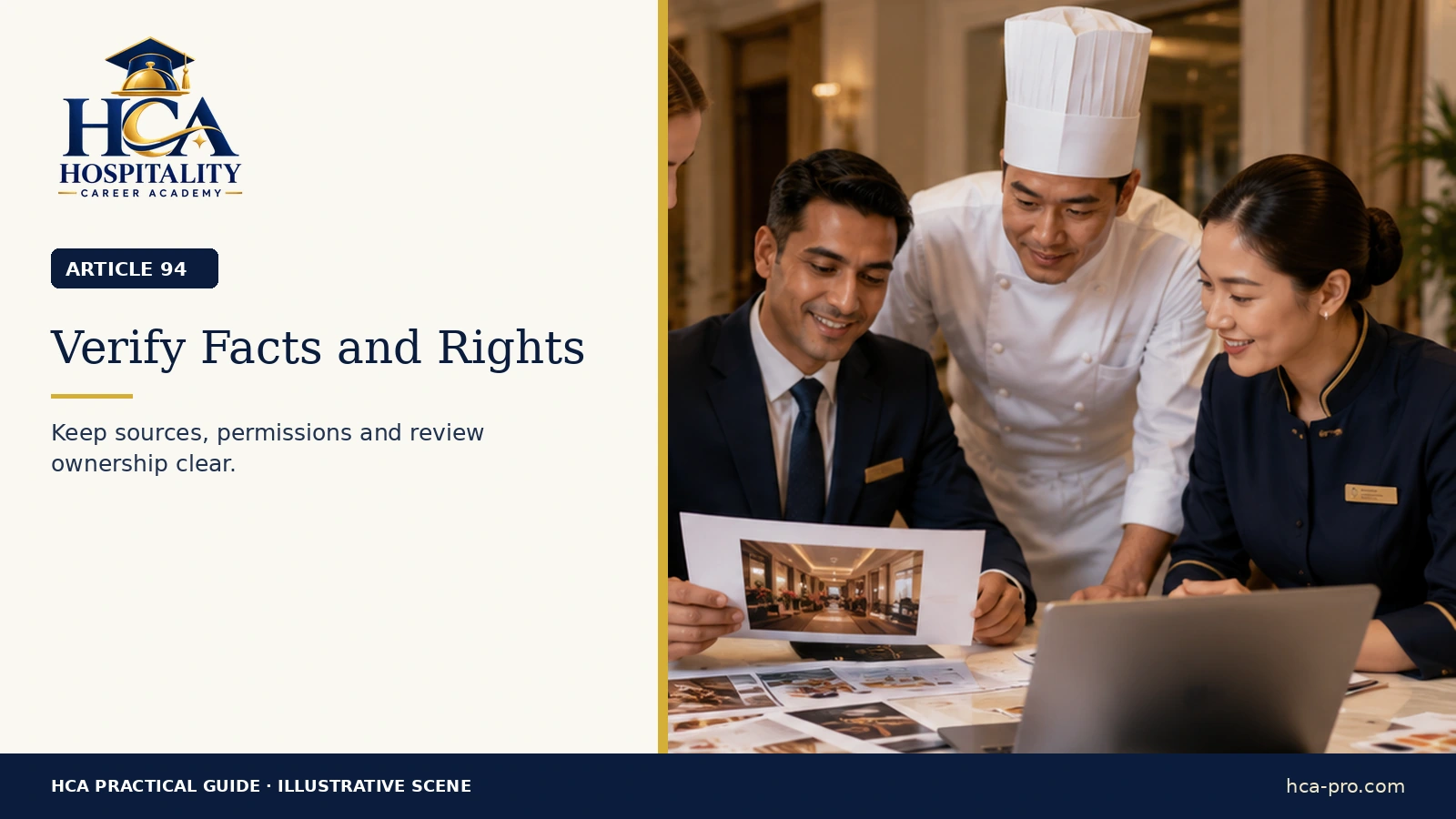
Translate the meaning, examples, tables, captions and conditions—not only the introduction. Use natural hospitality terminology and review Arabic direction, punctuation, numbers, telephone details and links on a mobile screen.
An Arabic article can be shorter or longer than the English version and still be equivalent. What matters is that no important restriction, safety point, price condition or action disappears. Compare section purpose, examples and facts rather than requiring matching word counts.
Do not advertise an Arabic version until it contains a complete reviewed article. The developer should use the site’s verified language-routing behaviour and avoid serving an English page while labelling it Arabic.
Offer one useful next step
Match the action to the question. A meeting-planning guide can link to an enquiry form; a room-layout guide can link to the relevant accommodation page; a training article can link to a real worksheet or course.
Explain what happens after the click. Do not publish a download button until the file has a working public location. A related article should add information rather than send the reader into a loop of pages repeating the same answer.
Principle 4: Maintain the article after publication
Assign an owner and a review trigger. Triggers may include a menu change, refurbishment, new booking terms, a closure, a course revision or changed transport information. Time-sensitive content needs more frequent attention than a stable skills explanation.
Preserve the original publication date and use an accurate update date when substantive changes occur. Do not refresh the date alone to make an old article look new. Keep a revision note explaining what changed and why.
After publishing, inspect the page on desktop and mobile in both languages. Test image loading, tables, links, forms and downloads. Confirm the intended page identity and language alternatives rather than assuming a preview matches production.
A practical editorial workflow
Use seven stages: brief, evidence, draft, specialist review, language review, technical preview and authorised publication. The same person may cover more than one stage in a small team, but the checks still need to happen.
A useful handover tells the editor which record is being updated, what must remain unchanged, what sources support the new claims, where the images belong and which approvals are still outstanding. “SEO-ready” is not a substitute for that information.
For a hotel article, ask operations to verify the product before polishing promotional wording. For a training article, ask a relevant practitioner to check the procedure and boundaries. Keep unresolved questions visible in the draft workflow rather than hiding them in published copy.
Measure whether the page is helping
Review search queries, impressions and clicks alongside meaningful reader actions: viewing the relevant room page, using a worksheet, submitting a qualified enquiry or finding an answer without contacting reception again. Choose the measure to match the article’s purpose.
Do not interpret one click or a few impressions as proof that a rewrite succeeded or failed. Compare comparable periods, consider seasonality and record other changes affecting the page. Change important elements deliberately so you can learn from the results.
If two articles repeatedly serve the same query and reader need, review whether to distinguish or consolidate them. Do not delete or redirect a page automatically without checking its links, traffic, content and historical purpose.
Practical HCA working resource supplied with this article.
Download Hotel Blog Brief, Evidence and Review Checklist (CSV)
Related HCA guides
Update references
- Good vs Bad Blogger | 4 tips to enhance your blog — Hospitality Career Academy
- Creating Helpful, Reliable, People-First Content — Google Search Central
- Frequently Asked Questions: Copyright — WIPO
- Image SEO Best Practices — Google Search Central
- Images Tutorial — W3C WAI
Frequently asked questions
How long should a hotel blog article be?
Long enough to answer the reader’s question accurately and usefully. Remove repetition and add detail only when it helps the decision. There is no universal SEO word-count target.
Can generated images be used in hospitality articles?
They can be used as clearly presented illustrations, subject to applicable rights and policies. Do not present them as real photographs of a specific hotel, guest, event or completed service.
Use the editorial checklist
Complete the included Hotel Blog Brief, Evidence and Review Checklist before publication. HCA’s hospitality branding guide covers brand promise and identity; the social media strategy guide covers channel planning. This article owns the written-page editorial process.
Sources and scope
[1] Google Search Central: Creating Helpful, Reliable, People-First Content.
[2] WIPO: Copyright Questions and Answers.
[3] Google Search Central: Image SEO Best Practices.
[4] W3C WAI: Images Tutorial. The briefs, examples and workflow are HCA editorial recommendations; no ranking or conversion outcome is guaranteed.
Frequently asked question
How long should a hotel blog article be?
Long enough to answer the reader’s question accurately and usefully. Remove repetition and add detail only when it helps the decision. There is no universal SEO word-count target.
Hotel Blog Brief, Evidence and Review Checklist