The executive housekeeper is not simply the person in charge of cleaning. The role leads one of the hotel’s largest operational departments and protects room availability, guest trust, employee safety, asset condition, linen control and service consistency.
In a full-service hotel, resort, serviced residence or luxury property, the executive housekeeper may manage room attendants, public-area cleaners, supervisors, coordinators, linen and uniform rooms, laundry operations and outsourced partners. In a smaller property, several of these responsibilities may sit with one manager.
This guide explains what an executive housekeeper actually does, which skills employers look for, how performance can be measured fairly and how a housekeeping professional can prepare for the role.
Executive housekeeper role at a glance
| Area | Main accountability |
|---|---|
| Guest rooms | Clean, inspected and released according to occupancy and arrival priorities |
| Public areas | Safe, clean and presentable guest and back-of-house spaces |
| People | Staffing, scheduling, training, conduct, wellbeing and productivity |
| Quality | SOPs, inspections, defect trends and corrective action |
| Linen and laundry | Availability, hygiene, stock levels, losses and supplier control |
| Supplies and chemicals | Approved products, safe use, storage, par levels and cost control |
| Coordination | Front office, engineering, security, finance, procurement and HR |
| Budget | Labour, amenities, linen, laundry, equipment and outsourced services |
| Guest trust | Privacy, lost and found, room security and accurate service recovery |
The exact reporting line differs by company. The role may report to the general manager, director of rooms, rooms division manager or hotel manager.
Core duties and responsibilities
1. Lead room and public-area operations
The executive housekeeper converts occupancy and arrival information into an executable daily plan. This involves:
- reviewing occupied, departure, vacant, out-of-order and priority rooms;
- planning room-attendant sections and supervisor coverage;
- prioritising early arrivals, VIPs, families, accessible requirements and special setups;
- coordinating public-area and back-of-house schedules;
- responding to unexpected demand, absenteeism or maintenance issues;
- ensuring room-status changes are accurate and timely.
A strong leader protects quality while using resources intelligently. Speed matters, but it should never be rewarded at the expense of safety, privacy or cleanliness.
2. Build and maintain cleaning standards
Standards must be specific enough to teach, observe and inspect. The executive housekeeper should ensure that the department has current procedures for:
- entering occupied and vacant rooms;
- bed making and linen handling;
- bathroom cleaning and disinfection;
- touch-point cleaning;
- guest belongings and privacy;
- room amenities and minibar coordination;
- waste and sharps response;
- chemical dilution and colour coding;
- lost and found;
- DND and welfare-check escalation;
- public-area and back-of-house cleaning;
- defect and pest reporting.
The manager should review standards after renovations, product changes, incidents, guest feedback and new legal or brand requirements.
3. Inspect quality and coach the team
Inspection is not only a pass-or-fail activity. It should reveal patterns and support development.
A practical inspection process includes:
- Select rooms and areas using a risk-based sample.
- Inspect against a clear checklist.
- Record the exact defect rather than a vague comment.
- Correct urgent guest or safety issues immediately.
- Coach the responsible employee privately.
- Identify whether the cause is knowledge, skill, time, supply, equipment or process.
- Track repeat defects by room, floor, shift or task.
- verify that corrective action worked.
Feedback such as “mirror edge has marks” or “shower drain was not checked” is more useful than “room not good.”
4. Plan staffing, schedules and productivity
Housekeeping labour must reflect occupancy, departures, stayovers, room size, service level and special work—not a single universal rooms-per-shift target.
The executive housekeeper should understand:
- forecast occupancy and departure patterns;
- room credits or workload values where used;
- labour standards by room or task type;
- employee availability, leave and legal rest requirements;
- supervisor span of control;
- deep-cleaning, project and public-area work;
- overtime, outsourcing and cross-training rules;
- productivity without unsafe shortcuts.
A fair plan considers the difference between a lightly occupied room and a heavily used departure suite. Productivity data should be used to investigate and improve, not to punish employees without context.
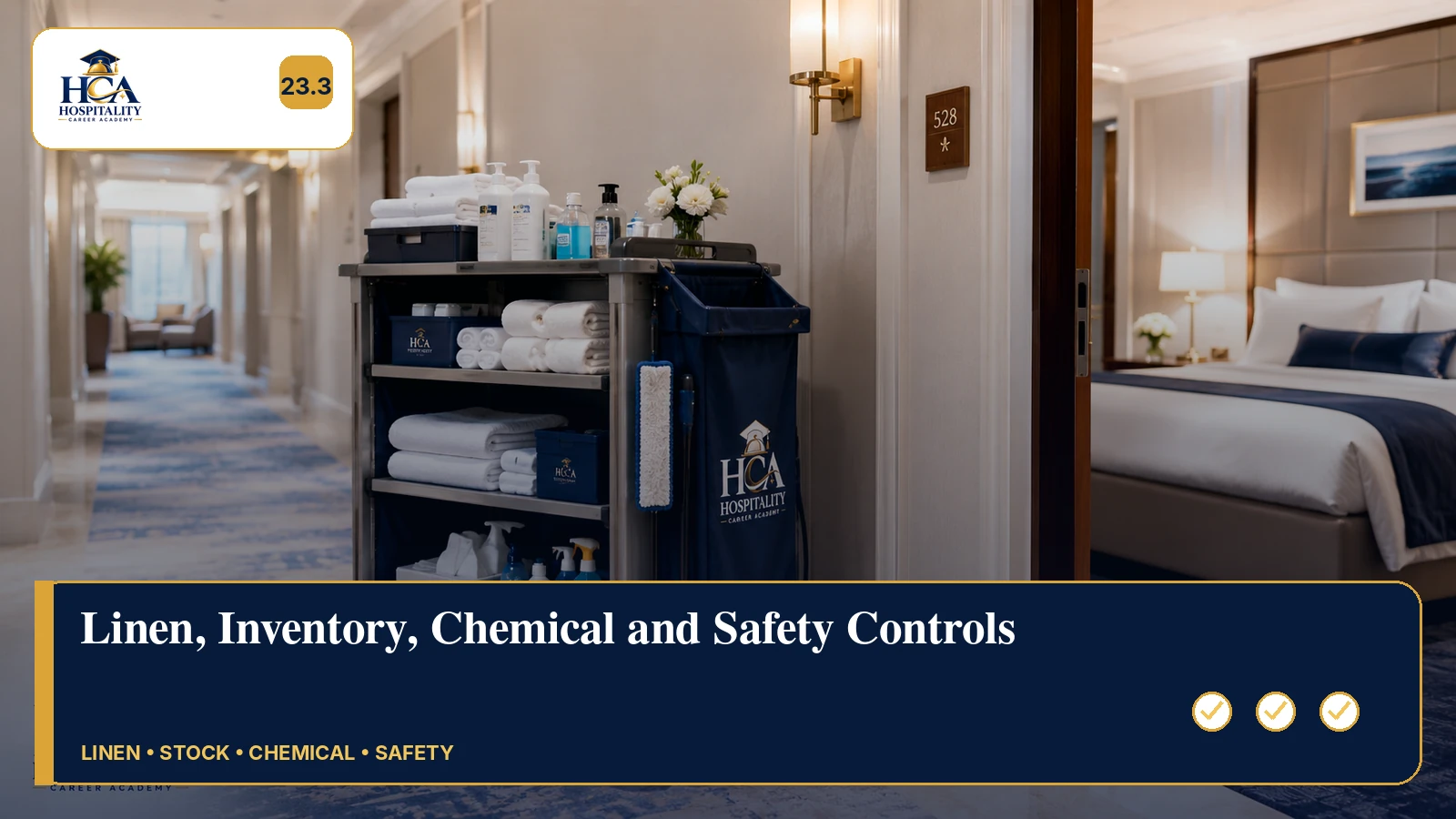
5. Control linen, uniforms, amenities and supplies
Inventory is a major part of the role. Weak controls create shortages, waste, emergency purchasing and guest complaints.
Key responsibilities may include:
- setting and reviewing par levels;
- conducting physical inventory;
- tracking linen discard, damage and unexplained loss;
- separating clean, soiled, rejected and condemned items;
- checking outsourced laundry quality and counts;
- controlling uniforms and employee issue records;
- monitoring guest amenities and cleaning supplies;
- approving requisitions within authority;
- reviewing consumption against occupancy and budget;
- protecting stores from contamination and unauthorised access.
The manager should distinguish normal wear from preventable loss and should investigate unusual changes before drawing conclusions.
6. Protect chemical, equipment and employee safety
Housekeeping employees face manual-handling, slip, trip, chemical, electrical, sharps and ergonomic risks. The executive housekeeper must work with the hotel’s safety process and applicable local requirements.
Controls include:
- using only approved and labelled products;
- keeping safety information accessible;
- training employees on dilution, PPE and incompatibilities;
- never transferring chemicals into unlabelled drink containers;
- inspecting machines, cords, trolleys and ladders;
- reporting damaged equipment;
- teaching safe lifting, pushing and repetitive-work techniques;
- having a defined response to blood, body fluids, needles, broken glass and spills;
- investigating incidents and near misses.
Safety cannot be delegated to a poster on the wall. It must be visible in scheduling, supervision, equipment and daily decisions.
7. Coordinate with other departments
Housekeeping quality depends on cross-department communication.
Front office
- room priorities and status accuracy;
- early arrivals and late departures;
- room moves, VIPs and guest requests;
- connecting or accessible requirements;
- service recovery and communication with guests.
Engineering
- defect reporting and priority;
- rooms placed out of order or out of service;
- preventive maintenance access;
- recurring leaks, odours, lighting or HVAC issues;
- sign-off after repair.
Security and loss prevention
- lost and found;
- key control;
- suspicious items or activity;
- guest welfare and privacy;
- incident preservation and reporting.
HR, finance and procurement
- recruitment, attendance and development;
- payroll and labour reporting;
- approved suppliers and purchase orders;
- budget monitoring and inventory controls.
The executive housekeeper should create clear handover routes rather than depend on personal messages that cannot be tracked.
8. Manage guest concerns and service recovery
The manager may become involved when a guest reports cleanliness, odour, missing items, privacy concerns or repeated service failure.
A professional response should:
- listen without becoming defensive;
- confirm the effect on the guest;
- apologise appropriately;
- protect privacy and evidence;
- arrange the authorised immediate solution;
- coordinate room move, reclean, maintenance or replacement where needed;
- document ownership and follow-up time;
- investigate the process after the guest is safe and supported.
The purpose is not only to correct one room. It is to prevent the same failure elsewhere.
A practical operating rhythm
Daily
- review forecast, room status and arrivals;
- conduct briefing and allocate work;
- monitor priority rooms and public areas;
- review staffing changes and safety issues;
- inspect a risk-based sample;
- follow up maintenance and guest concerns;
- complete shift handover.
Weekly
- analyse repeated defects and complaints;
- review productivity with context;
- check inventory exceptions and laundry quality;
- conduct coaching and practical refreshers;
- plan deep cleaning and projects;
- meet front office and engineering on recurring issues.
Monthly
- complete physical inventory;
- review labour, supplies, laundry and amenity costs;
- compare budget and forecast;
- evaluate supplier performance;
- update the training plan;
- recognise strong performance and address persistent gaps;
- report risks, results and planned actions to hotel leadership.
Executive housekeeper KPIs
No single measure should control the role. Use a balanced scorecard.
| Area | Possible measure | Important caution |
|---|---|---|
| Room readiness | Priority rooms released by agreed time | Do not hide incomplete work through inaccurate status changes |
| Quality | Inspection pass rate and repeat-defect rate | Check whether sampling is fair and consistent |
| Guest experience | Verified cleanliness themes and recovery completion | One survey score does not explain the cause |
| Productivity | Workload completed per paid hour or room credit | Adjust for room type, occupancy and special work |
| Labour | Labour cost against forecast and budget | Protect legal rest, safety and service standards |
| Linen | Loss, discard and stock availability | Separate normal wear from avoidable loss |
| Supplies | Consumption per occupied room or task | Consider product changes and deep cleaning |
| Safety | Incidents, near misses and corrective-action closure | Low reporting can mean under-reporting, not low risk |
| People | Turnover, absence, training completion and competence | Attendance alone does not prove skill |
| Maintenance | Recurring defects and closure time | Ownership is shared with engineering |
The best KPI discussion asks what the result means and what action is required.
Skills employers look for
Operational housekeeping knowledge
The manager must understand room cleaning, public areas, linen, laundry, chemicals, equipment, inspection and guest-room presentation well enough to make safe decisions and coach others.
Leadership and people management
The role requires briefing, delegation, feedback, conflict handling, recognition, attendance management and development across a diverse team.
Planning and organisation
The department works against arrival times, occupancy changes and limited resources. Priorities must be clear and adaptable.
Financial and analytical ability
The executive housekeeper should be comfortable with labour reports, budgets, inventory, purchasing, forecast information and basic cost analysis.
Communication
The manager must communicate with room attendants, executives, guests, suppliers and multiple departments. Clear written handovers are as important as verbal leadership.
Digital confidence
Hotels may use PMS room-status functions, task systems, inventory tools, scheduling software and reporting dashboards. The exact technology varies, but the ability to learn and verify systems is essential.
Qualifications, certification and experience
There is no single qualification required in every country or company. Employers may value:
- progressive housekeeping experience;
- experience as room attendant, supervisor, coordinator or assistant executive housekeeper;
- evidence of leading teams and budgets;
- knowledge of safety and chemical controls;
- hospitality, rooms division or management education;
- relevant professional development or certification;
- strong references and measurable achievements.
A degree can help but is not the only route. Practical competence, leadership evidence and the ability to manage a large operation often carry significant weight.
Executive housekeeper salary
Salary varies by country, city, property size, brand, accommodation provided, service charge, benefits, experience and scope. A 100-room select-service hotel and a 700-room luxury resort do not offer the same job.
When comparing an offer, review:
- base salary and currency;
- service charge or incentive structure;
- housing or allowance;
- meals, transport and medical cover;
- working schedule and duty expectations;
- team size and outsourced operations;
- laundry, public-area and uniform-room scope;
- relocation, flights or family benefits where relevant.
Use current local salary data and the exact job description rather than relying on one global figure.
Career path to executive housekeeper
A common pathway is:
Room attendant → housekeeping coordinator or senior attendant → supervisor → assistant executive housekeeper → executive housekeeper → director of housekeeping or rooms leadership
Career movement is not identical for everyone. Laundry, public-area, training or quality roles can also lead into department leadership.
A 90-day readiness plan
Days 1–30: Strengthen the foundation
- master the complete room and public-area standards;
- learn room status, occupancy and workload planning;
- review chemical and equipment controls;
- practise clear inspection feedback;
- understand linen and supply movement.
Days 31–60: Build leadership evidence
- lead briefings and shift allocation under supervision;
- analyse a recurring defect;
- coach one skill and verify improvement;
- support inventory and schedule preparation;
- coordinate one issue with front office and engineering.
Days 61–90: Demonstrate management thinking
- prepare a simple labour and workload plan;
- present a quality trend and corrective action;
- build a small training plan from evidence;
- explain a budget variance or stock exception;
- request feedback against the executive-housekeeper competencies.
Evidence to show in an interview or CV
Stronger evidence includes:
- size of team or operation supported;
- number and type of rooms or areas managed;
- improvement in a verified quality trend;
- successful opening, renovation or deep-clean project;
- labour, linen or supply control with context;
- training delivered and competence verified;
- incident or guest concern handled responsibly;
- cross-department problem solved;
- process or checklist improved.
Avoid claiming savings or guest results you cannot explain. Employers are more likely to trust a clear example with your role, action and result.
Common mistakes in the role
- prioritising speed while quality or safety falls;
- using inspection only to blame employees;
- changing room status before work is complete;
- failing to verify connecting, accessible or special-set-up requirements;
- ignoring linen and amenity losses until stock runs out;
- relying on verbal messages for defects and guest follow-up;
- applying one productivity target to every room type;
- allowing unsafe chemical decanting or unlabelled bottles;
- solving today’s complaint without correcting the process.
Related HCA guides
Update references
- HCA original article — Hospitality Career Academy
- First-Line Supervisors of Housekeeping and Janitorial Workers — O*NET OnLine
- Hazard Communication — Occupational Safety and Health Administration
- Professional Housekeeping and Room Attendant Operations — Hospitality Career Academy
Frequently asked questions
What does an executive housekeeper do?
The executive housekeeper leads housekeeping operations, people, room and public-area quality, linen and supply controls, safety, budgets, training and coordination with other hotel departments.
Do you need a degree to become an executive housekeeper?
Not always. Requirements vary. Many successful leaders progress through operational experience, while some employers prefer hospitality or management education for larger roles.
Which KPI is most important?
There is no responsible single KPI. Room readiness, inspection quality, guest feedback, productivity, labour, inventory, safety and employee competence should be reviewed together.
Is the executive housekeeper responsible for maintenance?
Engineering normally owns technical repair, while housekeeping identifies, records, prioritises and verifies many room defects. Strong coordination is essential.
Final takeaway
The executive housekeeper is a people, quality and business leader. The role connects clean rooms with accurate status, safe work, controlled inventory, trained employees, maintained assets and guest trust.
Professionals preparing for this position should build evidence beyond cleaning knowledge. They need to show that they can plan, coach, analyse, coordinate and make balanced decisions under real hotel pressure.
Frequently asked question
What does an executive housekeeper do?
The executive housekeeper leads housekeeping operations, people, room and public-area quality, linen and supply controls, safety, budgets, training and coordination with other hotel departments.
Study professional housekeeping operations