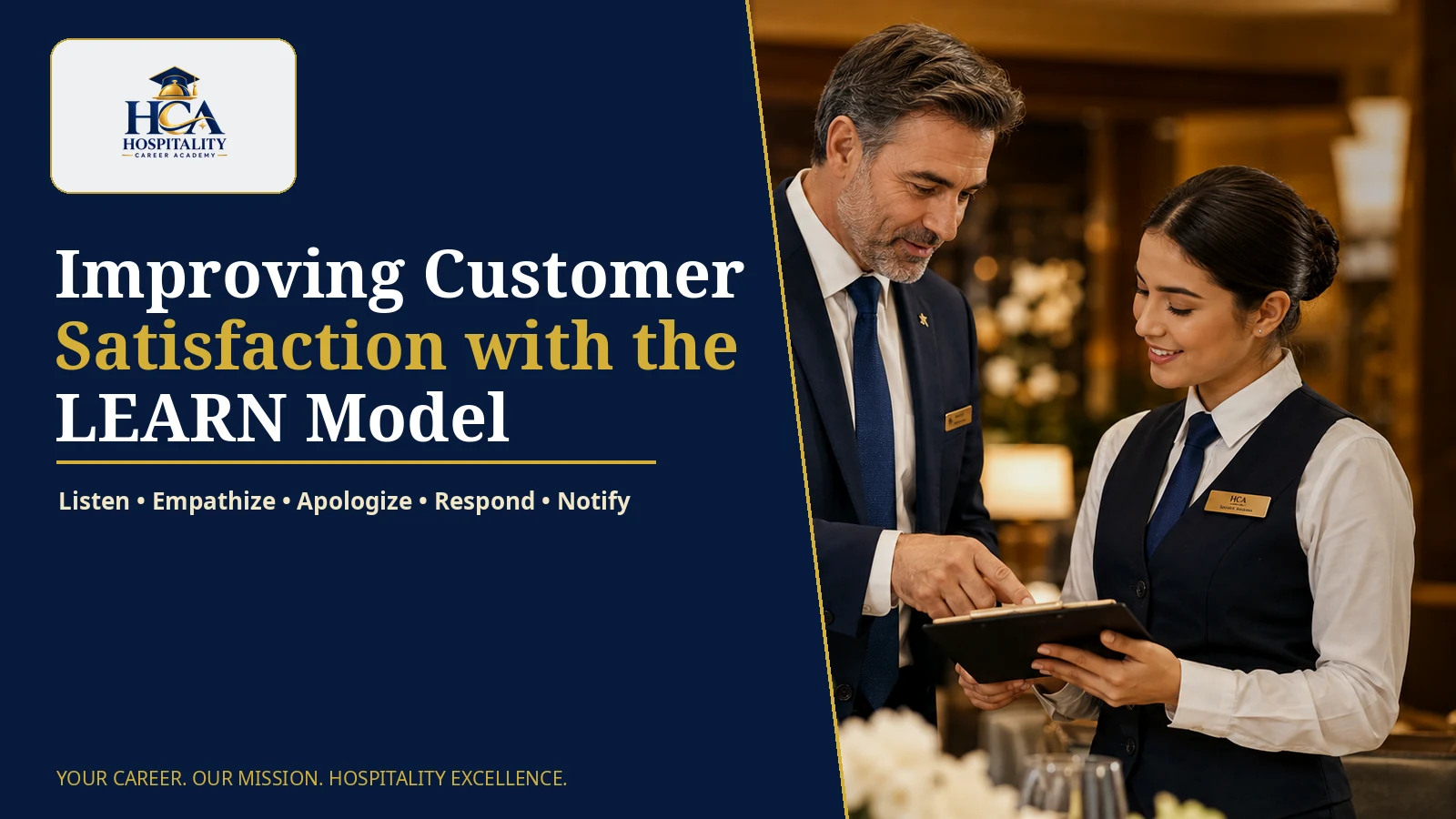
A guest complaint is not fully resolved when the conversation ends. The real test is what happens next: Was the promised action completed? Did the guest confirm that the solution worked? Was the underlying cause corrected? Did the next shift receive the right information?
The LEARN model gives hospitality employees a clear service-recovery sequence: Listen, Empathize, Apologize, Respond and Notify. HCA’s main LEARN guide explains how to use those five steps during a guest complaint. This article focuses on the next layer—how hotels, restaurants and serviced residences can use LEARN to improve customer satisfaction over time, not only calm one difficult interaction.
Key takeaway: A good recovery solves the guest’s immediate problem. A strong recovery system also records the lesson, assigns ownership and prevents the same failure from reaching another guest.
LEARN at a glance

Before measuring improvement, the team must use the model consistently:
- Listen: Let the guest explain, ask focused questions and confirm the facts.
- Empathize: Recognize the effect on the guest without becoming defensive.
- Apologize: Offer a sincere apology for the experience.
- Respond: Agree an appropriate solution, owner and timing within your authority.
- Notify: Record the case, inform the right people and follow up until it is closed.
Some organisations use “Resolve” instead of “Respond”. Employees should follow the wording and authority limits documented by their property. The important point is that the “R” must lead to a clear action—not another vague promise.
1. Define what a successful recovery looks like
If success is not defined, teams may believe that a complaint is closed simply because the guest stopped speaking. A better definition includes several checks:
- The guest’s immediate need was understood.
- The proposed solution was realistic and authorised.
- One person owned the next action.
- A specific completion or update time was agreed.
- The guest was contacted through the preferred channel.
- The result was confirmed and documented.
- Any recurring operational cause was escalated for review.
This definition prevents the common “I informed the other department” problem. Informing another department is not the same as completing the recovery. Ownership stays visible until the guest receives the result.
2. Capture the right information—without writing a novel
Complaint records should be useful, factual and proportionate. They should not become emotional essays or contain unnecessary personal information.
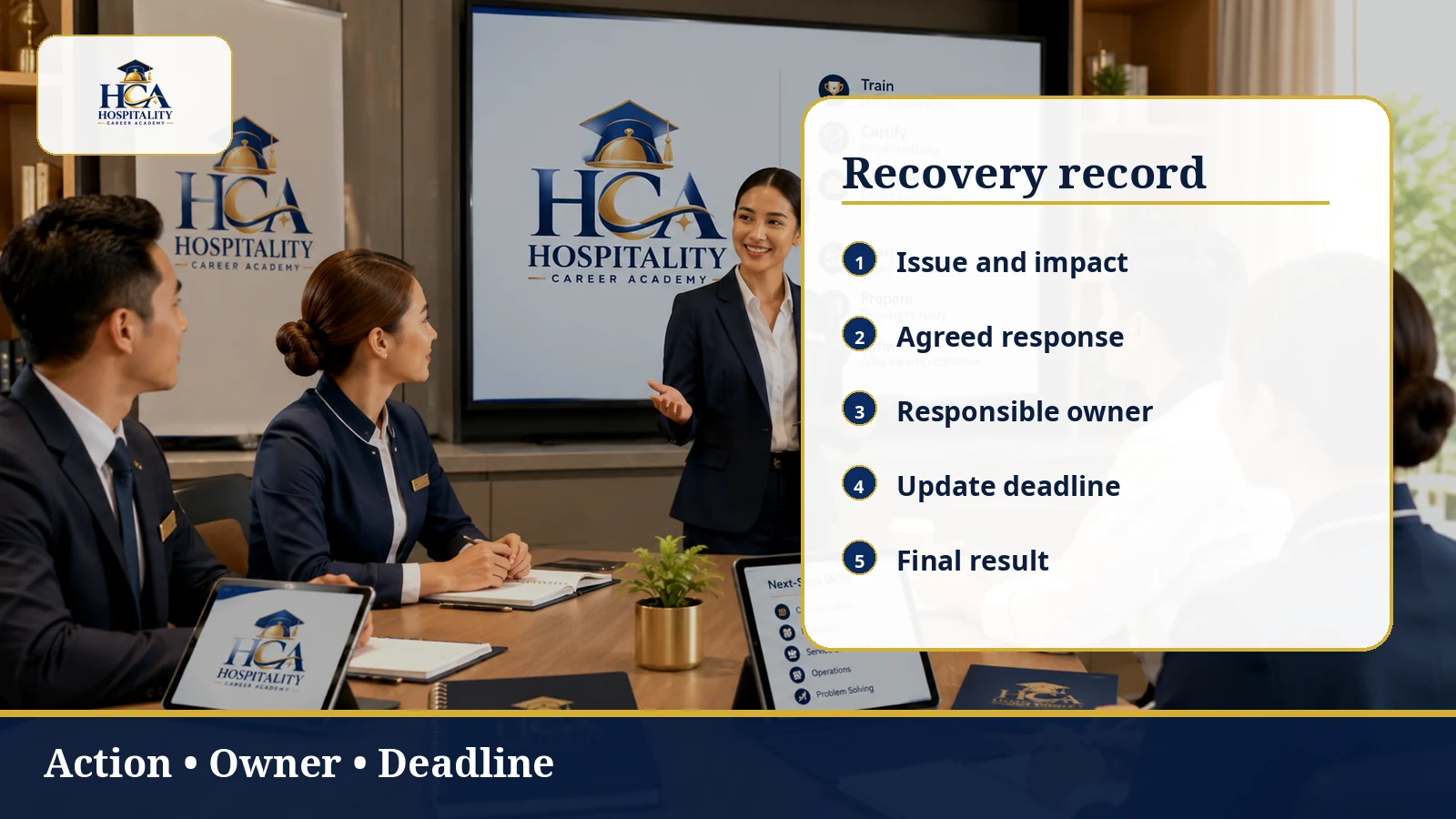
A practical LEARN record can include:
- Issue: What happened, in neutral language.
- Impact: How the guest was affected.
- Guest expectation: What outcome the guest requested or accepted.
- Immediate response: What was done during the interaction.
- Owner: The person or department responsible for the next step.
- Deadline: When the action or update is due.
- Follow-up channel: Call, message, email or face-to-face contact.
- Final result: What was completed and whether the guest confirmed satisfaction.
- Learning tag: A simple category such as room readiness, cleanliness, billing, noise, food quality or communication.
Record only what is required under the organisation’s privacy and retention rules. Sensitive matters involving safety, security, injury, discrimination, suspected crime or legal claims should follow the property’s escalation process.
3. Measure recovery quality with practical indicators
Customer satisfaction cannot be reduced to one number. A useful view combines guest feedback, completion data and recurring operational themes.
Same-stay closure
Was the issue fully resolved while the guest was still in the hotel or outlet? Some problems require longer action, but avoidable delay often increases frustration.
Promised-time compliance
Did the team update or complete the action by the time promised? A realistic promise kept is better than an impressive promise missed.
Reopened cases
Did the guest need to contact the team again because the first solution was incomplete, unclear or not delivered? Reopened cases often reveal weak ownership or handover.
Guest confirmation
Did someone check that the solution worked? A maintenance task may be marked complete while the room is still uncomfortable. Operational completion and guest confirmation are not always the same thing.
Repeat themes
Are several guests reporting the same issue? Repetition matters more than one isolated complaint. A pattern may point to an SOP gap, training need, supplier issue, maintenance defect or misleading guest communication.
Qualitative comments
What words do guests use after the recovery? Comments such as “thank you for keeping me updated” or “I had to explain the problem three times” reveal details that a score alone may miss.
4. Turn individual complaints into operational learning
The “Notify” step should do more than send a message. It should connect the guest’s experience to the people who can prevent a repeat.
A simple review rhythm can work at three levels:
During the shift
- assign an owner and deadline;
- alert departments affected by the solution;
- update the case after each meaningful action;
- include unresolved items in the handover.
Daily briefing
- review open high-priority cases;
- confirm whether promised follow-ups were completed;
- identify any issue affecting multiple rooms, tables or guests;
- agree the next operational control.
Weekly or monthly review
- group cases by cause, not only by department;
- identify repeat failures and reopened cases;
- compare recovery performance across shifts or outlets carefully;
- decide whether the response requires coaching, an SOP change, maintenance, system configuration or clearer guest communication;
- assign one improvement owner and review date.
The goal is not to blame the department with the most complaints. Departments that interact with guests most frequently may also record more issues. Look for root causes, quality of closure and preventable repetition.
5. Coach the behaviour, not only the result
A manager should review both what solution was provided and how the employee handled the guest.
Useful coaching questions include:
- Did the employee let the guest finish?
- Did they confirm the facts before offering a solution?
- Was the empathy statement specific to the impact?
- Did the apology avoid blame or excuses?
- Was the proposed response within the employee’s authority?
- Were the owner and timing clear?
- Was the case documented and followed up?
Avoid coaching only when something goes badly. Recognise examples where an employee listened well, coordinated departments and closed the loop. Positive examples help the team understand what “good” looks like.
Worked hospitality example: delayed room readiness
Situation: A family arrives after a long journey and their room is not ready at the communicated time.
Listen
The receptionist lets the guest explain, confirms the booking details and asks what the family needs immediately.
Empathize
“I understand that waiting with tired children after travelling is especially frustrating.”
Apologize
“I’m sorry that the room was not ready at the time you expected.”
Respond
The receptionist confirms the realistic completion time, offers an authorised waiting option, arranges luggage handling and commits to a personal update by a specific time.
Notify
The case is recorded. Housekeeping and the duty manager receive the agreed deadline. The next update is assigned to one person. After the family enters the room, the receptionist calls to confirm that everything is comfortable.
Operational learning
The next-day review discovers that the room status was changed late because a maintenance defect was not communicated during the previous handover. The corrective action is therefore not “tell reception to apologise better”. It is to improve defect escalation and room-status handover.
LEARN follow-up template
Use this short template in a guest-recovery log or handover:
- Guest concern:
- Confirmed impact:
- Agreed response:
- Responsible owner:
- Action/update due:
- Guest contact preference:
- Status: Open / monitoring / closed
- Guest confirmed resolution: Yes / no / not yet reached
- Root-cause category:
- Preventive action required:
Common mistakes that weaken customer satisfaction
Solving before listening
The employee offers compensation immediately without understanding what the guest actually needs.
Apologising without an action
Repeated apologies can increase frustration when no owner or timing follows.
Overpromising
The team promises an upgrade, refund or completion time that is not authorised or operationally realistic.
Passing the case between departments
The guest repeats the story because every department treats the issue as somebody else’s problem.
Closing the task but not the guest experience
The internal job is marked complete, but nobody confirms whether the guest is satisfied.
Collecting data without improvement
The business gathers complaint reports but never reviews themes or changes the process.
A 30-day implementation plan
Week 1: Standardise
- confirm the property’s LEARN wording;
- define escalation and compensation authority;
- agree the minimum complaint-record fields;
- publish one simple recovery checklist.
Week 2: Practise
- run short role plays using real operational scenarios;
- coach listening, empathy and clear promise-setting;
- practise documenting facts without blame.
Week 3: Review
- begin a daily open-case check;
- identify missed deadlines and reopened cases;
- review one recurring complaint theme.
Week 4: Improve
- implement one root-cause correction;
- share the result with the team;
- recognise good examples;
- set the next review date.
Final takeaway
The LEARN model improves customer satisfaction when it is treated as both a guest-conversation tool and an operational learning system. Listen carefully, empathize with the impact, apologise sincerely, respond with a clear action and notify the people who must complete and learn from the recovery.
A guest should not need to chase the hotel for a promised solution. The strongest hospitality teams make ownership visible, follow up at the agreed time and turn repeated complaints into better procedures, training and communication.
Frequently asked question
How can a hotel measure whether the LEARN model is working?
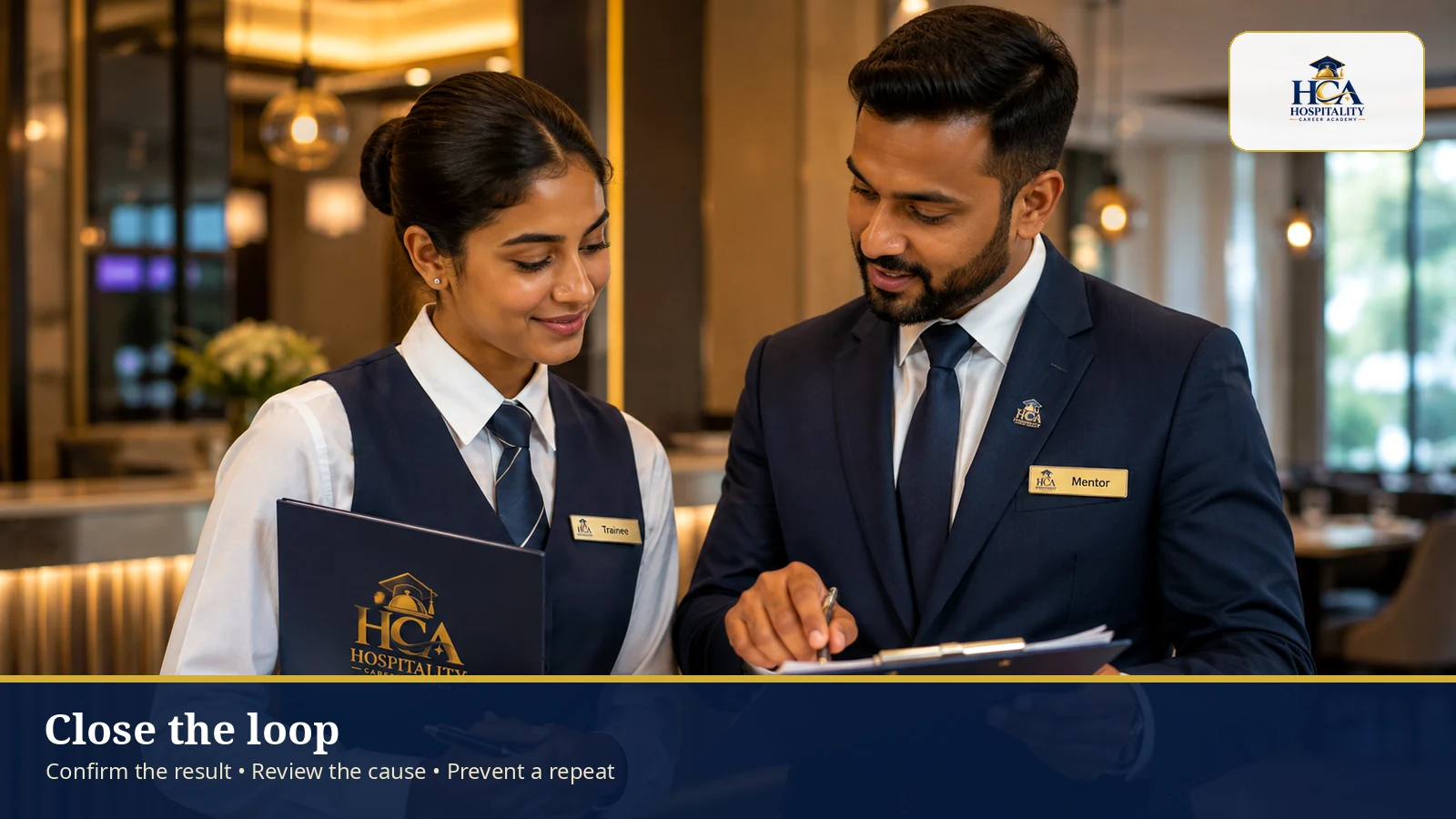
Track whether cases are resolved during the stay, whether promised updates are delivered on time, whether cases reopen, whether the guest confirms the solution and whether recurring complaint causes reduce after corrective action. Combine these indicators with guest comments rather than relying on one score alone.
Sources and update note
- HCA: LEARN Model in Hospitality: 5 Steps for Guest Complaints.
- ISO 10002:2018: guidance for complaints-handling processes within organisations.
Reviewed and substantially rewritten on 2 September 2026. Properties should apply their own authority limits, emergency procedures, privacy rules and complaint-retention requirements.
Related HCA guides
Update references
- LEARN Model in Hospitality: 5 Steps for Guest Complaints — Hospitality Career Academy
- ISO 10002:2018 — Quality management — Customer satisfaction — International Organization for Standardization
Frequently asked question
How can a hotel measure whether the LEARN model is working?
Track same-stay closure, promised-time compliance, reopened cases, guest confirmation and whether repeated causes decline after corrective action. Combine these measures with guest comments rather than relying on one score.
Learn the full LEARN complaint-handling method