
Digital marketing and e-commerce in a hotel are not one job and not one department. Search, content, social media, website accuracy, rate distribution, booking technology, campaign measurement, guest messages and online reputation all touch different teams.
Problems begin when every digital task is sent to one junior employee, or when several departments assume somebody else owns the final result. A social media post may belong to marketing, but the room facts come from operations, the price from revenue, the booking route from e-commerce or reservations, the payment process from finance and technology, and the guest experience from the whole hotel.
This guide explains how hotel teams can separate roles, assign accountability and measure useful outputs without creating silos. It also provides a practical career map for people entering digital marketing or e-commerce in hospitality.
Begin with the difference between marketing and e-commerce
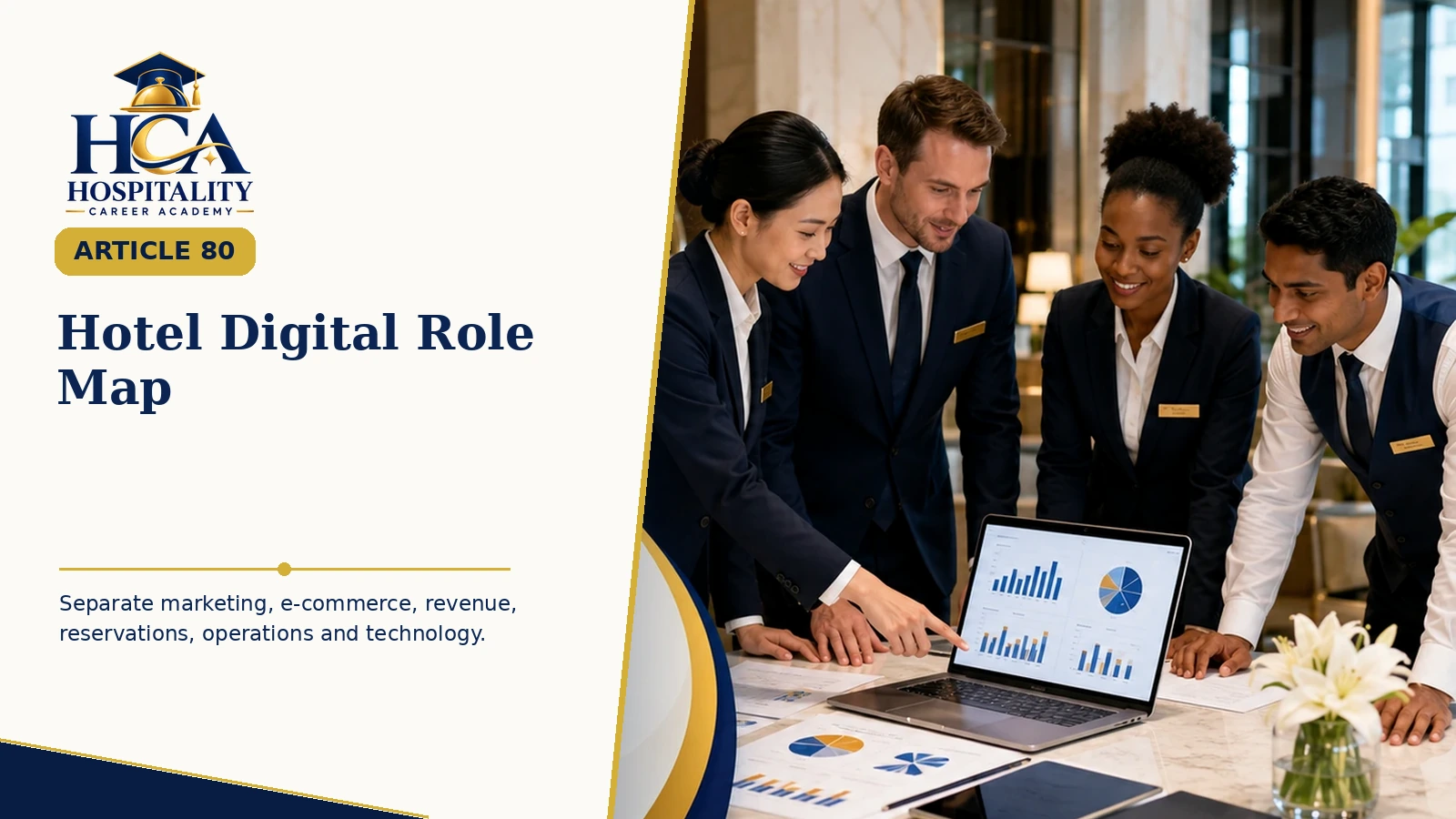
The terms overlap, but they are not identical.
Digital marketing
Digital marketing creates and manages demand, communication and audience relationships through channels such as:
- search and content;
- social media;
- email;
- paid media;
- digital public relations;
- creator or partner campaigns;
- website and landing-page content;
- online reputation and community management.
Hotel e-commerce
Hotel e-commerce makes products discoverable, bookable, measurable and commercially controlled across digital channels. It commonly includes:
- website and booking-engine health;
- room, rate and package content;
- direct booking conversion;
- OTA and metasearch coordination;
- distribution and channel mapping;
- digital merchandising;
- transaction and funnel measurement;
- campaign landing paths;
- reconciliation with booking and stayed business.
In a small hotel, one person may support both areas. The responsibilities still need to be named separately.
Core roles in a hotel digital-commercial team
Job titles vary by property size, brand and market. Focus on outcomes and authority, not labels alone.
1. Marketing or commercial leader
Main purpose
Connect business priorities, positioning, segments, campaigns and budget.
Typical responsibilities
- set the annual and quarterly marketing direction;
- approve target audiences and messages;
- coordinate with sales, revenue, rooms, food and beverage, spa and events;
- control budget and agency relationships;
- protect brand standards;
- approve campaigns according to authority;
- review commercial contribution and learning.
Useful KPIs
Campaign contribution, qualified demand, budget control, brand accuracy, speed of cross-department approval and delivery of agreed commercial priorities.
2. Digital marketing specialist or coordinator
Main purpose
Plan and execute digital campaigns and content across approved channels.
Typical responsibilities
- manage content calendars;
- prepare campaign briefs;
- coordinate copy, design, photography and video;
- build or update landing content;
- support email and paid campaigns;
- apply campaign tracking;
- monitor channel performance;
- document approvals and rights;
- report findings and next actions.
Useful KPIs
On-time delivery, fact-error rate, qualified traffic, campaign actions, cost per meaningful action, landing-page quality and implementation of approved learning.
3. Social media and community specialist
Main purpose
Manage social publishing, conversation, reputation signals and escalation.
Typical responsibilities
- create platform-specific content;
- schedule approved posts;
- respond to comments and messages;
- route enquiries and complaints;
- maintain permissions and content rights;
- support creator partnerships;
- track audience and content themes;
- report operational insights from guest conversations.
Useful KPIs
Response quality and time, resolved or correctly routed cases, useful engagement, qualified actions, rights compliance and content accuracy—not follower count alone.
4. E-commerce or digital distribution specialist
Main purpose
Protect digital product accuracy, channel health, conversion and net value.
Typical responsibilities
- maintain website and booking-engine products;
- coordinate room, rate, package and policy content;
- check direct and third-party booking paths;
- support OTA and metasearch controls;
- review availability and mapping;
- monitor conversion and booking defects;
- reconcile analytics with reservations;
- raise technical or commercial issues;
- coordinate testing and controlled improvements.
Useful KPIs
Booking-path availability, mapping accuracy, content completeness, conversion progression, transaction errors, direct or channel net contribution and issue-resolution time.
5. Revenue management
Main purpose
Control pricing, availability and restrictions in line with demand and business strategy.
Digital responsibilities
- approve rates and restrictions;
- manage inventory and channel availability;
- define offer conditions;
- review displacement and need periods;
- support campaign pricing;
- monitor channel and segment contribution;
- verify that displayed commercial conditions match the approved strategy.
Useful KPIs
Revenue and profitability measures, forecast accuracy, channel mix, availability control, offer performance and pricing or restriction error rate.
Marketing or e-commerce should not invent a rate without revenue approval.
6. Reservations and contact-centre team
Main purpose
Convert and service enquiries accurately across telephone, email and approved messaging routes.
Digital responsibilities
- understand live offers and policies;
- assist guests who cannot complete a digital booking;
- record reasons for assisted conversion;
- report repeated website questions or defects;
- protect payment and privacy rules;
- confirm booking details;
- manage modifications and cancellations within authority.
Useful KPIs
Accuracy, response time, conversion quality, repeat-contact rate, escalation quality and correct capture of booking-source or issue reasons.
7. Content, design and production support
This may be an internal employee, cluster team, freelancer or agency.
Responsibilities
- translate the brief into approved assets;
- use current, representative product imagery;
- apply brand and accessibility requirements;
- prepare correct sizes and formats;
- preserve source files and licences;
- avoid unapproved claims or invented facts;
- deliver versions for required languages and channels.
Useful KPIs

Brief compliance, revisions caused by creative error, accessibility, asset performance, rights completeness and on-time delivery.
8. Public relations and communications
Responsibilities
- media and stakeholder communication;
- approved announcements;
- reputation and crisis coordination;
- executive or spokesperson support;
- partnership communication;
- control of sensitive or high-risk public responses.
PR is not the same as routine social publishing. Legal, safety, discrimination, regulator or serious media issues need an authorised route.
9. Technology, web and data support
Responsibilities
- website and integration reliability;
- tag and analytics implementation;
- access control;
- consent and privacy configuration;
- booking-engine and API support;
- performance, security and backups;
- defect investigation;
- change, testing and rollback support.
The commercial team defines the business requirement; technology protects implementation quality.
10. Operational fact owners
Rooms, food and beverage, spa, events, engineering, security and other departments own the reality behind the content.
They must verify:
- product description;
- operating hours;
- capacity;
- inclusions;
- safety conditions;
- accessibility details;
- fulfilment readiness;
- temporary closures or changes.
Marketing communicates the promise; operations confirms it can be delivered.
Three team structures
Small independent property
One marketing or commercial coordinator may manage content, website updates, social media and basic e-commerce support. To reduce risk:
- appoint department fact owners;
- define which rate and distribution changes require revenue or management approval;
- use an agency only with clear access and rights controls;
- maintain a simple approval matrix;
- separate payment handling from public messaging.
Full-service hotel
A larger property may have specialist roles in marketing, e-commerce, revenue, sales and communications. The main risk is fragmentation. Use a shared calendar, weekly digital-commercial meeting and one issue log.
Cluster or corporate model
A central team may manage platforms, campaigns or distribution for several properties. Each property still needs local fact owners, operational approval and responsibility for guest delivery. The cluster team should not publish outdated information because the hotel failed to communicate a change.
The hotel digital workflow
Every campaign or material digital change should follow a controlled workflow.
Step 1: Business brief
Record:
- business need;
- product;
- audience;
- dates;
- approved offer;
- owner;
- budget;
- required action;
- primary KPI;
- risk or dependency.
Step 2: Fact collection
Obtain current information from revenue, reservations, operations, finance and other owners. Do not copy an old campaign without revalidation.
Step 3: Channel and journey design
Choose the channel based on audience and action. Map the path from message to landing page, booking or enquiry, confirmation and operational fulfilment.
Step 4: Production
Create copy, visual, page, tracking and required language versions. Follow rights, accessibility, brand and data rules.
Step 5: Approval
The approval matrix may include:
- fact owner;
- revenue or commercial approver;
- brand or marketing approver;
- legal, privacy, finance or safety reviewer when relevant;
- final publishing authority.
Step 6: Preflight test
Test links, dates, price, inventory, language, mobile display, tracking, payment, confirmation and receiving team knowledge.
Step 7: Publish and monitor
Watch technical health, guest response, booking or enquiry quality, spend and operational capacity. Use stop rules for inaccurate, unavailable or harmful content.
Step 8: Reconcile and learn
Compare campaign analytics with booking, PMS, restaurant, sales or finance evidence. Report:
- what happened;
- why it may have happened;
- confidence and limitations;
- what to continue, stop or test;
- owner and due date.
A practical RACI example
For a direct room offer:
- Accountable: marketing or commercial leader;
- Responsible for rate and restrictions: revenue;
- Responsible for product facts: rooms division;
- Responsible for website and campaign execution: digital marketing/e-commerce;
- Consulted: reservations, finance, technology and brand;
- Informed: front office, guest relations and other receiving teams.
The exact model varies, but one accountable owner is essential.
Role boundaries that protect quality
- Social media should not promise compensation without authority.
- Marketing should not create room facts or prices.
- Revenue should not publish guest-facing copy without communication review.
- Agencies should not own the only account credentials.
- Designers should not invent inclusions to fill a layout.
- Reservations should not collect card data through unapproved channels.
- Technology should not decide the commercial objective alone.
- Analysts should explain measurement limits rather than presenting every number as exact.
Building a career in hotel digital marketing or e-commerce
Entry-level professionals can develop through practical evidence.
Core skills
- clear writing and proofreading;
- hotel product and guest-journey knowledge;
- spreadsheet and reporting confidence;
- basic analytics and campaign tracking;
- content management systems;
- search and website fundamentals;
- social and community management;
- commercial awareness;
- data, privacy and payment awareness;
- project coordination;
- bilingual content quality where relevant.
O*NET describes search marketing work as using search tactics, analysing query behaviour, understanding user intent and measuring outcomes for optimisation. In hotels, those skills must be connected to real inventory, rates, booking systems and guest service.
Portfolio evidence
A useful portfolio may include:
- a corrected hotel landing page;
- a bilingual content calendar;
- a campaign brief and approval record;
- a booking-path audit;
- an SEO content improvement;
- a social response and escalation matrix;
- a simple dashboard with business decisions;
- a before-and-after case that explains limitations honestly.
Do not include confidential guest, rate, performance or company data without permission.
A 90-day team improvement plan
Days 1–30: Clarify ownership
- list every digital channel and system;
- name business, fact and technical owners;
- review access and agencies;
- map current workflow;
- identify duplicate or missing responsibilities.
Days 31–60: Standardise execution
- introduce one brief and approval template;
- create a shared calendar;
- define KPIs by role;
- test campaign and booking paths;
- train receiving teams;
- clean expired content.
Days 61–90: Measure and improve
- reconcile channel data with real business;
- review errors and delays;
- clarify authority boundaries;
- improve one major workflow;
- set the next-quarter priorities.
Common mistakes
- assigning all digital work to one junior employee;
- measuring every role by followers or traffic;
- confusing SEO with paid search;
- separating website content from rates and availability;
- publishing before operational approval;
- allowing several teams to edit without ownership;
- reporting bookings without cancellations or net value;
- ignoring Arabic or mobile quality;
- using agencies without access and rights controls;
- treating digital marketing as separate from guest service.
Frequently asked question
Who owns hotel e-commerce?
A named commercial or e-commerce owner should be accountable, but execution is shared. Revenue owns rates and inventory, operations owns product facts and delivery, reservations supports conversion, technology protects systems, and marketing connects demand and communication.
Final takeaway
Hotel digital performance depends less on having perfect job titles and more on clear ownership, safe handovers and useful measurement. Each role should know what it owns, what it may approve, what it must verify and when it must escalate.
Use the HCA responsibility matrix to map activities across marketing, e-commerce, revenue, reservations, operations, finance and technology. Then close the most important ownership gap before adding another channel or campaign.
Practical HCA working resource supplied with this article.
Download Hotel Digital Marketing and E-Commerce RACI Matrix (CSV)
Frequently asked question
Who owns hotel e-commerce?
A named commercial or e-commerce owner should be accountable, but execution is shared. Revenue owns rates and inventory, operations owns product facts and delivery, reservations supports conversion, technology protects systems, and marketing connects demand and communication.