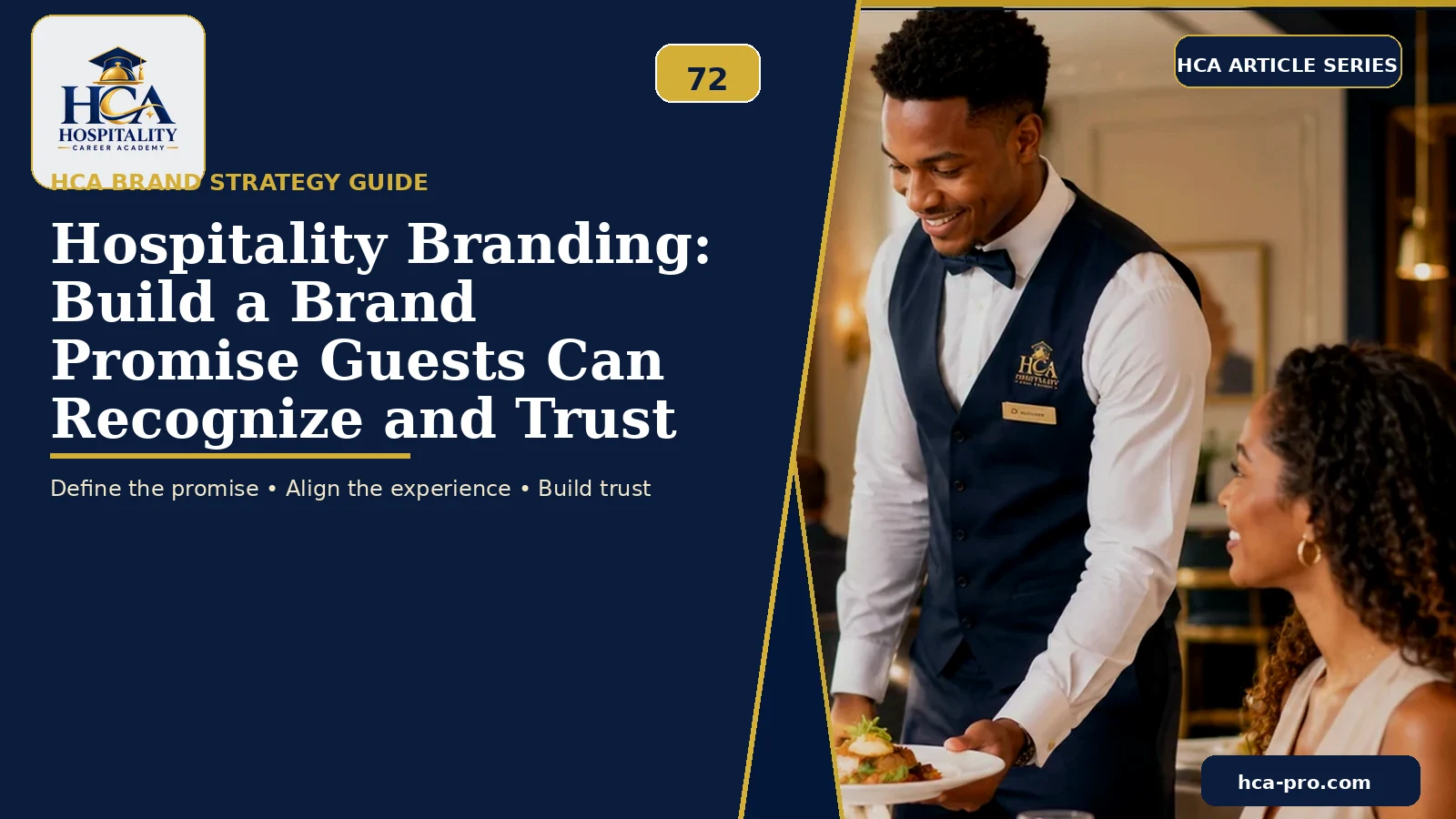
A hospitality brand is not only a name, logo, colour palette or advertising style. It is the expectation created before a visit and the experience remembered afterwards. In a hotel, restaurant, café, resort or serviced residence, the brand is tested through booking information, arrival, cleanliness, food, staff behaviour, problem-solving, billing and farewell.
This is why branding cannot belong to the marketing team alone. Marketing may express the promise, but operations must deliver it. A beautiful identity with an inconsistent guest experience creates disappointment more quickly, because the communication raises an expectation the business cannot reliably fulfil.
This guide explains how to build a practical hospitality brand system: who the business is for, what it promises, how that promise becomes operating behaviour, and how leaders can review whether the experience still matches the message.
Brand, identity and trademark are related—but different

These terms are often mixed together.
- Brand: the meaning and expectation people associate with the business.
- Brand identity: the controlled verbal and visual system used to express that meaning—name, logo, colours, typography, imagery and voice.
- Positioning: the place the business wants to occupy in the mind of a chosen audience compared with alternatives.
- Brand promise: the experience or value the business commits to delivering consistently.
- Trademark: a legal sign or identifier that may protect parts of the brand in relevant jurisdictions.
WIPO explains that trademarks distinguish the goods or services of one enterprise from those of others. Legal protection is important, but registration alone does not create a strong hospitality brand. The guest experience still has to earn recognition and trust.
Why branding matters especially in hospitality
Hospitality products are experienced over time. A guest cannot fully inspect a stay, event or dinner before purchasing it. They rely on photographs, descriptions, reviews, recommendations, price signals and the reputation of the business.
A clear brand helps the guest answer:
- Is this place suitable for me?
- What kind of experience should I expect?
- Why should I choose it over alternatives?
- Can I trust the promise?
- Will the price feel justified?
- Will the experience be consistent across touchpoints?
A strong brand also helps employees make decisions. If the promise is clear, teams can understand what “on brand” means in service recovery, room presentation, menu language, telephone communication and guest recognition.
The hospitality brand architecture
A practical brand system contains several connected elements.
| Element | Question it answers |
|---|---|
| Purpose | Why does the business exist beyond selling? |
| Audience | Whose needs and situations are the priority? |
| Positioning | What relevant space should the brand own? |
| Promise | What should guests be able to rely on? |
| Personality | How should the brand feel and communicate? |
| Service principles | What behaviours make the promise real? |
| Proof | What evidence supports the claim? |
| Identity | How is the brand recognised visually and verbally? |
| Governance | Who protects consistency and approves change? |
| Measurement | Where is the gap between promise and delivery? |
If one element is missing, the brand becomes weaker. A logo without positioning is decoration. A promise without service principles is wishful thinking. A campaign without proof is a risk.
Step 1: Begin with evidence, not adjectives
Many brand workshops begin by choosing attractive words such as “luxurious”, “authentic”, “innovative” or “friendly”. These words are too broad unless they are supported by evidence and translated into specific choices.
Start with four evidence groups.
Guest evidence
Review:
- why guests choose the property;
- what they mention positively or negatively;
- the questions they ask before booking;
- the moments they photograph or share;
- reasons for repeat visits;
- reasons for cancellation or disappointment;
- differences between audience groups.
Business evidence
Understand:
- location and physical product;
- service model and staffing;
- price position;
- profitable and strategic demand;
- ownership priorities;
- distribution dependence;
- planned investment and limitations.
Competitor and alternative evidence
The guest may compare the hotel not only with a direct competitor, but also with:
- serviced apartments;
- short-term rentals;
- different neighbourhoods;
- another restaurant concept;
- staying at home;
- postponing the trip;
- choosing a lower or higher price level.
Identify what the alternatives promise and where the property can be meaningfully different.
Employee evidence
Frontline teams often know where the public message and operational reality do not match. Ask them:
- What do guests expect incorrectly?
- Which promise is hardest to deliver?
- What service behaviour earns praise?
- Where do departments interpret the brand differently?
- What should never be compromised?
Step 2: Define the priority audience and position
A brand designed for everyone usually becomes vague. Define the audience situations the business is best equipped to serve.
A useful positioning statement can follow this structure:
For [priority audience in a relevant situation], [brand] is the [category or frame of reference] that provides [distinctive value], because [credible proof].
Illustrative hotel example:
For regional professionals who need a calm, efficient base for short business stays, Harbour Lane is the city hotel that makes work travel feel uncomplicated, because it combines fast access, quiet rooms, practical workspaces and responsive service.
This is an invented training example, not a claim about a real hotel. The value is in the structure: audience, situation, category, difference and proof.
Step 3: Write a promise the operation can deliver
A good brand promise is:
- relevant to the chosen audience;
- distinctive enough to guide choice;
- simple enough for employees to remember;
- credible based on real capabilities;
- measurable through guest experience;
- flexible enough to work across channels;
- specific enough to influence decisions.
Weak promise:
Unforgettable luxury for everyone.
Stronger operational promise:
Thoughtful city stays that remove friction from arrival to departure.
The second promise can shape real standards: accurate pre-arrival information, efficient check-in, quiet room readiness, clear directions, reliable Wi-Fi support, simple billing and proactive problem resolution.
Step 4: Convert the promise into service principles
A brand becomes useful when employees can act on it. Create three to five service principles with observable behaviour.
Example for a brand promising “calm, uncomplicated stays”:
Be prepared
- Review arrivals and special requests.
- Confirm room and booking information.
- Resolve obvious gaps before the guest asks.
Be clear
- Explain options and conditions in plain language.
- Confirm the next step and timing.
- Avoid transferring guests without ownership.
Protect the guest’s time
- Remove repeated questions.
- Use efficient handovers.
- Escalate delays early.
Close the loop
- Record requests.
- Confirm completion.
- Follow up when the issue matters.
These principles can then be built into SOPs, training, briefings and performance conversations.
Step 5: Design the verbal identity
The verbal identity controls how the brand sounds.
Define:
- preferred tone;
- level of formality;
- sentence style;
- words the brand uses;
- words it avoids;
- how it welcomes and apologises;
- how it communicates limits;
- how English and Arabic versions preserve the same character;
- how emergency or legal communication becomes appropriately direct.
A friendly brand should not sound childish. A luxury brand should not use complicated language merely to appear sophisticated. Clarity is part of service.
Example voice guide
| Situation | Preferred approach |
|---|---|
| Welcome | Warm, specific and confident |
| Offer | Clear value, full conditions and one action |
| Complaint | Calm acknowledgement, ownership and next step |
| Delay | Honest timing and available alternatives |
| Social reply | Human, brief and privacy-aware |
| Policy | Respectful, direct and non-judgemental |
Arabic localisation should carry the intended personality naturally rather than copy English sentence structure. Titles, calls to action and hospitality terminology need a native-language review.
Step 6: Build a visual identity that supports recognition
A visual system may include:
- primary and secondary logos;
- icon;
- colour palette;
- typography;
- photography direction;
- graphic shapes and patterns;
- signage;
- uniforms and name badges;
- templates for menus, offers and presentations;
- digital and social layouts;
- accessibility rules;
- correct and incorrect usage.
Consistency helps recognition, but consistency does not mean every asset must look identical. The system should be flexible enough for rooms, food, careers, events and corporate communication while remaining recognisably one brand.
Protect readability. Do not place long text on busy photographs, use weak contrast, or make the logo so small that it becomes meaningless. W3C accessibility guidance is written for digital content, but principles such as text alternatives, readable contrast and understandable presentation are useful for hospitality websites and linked campaign pages.
Step 7: Map the brand across the guest journey

The promise should be visible before, during and after the experience.
Discovery
- search result;
- social post;
- online travel listing;
- map profile;
- public relations;
- recommendation.
Consideration
- website;
- room and menu descriptions;
- photographs;
- reviews;
- sales proposal;
- telephone and chat response.
Booking
- rate and package clarity;
- payment and cancellation conditions;
- confirmation message;
- pre-arrival communication.
Arrival and stay
- physical signage;
- greeting;
- room condition;
- service speed;
- food and beverage;
- problem resolution;
- employee confidence.
Departure and relationship
- bill accuracy;
- farewell;
- feedback request;
- loyalty communication;
- follow-up and recovery.
Create a journey audit. For each touchpoint, record the intended promise, current experience, evidence, owner and improvement action.
Step 8: Align the product and commercial choices
Branding is not a layer added after the product is designed. It should influence:
- room and public-area choices;
- service level;
- menu design;
- packages and partnerships;
- distribution channels;
- pricing presentation;
- amenities;
- event style;
- technology and self-service;
- recruitment and training.
If a hotel promises local connection but uses generic destination content and no local partnerships, the promise lacks proof. If it promises simple value but has confusing fees and booking conditions, the commercial experience contradicts the brand.
Step 9: Govern the brand
Without governance, brand assets and messages drift.
A practical governance model should define:
- brand owner;
- operational owner of each promise;
- approved asset library;
- template access;
- naming and logo rules;
- approval levels;
- translation and localisation process;
- photography and people permissions;
- claims and sustainability evidence;
- creator and agency rules;
- crisis communication authority;
- version control;
- review schedule.
Do not share unapproved logos through informal messaging groups and expect consistency. Maintain one controlled source of current files.
Step 10: Measure the promise-delivery gap
Brand performance is not measured only by awareness. Use evidence from several levels.
| Level | Useful questions and measures |
|---|---|
| Recognition | Do people correctly identify and recall the business? |
| Relevance | Does the chosen audience see the offer as suitable? |
| Consideration | Do qualified users explore rooms, menus or proposals? |
| Conversion | Does the brand support booking or enquiry quality? |
| Delivery | Are the promised standards achieved consistently? |
| Trust | Are information, reviews and recovery handled credibly? |
| Loyalty | Do suitable guests return, recommend or deepen use? |
| Employee alignment | Can employees explain and demonstrate the promise? |
Avoid claiming that a logo change caused revenue growth when price, demand, distribution and product also changed. Use tests, guest feedback and operational measures together.
A practical brand audit
Score each item from 1 to 5 and require evidence.
- Priority audience is clear.
- Positioning is distinct and credible.
- Brand promise is understood internally.
- Product supports the promise.
- Service principles are observable.
- Website and listings are accurate.
- English and Arabic communication feel consistent.
- Visual assets are controlled and readable.
- Guest reviews support the intended experience.
- Employees receive brand training.
- Claims have proof.
- Leaders act when delivery misses the promise.
The score is a diagnostic, not a vanity rating. The action plan matters more than the total.
Branding examples across hospitality operations
Front office
A brand promising personal recognition may require teams to review preferences, use names naturally and coordinate repeat-guest information under privacy rules. It does not mean using a guest’s name excessively.
Housekeeping
A brand promising calm comfort should define room presentation, noise control, scent, lighting and defect standards—not only a colour palette.
Restaurant
A brand promising modern local dining needs menu language, ingredients, ambience and service knowledge that support the idea.
Sales and events
A brand promising dependable simplicity should produce accurate proposals, clear packages, fast handovers and controlled changes.
Service recovery
The way a business responds when something goes wrong may be the strongest proof of its brand. The apology, authority, solution and follow-up should reflect the promise.
Rebranding: when change is justified
Consider a rebrand when:
- the business model or target market has materially changed;
- the current identity no longer works across digital and physical uses;
- the brand architecture is confusing;
- ownership or portfolio strategy requires a clearer system;
- research shows a serious relevance or trust gap;
- expansion creates naming or legal problems.
Do not rebrand merely because the team is bored with the logo. First diagnose whether the real problem is product quality, unclear targeting, weak service, inconsistent content or outdated identity.
Before changing a protected name or logo, conduct appropriate trademark and legal checks for the relevant markets. WIPO and national or regional trademark offices provide official starting points, but legal advice may be needed.
Common hospitality branding mistakes
- treating branding as graphic design only;
- copying the language of competitors;
- choosing generic adjectives without proof;
- promising a service level the operation cannot deliver;
- using different facts and tone across channels;
- translating words without localising meaning;
- changing logos without updating operational behaviour;
- allowing agencies to invent unverified offers;
- ignoring employee understanding;
- measuring only followers or impressions;
- using sustainability or social claims without evidence;
- confusing trademark registration with guest trust.
Frequently asked question
What is the most important part of a hospitality brand?

The most important part is a credible promise that the organisation can deliver consistently. The logo, voice and campaigns should express that promise, while operations, people and product provide the proof.
Final takeaway
A hospitality brand is an operating commitment made visible. Start with evidence, choose the audience, define a credible position, write a clear promise and convert it into service principles. Then align the identity, guest journey, product, people and measurement.
Use the HCA brand-promise audit to identify where the message and experience support each other—and where the business must improve before making a louder claim.
Bilingual audit for positioning, promise, service principles, touchpoints, evidence, ownership and improvement actions.
Download Hospitality Brand Promise and Guest-Journey Audit (CSV)
Related HCA guides
- hotel marketing plan
- hospitality target market
- luxury service training
- hotel social media marketing
- hotel marketing channels and measurement
Update references
- The Importance of Branding in Hospitality Marketing — Hospitality Career Academy
- Trademarks — World Intellectual Property Organization
- Trade marks — European Union Intellectual Property Office
- Accessibility Principles — W3C Web Accessibility Initiative
- Plan your business: Market research and competitive analysis — U.S. Small Business Administration
- Hotel Marketing Plan: A Practical Framework for Hotels and Resorts — Hospitality Career Academy
Frequently asked question
What is the most important part of a hospitality brand?
A credible promise the organisation can deliver consistently. The identity and campaigns express it, while operations, people and product provide the proof.