The LEARN model is a five-step hospitality service-recovery method:
- L — Listen
- E — Empathize
- A — Apologize
- R — Respond
- N — Notify
It helps an employee slow down a tense interaction, understand the impact, agree a realistic solution and make sure the organisation learns from the issue. Some companies use a slightly different word—such as Resolve instead of Respond—so employees should follow the version documented by their property.
Use LEARN for complaints and service failures. For a normal request or recommendation, the GUEST service model is usually a lighter and more suitable sequence.
LEARN at a glance
| Step | Guest-facing purpose | Operational result |
|---|---|---|
| Listen | Understand what happened and what matters now | Reliable facts and confirmed impact |
| Empathize | Recognise the guest’s experience | Reduced defensiveness and stronger trust |
| Apologize | Acknowledge the poor experience sincerely | Clear ownership without blame-shifting |
| Respond | Offer an authorised, proportionate solution | Action, owner, deadline and guest agreement |
| Notify | Record, hand over, follow up and learn | Closed loop and prevention of recurrence |
Before LEARN: make the situation safe
A complaint framework does not replace emergency or security procedures. Act first when the concern involves:
- immediate medical risk;
- fire, violence or suspected crime;
- safeguarding or harassment;
- threats to a guest or employee;
- data exposure or payment-card risk;
- a missing child or vulnerable person;
- a serious engineering hazard.
Follow the property’s emergency and escalation process. Do not promise secrecy, admit legal liability, confront a suspected offender or investigate beyond your role. Move the conversation to a quieter place when appropriate, while respecting the guest’s preference and personal safety.
Step 1: Listen without becoming defensive
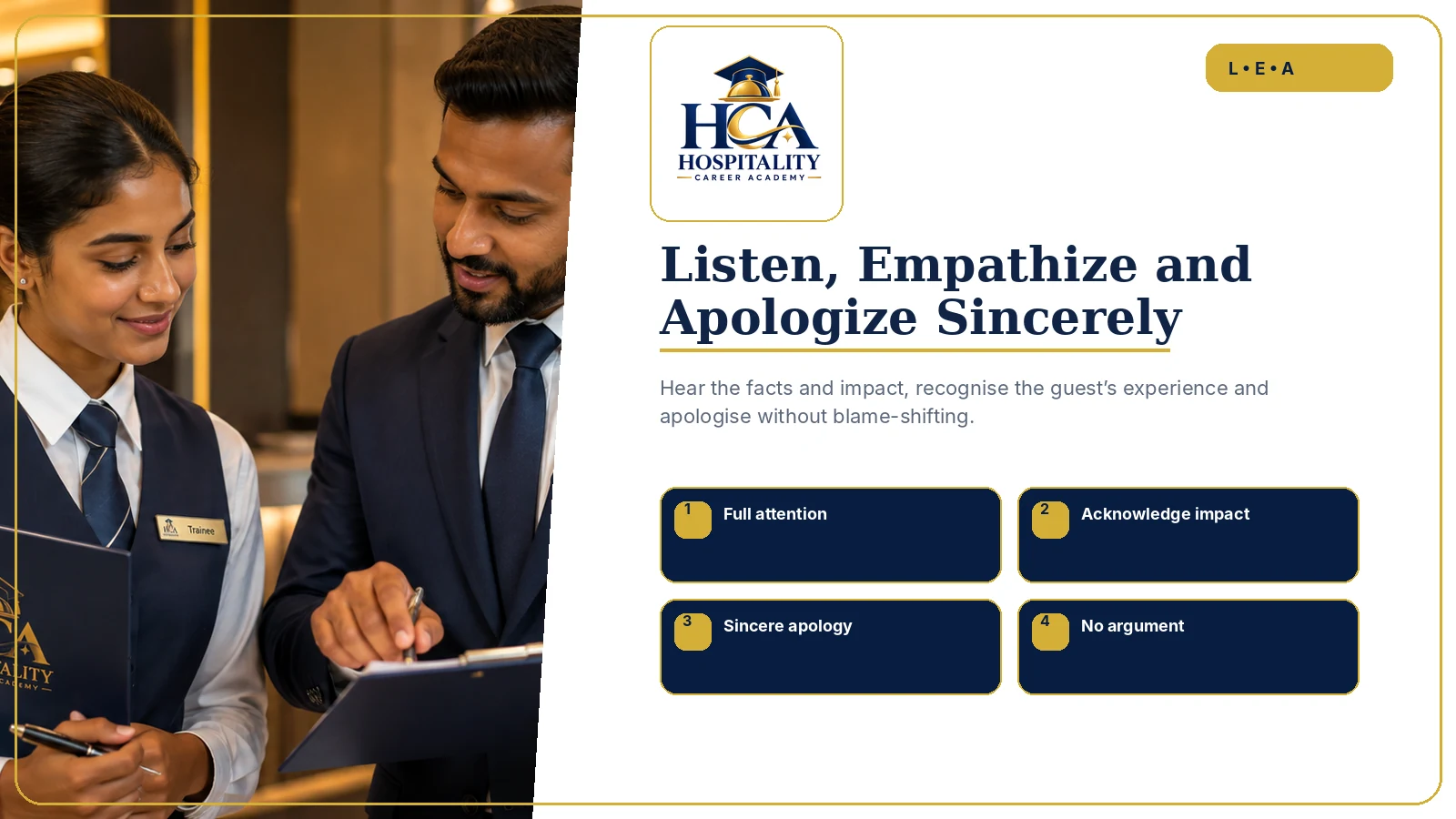
The employee’s first job is to understand—not to win an argument. Let the guest explain the issue, avoid interrupting and listen for both facts and impact.
A practical listening sequence
- Give full attention.
- Allow the guest to finish the main account.
- Ask short clarifying questions.
- Repeat the essential facts.
- Confirm what matters most now.
Useful phrases
- “Please tell me what happened from the beginning.”
- “May I confirm when the issue started?”
- “So the room was not ready at the promised time, and you missed part of your appointment. Is that correct?”
- “What would help you most right now?”
Avoid
- “That is not my department.”
- “No one else complained.”
- “You must have misunderstood.”
- interrupting with explanations before the guest finishes;
- forcing the guest to repeat the story to several people.
Listening does not mean agreeing with every conclusion. It means gathering the information needed to respond fairly and safely.
Step 2: Empathize with the impact
Empathy recognises how the situation affected the guest. It should be specific enough to sound human but not exaggerated or theatrical.
A useful empathy formula
“I understand that [specific impact] is especially [frustrating/disappointing/difficult], particularly because [context].”
Examples
- “I understand that waiting in the lobby with young children after a long flight is exhausting.”
- “I can see why being woken by noise before an early meeting was frustrating.”
- “I understand that receiving a dish containing an ingredient you asked us to avoid is concerning.”
- “I can appreciate how stressful it is not to know whether your airport car is confirmed.”
Avoid telling the guest to calm down, comparing the problem with someone else’s experience or using empty phrases such as “I know exactly how you feel.”
Step 3: Apologize sincerely
A sincere apology acknowledges the experience without blaming the guest or another department.
Strong apology examples
- “I’m sorry we did not have the room ready at the time we confirmed.”
- “Please accept my apology for the repeated calls you had to make.”
- “I’m sorry the meal did not meet the dietary instruction recorded with the order.”
- “I apologise that our handover failed and you were left without an update.”
Weak or harmful apologies
- “I’m sorry if you were upset.”
- “I’m sorry, but housekeeping was busy.”
- “It was the system’s fault.”
- “You should have told us earlier.”
An apology is not the same as making a legal admission. Employees should use the approved wording and escalate high-risk cases.
Step 4: Respond with an authorised solution
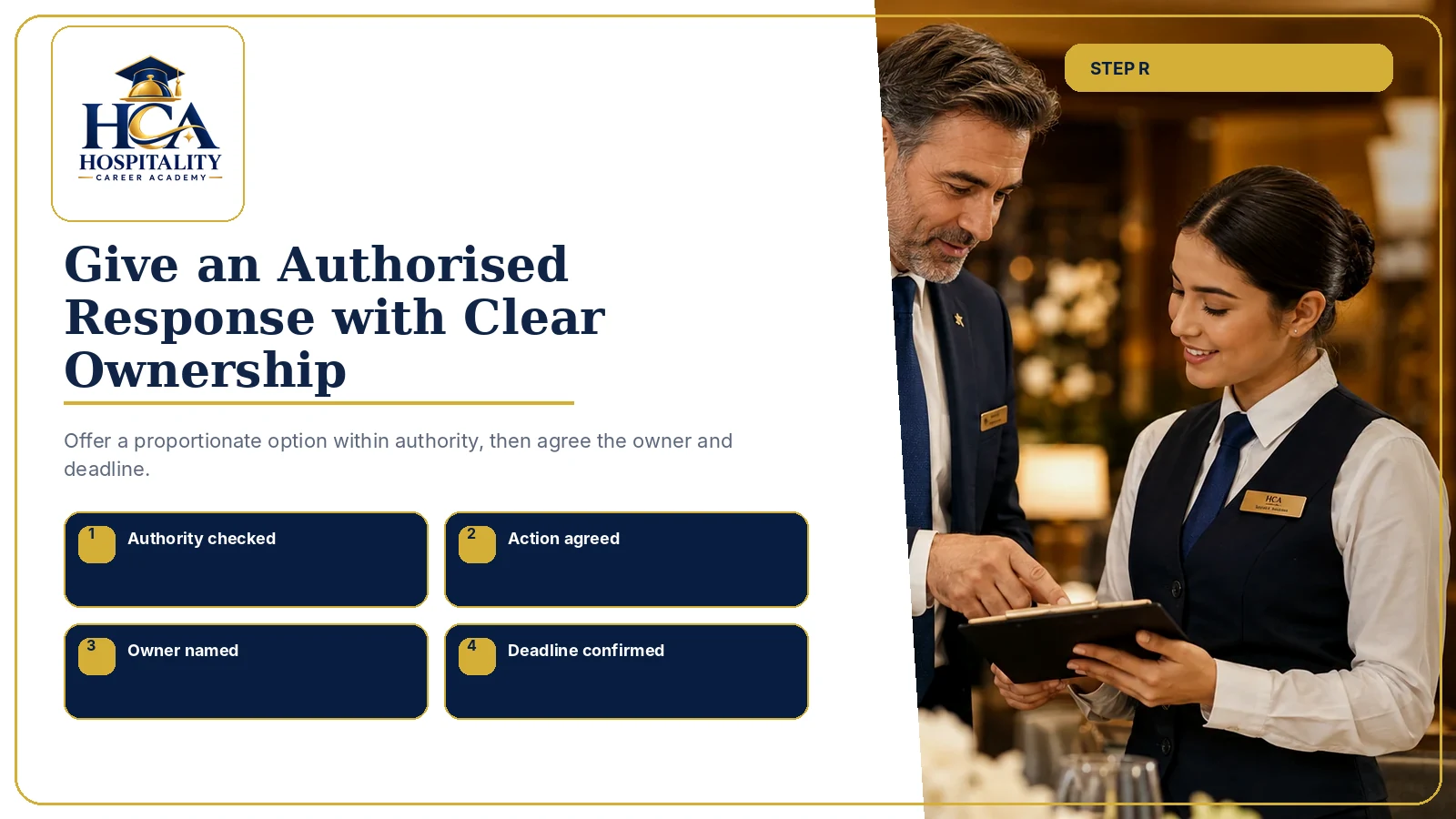
A strong response is proportionate to the impact, within authority and operationally deliverable. The employee should explain the option, confirm the guest accepts it and state exactly who will do what by when.
Response formula
“Here is what I can do now: [action]. I will personally [ownership] and update you by [specific time]. If that does not resolve the issue, the next step is [escalation].”
Three levels of response
| Level | Typical examples | Control required |
|---|---|---|
| Frontline action | replacement item, immediate re-clean, accurate information, priority follow-up | Within documented role authority |
| Supervisor action | room move, approved amenity, fee adjustment, alternative service arrangement | Supervisor approval or defined limit |
| Manager/specialist escalation | significant refund, safety concern, discrimination allegation, legal threat, data incident | Duty manager, security, HR, finance, legal or other specialist process |
The table is a training guide, not a universal compensation policy. Each property must define its own authority matrix.
Good response habits
- Offer the nearest workable solution, not an unrealistic ideal.
- Explain constraints honestly.
- Give alternatives when the preferred option is unavailable.
- State price or compensation terms clearly.
- Ask whether the guest accepts the proposed action.
- Agree the contact method for delayed solutions.
- Never promise an upgrade, refund or benefit outside your authority.
Step 5: Notify, document and follow up
A polite conversation can still fail if the internal hand-off is weak. Notify means recording the case, assigning ownership, briefing the right people and checking that the solution worked.
Minimum complaint record
Record only relevant information in the approved system:
- date and time;
- guest or booking reference according to privacy rules;
- factual description of what happened;
- guest impact and priority;
- action agreed;
- responsible owner or department;
- deadline or promised update time;
- preferred contact channel;
- approval or compensation reference where applicable;
- final outcome and follow-up result;
- recurring cause or prevention action if identified.
Avoid judgemental language, unnecessary personal detail and unverified accusations. Write facts that another colleague can understand and act on.
Close the loop
Follow up after the action is complete:
- “Mr Saleh, I’m calling to confirm that the engineer attended and the air conditioning is now comfortable.”
- “Ms Dina, the revised invoice has been emailed. May I confirm that the amount is now correct?”
- “I wanted to check that the new room is quiet and that your luggage arrived.”
If the action failed, do not mark the case closed. Reassess, escalate and give a new owner and deadline.
Complete LEARN example
Situation: Noise from a nearby event prevented a guest from sleeping before an important meeting.
Listen: “Please tell me when the noise started, whether it is continuing and what contact you have already had with the hotel.”
Empathize: “After travelling all day and preparing for an early meeting, losing sleep is especially frustrating.”
Apologize: “I’m sorry we did not provide the quiet night you expected or respond effectively when you first called.”
Respond: “I can move you now to a room away from the event floor. I will arrange luggage assistance and send a fresh key securely. I’ll call the new room in 20 minutes to confirm everything is comfortable. I will also ask the duty manager to review the earlier response.”
Notify: Record the case, inform security and the duty manager, update room status, brief the next shift and follow up at the agreed time.
Scenario examples by department
Front office: room not ready
Listen for the promised time, travel impact and immediate priority. Apologize for the missed expectation. Respond with accurate timing, luggage support, permitted facility access or another approved option. Notify housekeeping and the duty manager, then update the guest when promised.
Restaurant: wrong allergen information
Treat safety first. Stop service, involve the manager and chef, follow emergency procedures if exposure occurred and document accurately. Do not improvise medical advice. LEARN supports the communication, but the food-safety and emergency process takes priority.
Housekeeping: repeated missed request
Confirm what was requested, when and through which channel. Acknowledge the frustration of repeating the request. Arrange immediate delivery, assign one owner and investigate the handover failure after the guest need is met.
Reservations: incorrect rate expectation
Review the confirmation and booking source. Explain verified facts without blaming the guest or third party. Offer the authorised options, escalate any disputed financial commitment and document the exact explanation given.
Compensation is not the whole recovery
A voucher or refund cannot replace listening, accuracy and follow-through. Guests often need:
- the immediate problem solved;
- a clear explanation;
- confidence it will not happen again;
- an update at the promised time;
- respectful treatment;
- fair consideration of the impact.
Compensation should be appropriate, authorised and recorded. It should never be used to silence a guest or avoid fixing the root cause.
Assessed LEARN role-play
Scenario
A guest booked an airport car for 5:30 a.m. The booking was not passed to the transport provider, and the guest is now at risk of missing the flight.
Learner task
Handle the first five minutes of the interaction. The learner must prioritise immediate transport, communicate honestly, use the LEARN sequence and escalate within the property’s authority structure.
Assessment criteria
Score each criterion from 0 to 2:
| Criterion | 0 | 1 | 2 |
|---|---|---|---|
| Allowed the guest to explain and confirmed essential facts | ☐ | ☐ | ☐ |
| Identified the immediate risk and acted with urgency | ☐ | ☐ | ☐ |
| Used a specific, credible empathy statement | ☐ | ☐ | ☐ |
| Apologized directly without blame-shifting | ☐ | ☐ | ☐ |
| Offered an authorised and realistic response | ☐ | ☐ | ☐ |
| Gave an owner, deadline and contact method | ☐ | ☐ | ☐ |
| Documented and notified the correct people | ☐ | ☐ | ☐ |
| Planned follow-up and prevention review | ☐ | ☐ | ☐ |
Suggested pass standard: at least 13 out of 16, with no zero for safety/urgency, authority, ownership or notification.
Debrief questions
- What was the first operational priority?
- Which statement reduced tension most effectively?
- Did the learner make any promise that depended on another party?
- What facts belong in the complaint record?
- What process failure should management review?
Coaching and quality checklist
A supervisor observing live or recorded interactions can ask:
- Did the employee let the guest finish?
- Were the facts and impact confirmed?
- Was empathy specific rather than generic?
- Was the apology direct and free from blame?
- Was the solution proportionate and authorised?
- Did the guest agree to the proposed response?
- Were owner, deadline and update channel clear?
- Was the case documented with appropriate privacy?
- Did someone verify that the solution worked?
- Was a recurring cause escalated for prevention?
Common LEARN mistakes
- Jumping to compensation before understanding the issue.
- Defending the hotel or blaming another department.
- Saying “I understand” without naming the impact.
- Apologizing conditionally.
- Offering several confusing options when one urgent action is needed.
- Making a promise outside authority.
- Recording emotional opinions instead of facts.
- closing the case when the action was assigned rather than completed.
- failing to brief the next shift.
- using LEARN instead of emergency procedures in a safety-critical situation.
Related HCA guides
- GUEST model for normal service interactions
- measuring satisfaction after LEARN recovery
- HCA Academy
- more hospitality articles
Update references
- HCA LEARN model article — Hospitality Career Academy
- ISO 10002:2018 — Customer satisfaction: guidelines for complaints handling — International Organization for Standardization
- Complaint Communication: How Complaint Severity and Service Recovery Influence Guests’ Preferences and Attitudes — Cornell University eCommons
- A Look at the Relationship between Service Failures, Guest Satisfaction, and Repeat-Patronage Intentions — Cornell University eCommons
Frequently asked questions
What does LEARN stand for in hospitality?
In this HCA guide it means Listen, Empathize, Apologize, Respond and Notify. Some organisations use Resolve instead of Respond, so follow the property’s documented version.
Is LEARN an official Marriott policy?
LEARN-style mnemonics appear in different service-recovery programmes. HCA does not claim that this exact wording is a universal Marriott policy. Employees should use the standard approved by their employer.
Should a hotel always compensate a guest complaint?
No. The first requirement is an appropriate solution and respectful follow-through. Compensation depends on the impact, evidence, property policy and employee authority.
How should a hotel document a guest complaint?
Record the relevant facts, impact, agreed action, owner, deadline and follow-up result in the approved system. Include only necessary personal information and follow the property’s privacy and retention rules.
Final takeaway
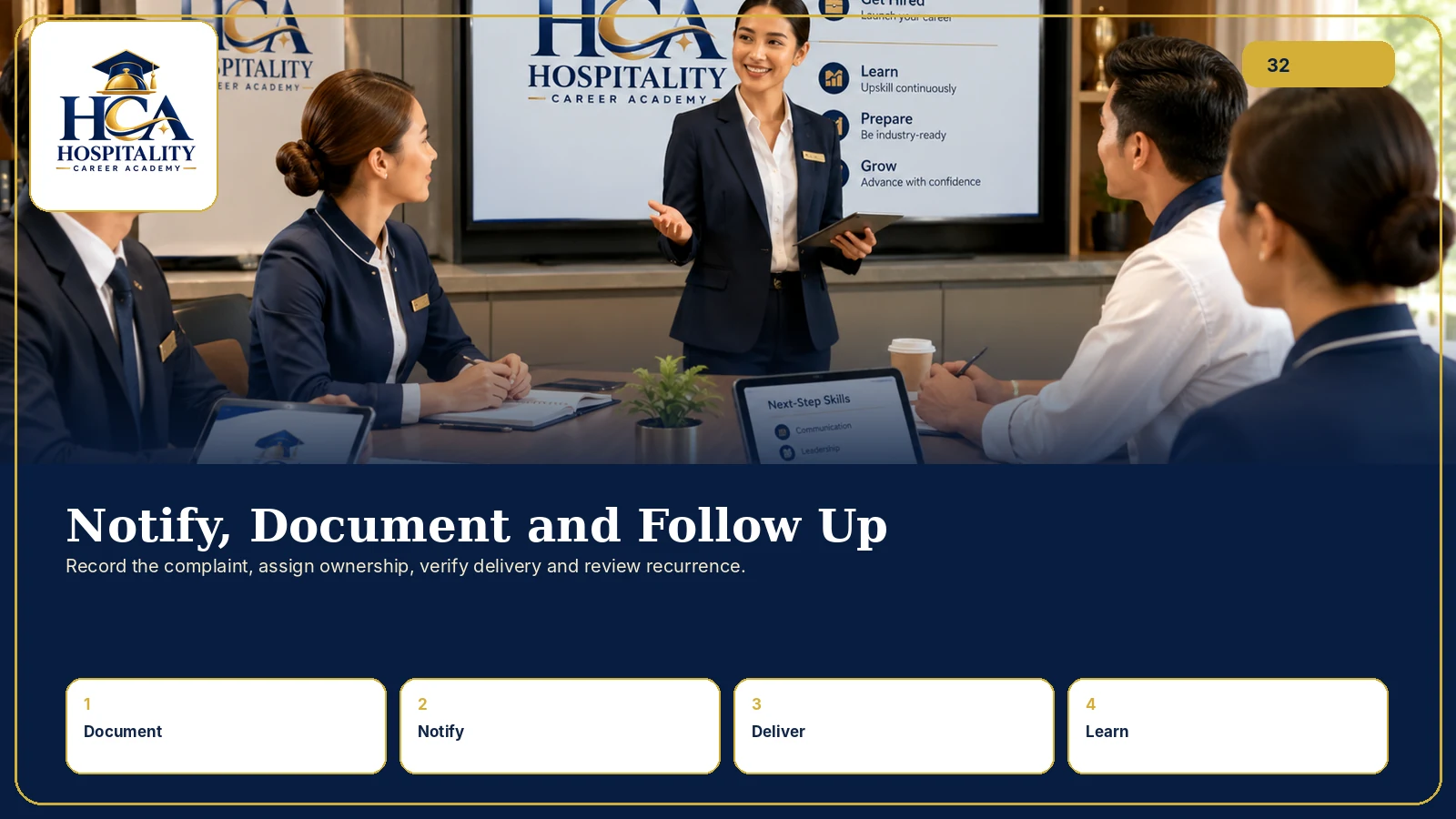
LEARN gives hospitality employees a reliable structure for difficult moments: listen carefully, recognise the impact, apologize sincerely, respond within authority and notify the organisation so the solution is completed and the cause can be addressed.
A complaint is not closed when the employee says “I have informed the team.” It is closed when the action is completed, the guest has been updated and the organisation has captured what it needs to prevent a repeat.
Sources and review note
This HCA guide was substantively reviewed on 2 September 2026. Its process principles align with recognised complaints-handling guidance and hospitality service-recovery research, while the exact scripts, authority limits and escalation rules must be adapted to the property.
Frequently asked question
What does LEARN stand for in hospitality?
In this HCA guide it means Listen, Empathize, Apologize, Respond and Notify. Some organisations use Resolve instead of Respond, so follow the property’s documented version.
Explore HCA complaint-handling training