Hospitality leadership is tested in real time. A manager may need to welcome a VIP arrival, support a new employee, resolve a room-status delay, answer a guest complaint and coordinate three departments within the same hour. In that environment, leadership cannot remain an abstract idea. It must appear in the way priorities are communicated, decisions are made and people are treated.
Strong team management is not about giving more orders. It is about creating enough clarity, capability and trust for the team to deliver the required standard—especially when the operation becomes busy.
Key takeaway: Hospitality leadership is the ability to connect people, standards and decisions so that the guest experience remains consistent even under pressure.
Leadership and management: what is the difference?
The two roles are closely connected:
- Management organises work: schedules, resources, standards, controls and follow-up.
- Leadership creates direction and commitment: why the work matters, what the priority is and how people should respond when the plan changes.
A hospitality supervisor needs both. Inspiration without organisation creates confusion. Organisation without leadership may produce compliance but little ownership.
1. Give the team clear direction
Employees perform better when they understand the shift’s priorities. “Do your best” is not a useful briefing. A clear direction states:
- the expected guest experience;
- the operational priorities;
- known risks or high-volume periods;
- individual ownership;
- when and how to escalate.
For example, a front office briefing may identify early arrivals, room moves, VIPs, group check-in timing and unresolved cases. A restaurant briefing may cover expected covers, menu changes, allergens, large parties and service timing. A housekeeping briefing may confirm room priorities, out-of-order rooms, special setups and inspection support.
The team should leave briefing knowing what matters most—not carrying a longer list of unrelated information.
2. Make standards visible and practical
Leaders cannot hold people accountable to a standard that is unclear, inaccessible or different from one supervisor to another.
Make standards easier to apply by using:
- short SOPs and checklists;
- demonstrations and role plays;
- clear examples of acceptable and unacceptable work;
- visual references for presentation standards;
- sign-off after practice;
- refresher coaching when the process changes.
The goal is not paperwork for its own sake. The goal is consistent understanding across shifts, languages and experience levels.
3. Build a reliable operating rhythm
High-performing hospitality teams use predictable routines to reduce missed information.
Before the shift
- review occupancy, reservations, expected covers or workload;
- identify high-risk or time-sensitive items;
- confirm staffing and role allocation;
- brief service changes and safety information.
During the shift
- monitor the operation without micromanaging every action;
- remove barriers and rebalance resources;
- check critical promises and open guest issues;
- coach in the moment when appropriate.
At handover
- transfer open items with owner and deadline;
- confirm status rather than relying on memory;
- highlight guest preferences, defects and operational risks;
- close or reassign incomplete tasks visibly.
After the shift
- review what worked and what failed;
- recognise good judgement;
- capture one or two lessons for the next briefing;
- follow up on unresolved issues.
A dependable rhythm allows the leader to spend less time chasing information and more time improving decisions.
4. Delegate outcomes, not just tasks
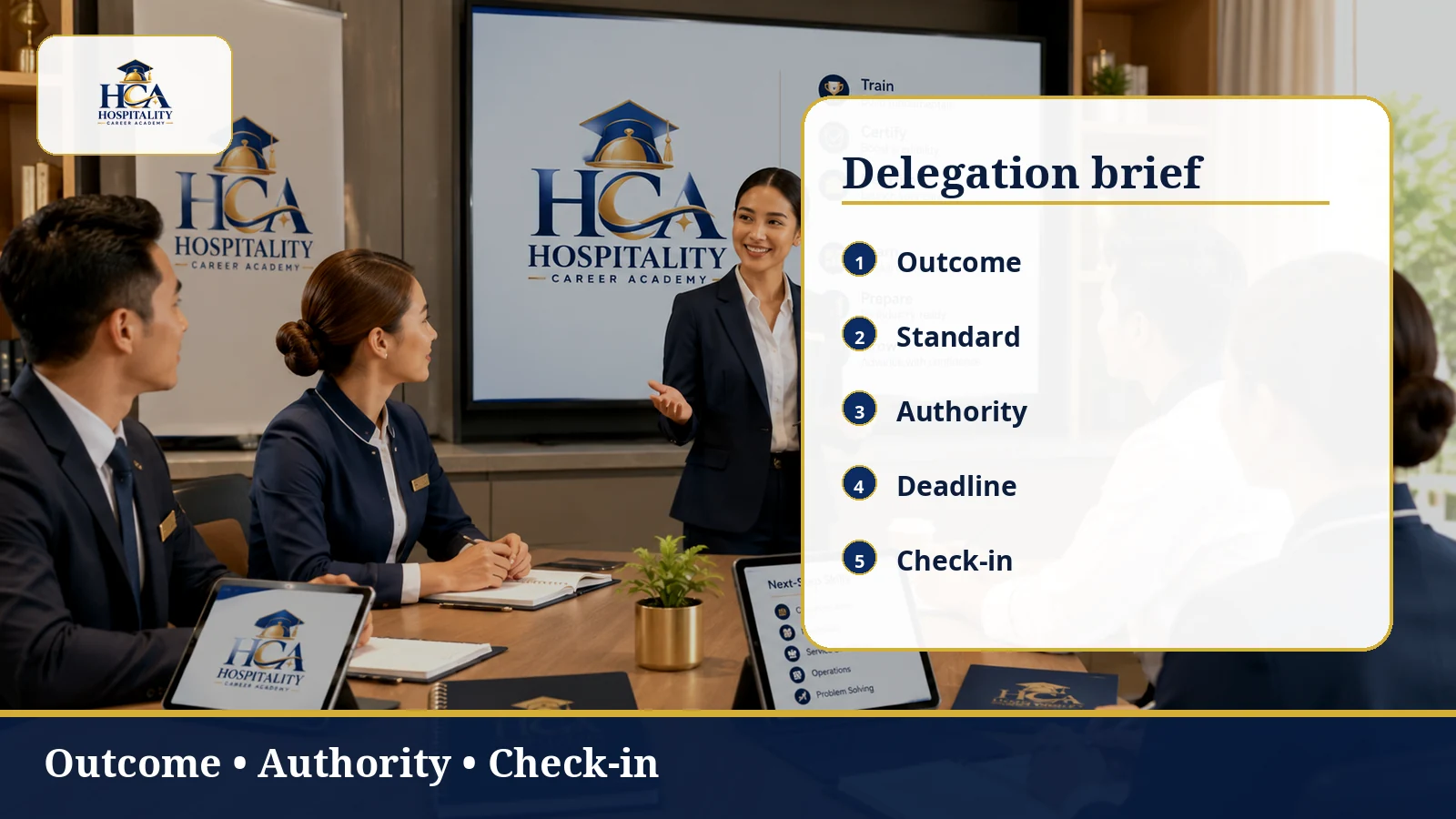
Delegation is a leadership skill, not simply workload transfer. Effective delegation includes:
- The outcome: What must be achieved?
- The standard: What does good completion look like?
- Authority: What decisions can the employee make?
- Resources: What information, tools or support are available?
- Deadline: When is it due?
- Check-in: When will progress be reviewed?
Weak delegation sounds like: “Handle the lobby.”
Better delegation sounds like: “Please lead the group arrival at 18:00. Confirm the key packets and queue positions by 17:30, brief the bell team and update me immediately if more than five rooms remain unavailable.”
Delegation also develops people. When employees receive appropriate responsibility with support, they practise judgement and become ready for future roles.
5. Make calm decisions under pressure
Hospitality pressure can encourage fast but poor decisions. A useful decision sequence is:
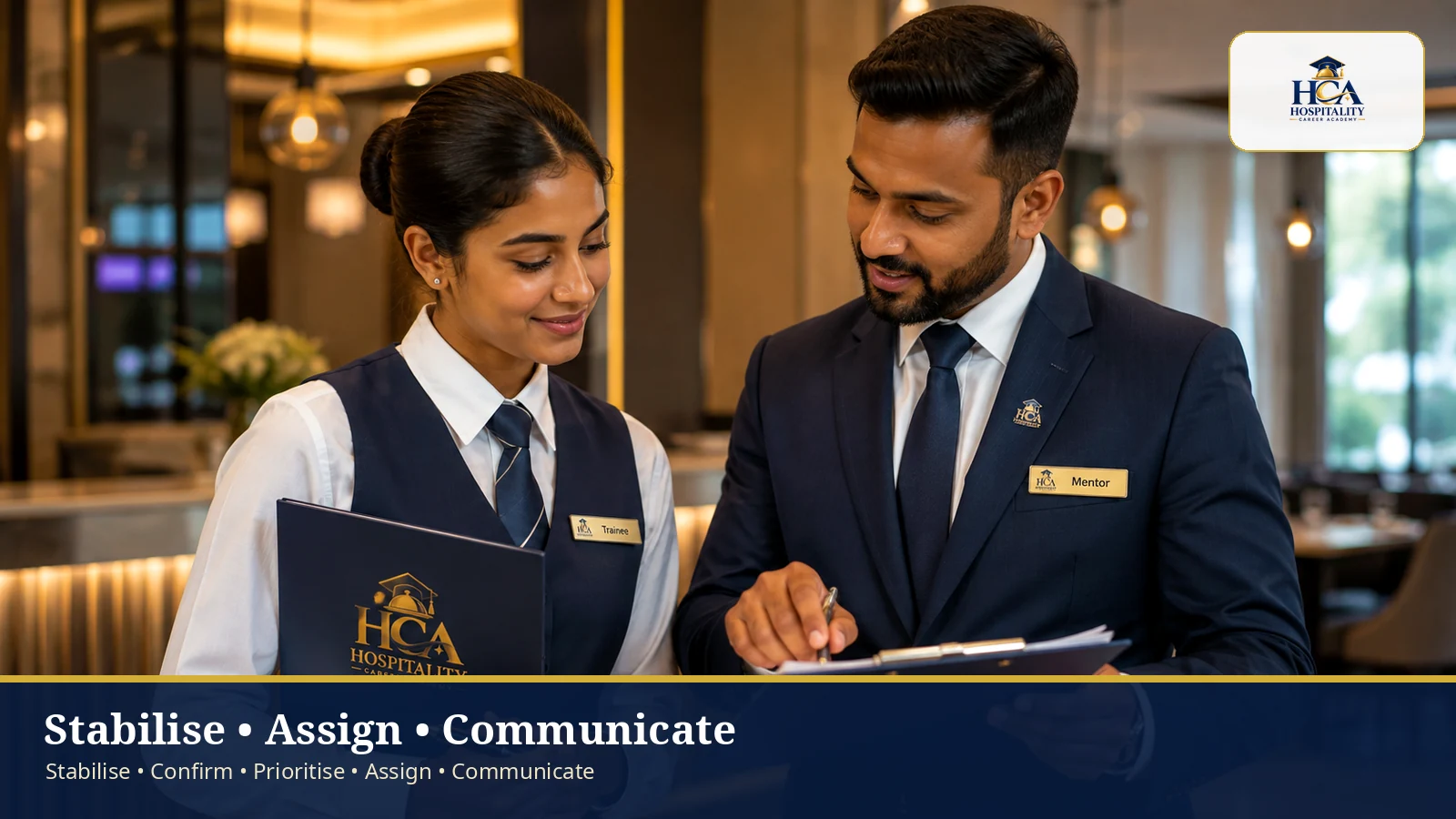
- Stabilise: Is anyone unsafe? Is the guest impact still increasing?
- Confirm: What facts are known, and what remains uncertain?
- Prioritise: Which action protects safety, service continuity and the guest first?
- Assign: Who owns each action and update?
- Communicate: What does the guest and team need to know now?
- Review: Did the action work, and what must happen next?
A calm leader does not pretend that everything is fine. They acknowledge the situation, create order and communicate honestly.
6. Communicate in a way that creates action
Good communication is not measured by how much the leader says. It is measured by what the team understands and does.
Use communication that is:
- specific: name the action and standard;
- brief: remove unnecessary background during urgent moments;
- two-way: ask for questions and read-back on critical items;
- consistent: avoid giving conflicting instructions to different people;
- respectful: correct behaviour without humiliation;
- documented when needed: especially for open tasks, safety issues and guest commitments.
When a message matters, do not assume silence means understanding. Ask the responsible employee to confirm the next step.
7. Create accountability without fear
Accountability means that responsibilities and results are visible. It should not mean that employees are afraid to report mistakes.
A healthy approach includes:
- clear ownership before the task begins;
- proportionate monitoring;
- factual feedback;
- recognition when standards are met;
- coaching when capability is the issue;
- formal action when serious or repeated conduct requires it;
- review of system barriers, not only individual behaviour.
If employees hide problems because they fear the leader’s reaction, the operation loses the chance to recover early. Leaders should make it safe to report an issue while remaining firm about the responsibility to act.
8. Handle conflict early and fairly
Hospitality teams work across cultures, languages and high-pressure shifts. Disagreement is normal. Unmanaged conflict is not.
When conflict begins to affect service:
- Separate facts from assumptions.
- Speak with the people involved privately.
- Clarify the operational impact and required behaviour.
- Allow each person to explain without personal attack.
- Agree a practical way of working.
- Document and escalate where policy requires it.
- Follow up rather than assuming the matter has disappeared.
Do not force a quick apology if the real issue remains unclear. The goal is professional behaviour and reliable cooperation, not artificial friendship.
9. Develop people deliberately
Strong leaders do not keep all important tasks for themselves. They identify who needs exposure, practice and feedback.
Development can include:
- leading part of the briefing;
- shadowing a duty-manager decision;
- cross-training with another department;
- handling a controlled guest-recovery scenario;
- completing a room, service or cash-control assessment;
- presenting an improvement idea;
- mentoring a new team member after competence is confirmed.
Development should be linked to operational need and career direction. Responsible workplace coaching can help employees turn experience into repeatable performance. Giving someone extra work without guidance is not development.
Worked example: managing a busy arrival wave
Situation: A hotel expects a tour group and several individual arrivals at the same time. Five rooms are still under inspection, the lobby is becoming crowded and one guest has a transport connection later.
Weak leadership response
The manager gives multiple instructions to different employees, changes priorities repeatedly and remains behind the desk handling one check-in personally. Team members are busy but not coordinated.
Strong leadership response
- The manager confirms the true room-status position with housekeeping.
- One employee owns group documents and key packets.
- One employee supports individual arrivals and identifies time-sensitive guests.
- Bell service controls luggage and lobby flow.
- Housekeeping provides room-release updates through one agreed channel.
- The manager speaks with waiting guests, gives realistic timing and handles exceptions within authority.
- Open promises are transferred clearly at handover.
The leader does not perform every task. They create a coordinated system in which each person knows the priority and the next communication point.
A practical hospitality team briefing structure
Keep the briefing focused:
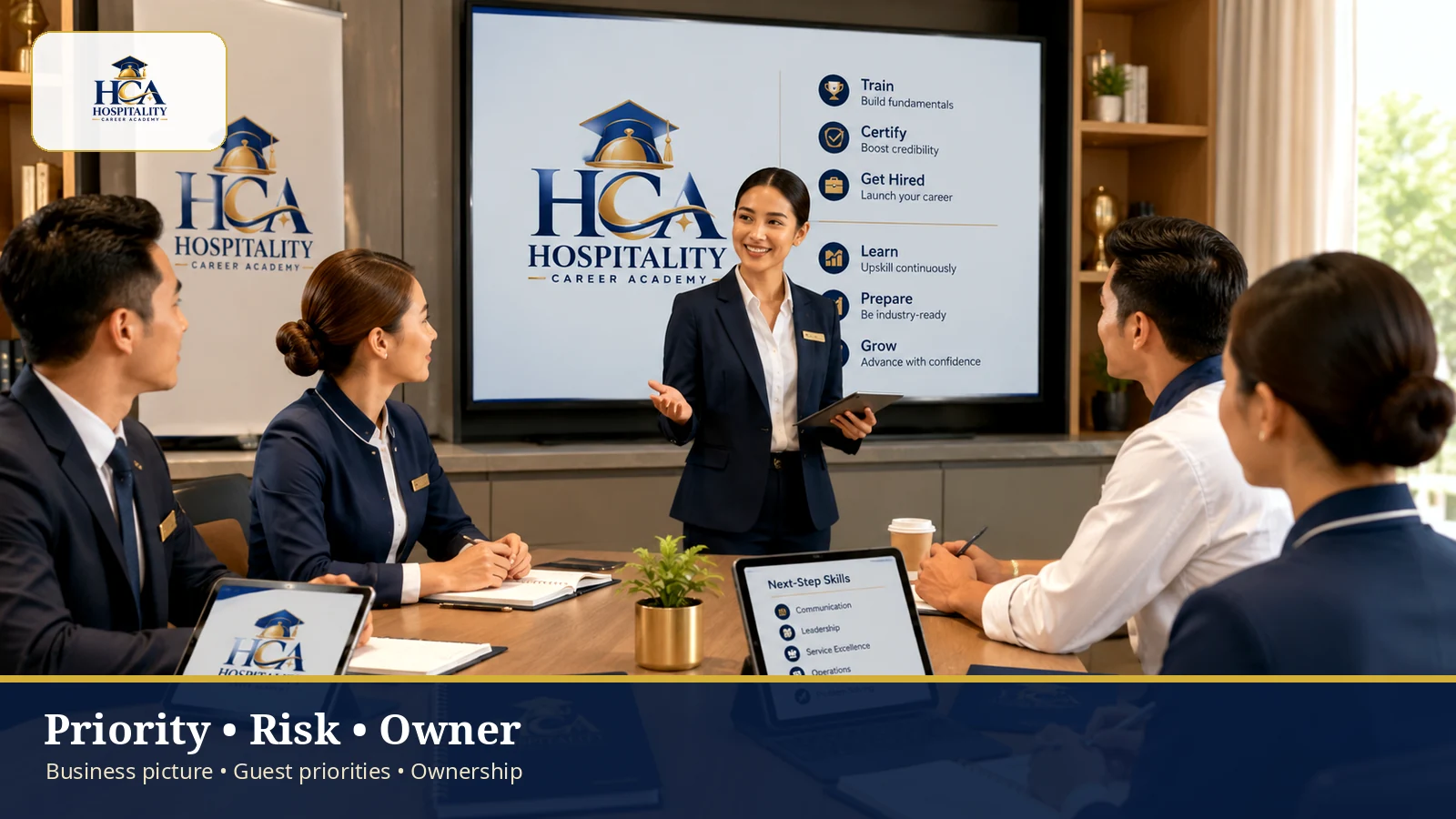
- Business picture: occupancy, covers, arrivals, departures or events.
- Guest priorities: VIPs, accessibility needs, celebrations and unresolved cases.
- Operational changes: menu, room, system, staffing or maintenance updates.
- Safety and compliance: one relevant reminder when needed.
- Role ownership: who owns what.
- Service focus: one behaviour or standard to practise.
- Questions and confirmation: critical items read back.
Common leadership mistakes
- changing direction without explaining the new priority;
- keeping information at management level until it is too late;
- delegating tasks without authority or resources;
- correcting people publicly when privacy is possible;
- solving every problem personally and making the team dependent;
- rewarding only speed while ignoring quality or safety;
- treating all mistakes as attitude problems;
- failing to follow up on promises made to employees or guests.
Leadership self-check
At the end of a demanding week, ask:
- Did the team understand the priorities?
- Were standards consistent across shifts?
- Did I delegate clearly and follow up proportionately?
- Did employees report problems early?
- Did I make decisions using facts or emotion?
- Whom did I develop this week?
- What operational barrier did I remove?
- What promise still needs closure?
Final takeaway
The art of hospitality leadership lies in turning standards and people into coordinated action. Strong leaders create direction, organise a reliable operating rhythm, delegate with clarity, make calm decisions, manage conflict fairly and develop the team deliberately.
The guest may never see the briefing, handover or coaching conversation behind the service. They will feel the result through faster responses, clearer communication and a team that works as one operation.
Frequently asked question
What is the most important leadership skill in hospitality?
There is no single skill for every situation, but clear communication combined with sound judgement is central. Hospitality leaders must identify the real priority, assign ownership, communicate the standard and adapt calmly when conditions change.
Sources and update note
- CIPD: Leadership in the workplace.
- CIPD: Management development.
- CIPD: Line managers’ role in supporting the people profession.
Reviewed and substantially rewritten on 2 September 2026 for practical hotel, restaurant and serviced-residence leadership. Apply local employment requirements and property policies when handling performance, conduct, safety or sensitive employee matters.
Related HCA guides
Update references
Frequently asked question
What is the most important leadership skill in hospitality?
Clear communication combined with sound judgement is central. Leaders must identify the real priority, assign ownership, explain the standard and adapt calmly when operating conditions change.
Build your hospitality leadership skills