Hospitality businesses rarely operate with one pure e-commerce model. A hotel may sell rooms directly to guests, accept corporate bookings through a business channel, distribute through a marketplace, sell gift vouchers, subscribe to software and buy supplies from approved vendors—all at the same time.
This is why a list of B2C, B2B, C2C, subscriptions and marketplaces is not enough for a practical decision. Those labels describe different dimensions. A hospitality manager needs to understand who transacts, who owns the customer relationship, how money is earned, how the product is fulfilled and which risks the operation can control.
This guide turns the existing “E-commerce Models” article into a decision framework for hotels, restaurants, cafés, resorts, serviced residences and hospitality entrepreneurs.
Start with four separate model dimensions
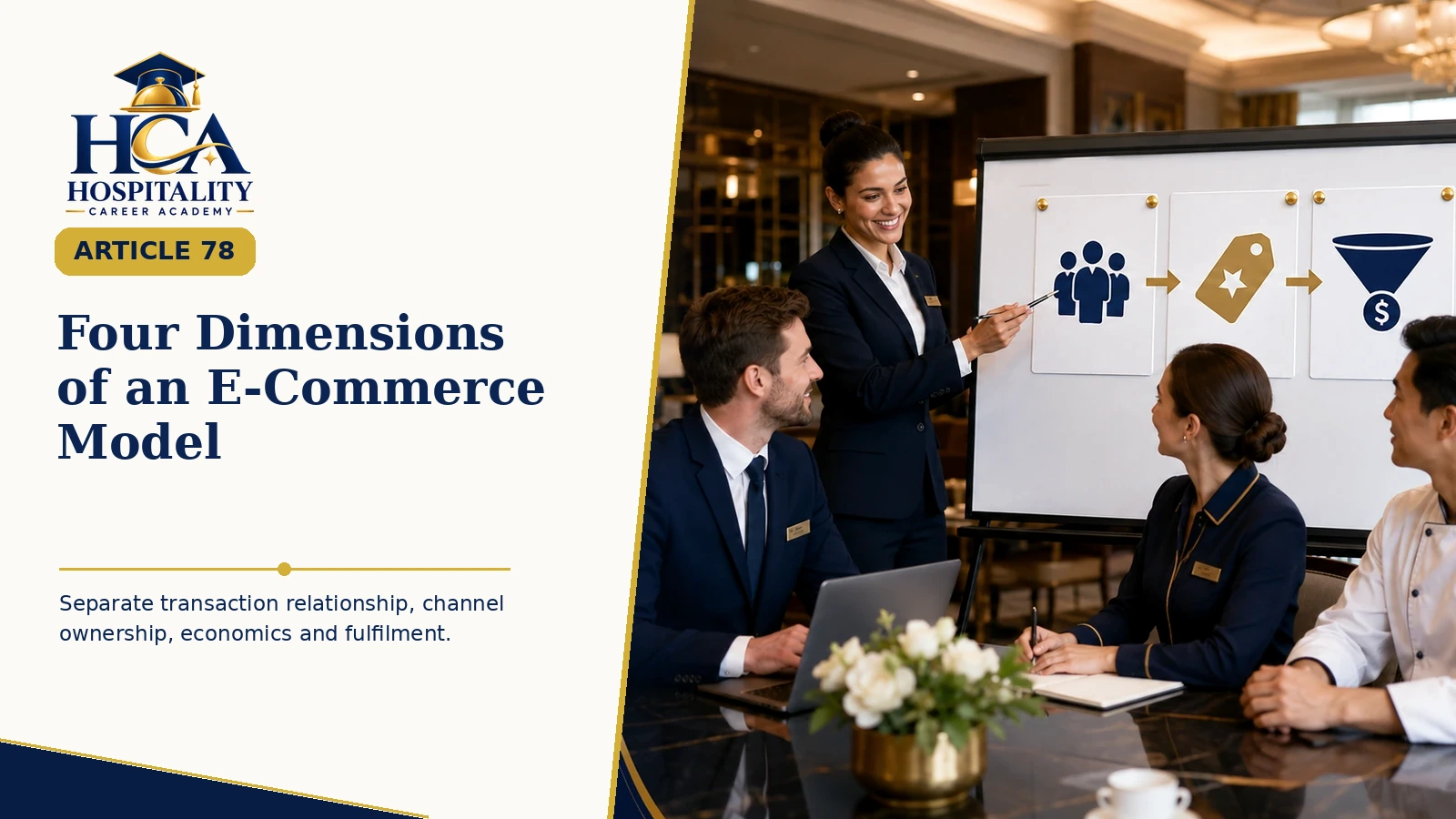
Do not force every decision into one label. Describe the proposed model across four dimensions.
1. Transaction relationship
This identifies the parties.
- B2C — business to consumer: a hotel sells a room, meal, spa treatment or voucher to an individual guest.
- B2B — business to business: a hotel sells to a company or buys from a supplier.
- C2B — consumer to business: an individual provides value to a business, such as a freelancer creating photography or a creator licensing content.
- C2C — consumer to consumer: individuals transact with one another through a platform. This is less central to core hotel operations but may appear in peer-to-peer travel or resale environments.
This dimension does not tell you who owns the platform, how the business earns money or how fulfilment works.
2. Channel and relationship ownership
The same B2C room can be sold through different channel models.
- Direct-owned channel: the hotel controls the website, booking engine, offer and primary guest relationship.
- Third-party marketplace or intermediary: a platform connects demand and supply, often under agreed commission or commercial terms.
- Affiliate or referral channel: a partner sends traffic or leads and receives an agreed fee or commission.
- Managed or white-label channel: another provider operates some technology or customer-facing elements under agreed branding and data rules.
- Social or conversational channel: discovery and enquiry happen through social or messaging tools, but payment and confirmation should still use an approved secure process.
Channel ownership affects control, reach, cost, data, service responsibility and dependency.
3. Revenue or economic model
How does the business earn or pay?
- Transaction margin: revenue minus direct cost for each sale.
- Commission: a percentage or fee paid for a completed transaction or qualified result.
- Subscription or membership: recurring payment for ongoing access or benefits.
- Licence or software fee: payment for use of technology or intellectual property.
- Advertising or placement: payment for visibility, subject to truthful presentation and clear measurement.
- Lead fee: payment for a qualified enquiry rather than a completed sale.
- Hybrid model: a combination, such as a monthly platform fee plus transaction commission.
A model that produces high gross sales can still create weak net value after commission, discount, support and fulfilment cost.
4. Fulfilment model
What must happen after the order?
- Service at the property: room stay, meal, event or spa treatment.
- Digital delivery: confirmation, certificate, voucher or access code.
- Physical delivery or collection: cake, merchandise, gift item or prepared food.
- Third-party fulfilment: another business delivers the product or service.
- Mixed fulfilment: the guest buys online and uses several physical services later.
Fulfilment determines operational readiness, inventory, safety, cancellation, refund and service-recovery requirements.
Why separating the dimensions matters
Consider a hotel gift voucher:
- relationship: B2C;
- channel: direct website;
- economic model: prepaid transaction;
- fulfilment: digital voucher followed by a future hotel service.
Now consider the same voucher sold through a marketplace:
- relationship: still B2C;
- channel: third-party marketplace;
- economic model: prepaid transaction with commission;
- fulfilment: still future hotel service.
The guest product is similar, but data access, cash timing, commission, redemption, fraud and customer-service responsibilities may be different.
The eight-question decision matrix
Score each proposed model against the following questions. Use evidence rather than enthusiasm.
1. Does it solve a real guest or business need?
Define the problem clearly.
- Can guests not currently buy the product easily?
- Is a company account asking for a controlled digital route?
- Is the property losing sales because availability or information is unclear?
- Is a manual procurement process creating delay or error?
A platform without a defined need becomes extra work.
2. Is the product suitable for digital sale?
Assess:
- standardisation;
- availability control;
- pricing clarity;
- need for consultation;
- safety or legal conditions;
- cancellation complexity;
- fulfilment capacity;
- ability to describe the product accurately.
A standard airport transfer may be easier to sell online than a complex wedding package that requires design, capacity and contractual discussion.
3. How much control is required?
Decide which elements the hotel must control directly:
- product description;
- price and restrictions;
- inventory;
- brand presentation;
- guest data;
- payment;
- confirmation;
- service recovery;
- refund;
- reporting.
More control usually requires more capability and responsibility.
4. What is the full economic value?
Build a simple net-value view:
Realised revenue minus commission, discounts, payment cost, fulfilment cost, media cost, cancellation impact and incremental servicing effort.
Also consider cash timing, refunds, breakage rules for vouchers, taxes and accounting treatment. Finance should confirm the method.
5. What data is needed and permitted?
Define:
- what data is collected;
- why it is needed;
- who can access it;
- whether the hotel can use it for future communication;
- how long it is retained;
- how the guest can exercise applicable rights;
- what data the partner keeps;
- what happens when the relationship ends.
Do not choose a model only because it promises “more customer data.” Data must be useful, accurate and handled lawfully.
6. Can the operation fulfil consistently?

Before launch, test:
- staffing and service hours;
- inventory or capacity;
- order delivery to the right system;
- payment and billing;
- confirmation and guest communication;
- exceptions, modifications and refunds;
- downtime and manual fallback;
- responsibility when a partner fails.
Digital demand can expose weak operations faster.
7. What are the platform and dependency risks?
Review:
- contract term and exit conditions;
- commission or fee changes;
- data portability;
- integration quality;
- platform downtime;
- account suspension;
- cyber and payment risk;
- duplicate inventory;
- brand and pricing rules;
- concentration on one channel.
A channel can be useful without becoming the only route to market.
8. How will success be measured?
Agree a small scorecard before implementation:
- qualified demand;
- conversion;
- realised net revenue or cost saving;
- cancellation and refund rate;
- fulfilment defects;
- support cases;
- repeat use;
- channel or supplier dependency;
- time saved;
- guest or user satisfaction.
Set review dates and stop rules.
Hospitality model examples
Direct hotel booking
- relationship: B2C;
- channel: hotel-owned;
- economic model: transaction revenue;
- fulfilment: room stay and hotel services;
- strengths: control, direct communication and clearer first-party relationship;
- requirements: reliable website, booking engine, payments, service and measurement.
OTA room distribution
- relationship: B2C with an intermediary;
- channel: marketplace;
- economic model: commission or contracted commercial terms;
- fulfilment: hotel stay;
- strengths: demand reach and booking convenience;
- requirements: accurate mapping, inventory, reservation delivery, reconciliation and net-value review.
Corporate accommodation programme
- relationship: B2B;
- channel: negotiated direct, travel-management or distribution route;
- economic model: contracted room revenue;
- fulfilment: repeated stays plus billing and reporting;
- requirements: account qualification, rate approval, credit, booking access and production review.
Hotel restaurant delivery
- relationship: B2C;
- channel: direct or delivery marketplace;
- economic model: transaction margin with possible commission;
- fulfilment: food production and physical delivery;
- requirements: menu accuracy, food safety, packaging, delivery responsibility, refunds and capacity control.
Spa or club membership
- relationship: B2C or B2B;
- channel: direct or partner route;
- economic model: subscription or prepaid membership;
- fulfilment: recurring access to services;
- requirements: benefit rules, capacity, renewal, cancellation, guest identification and accounting.
Hospitality supplier portal
- relationship: B2B;
- channel: supplier or marketplace platform;
- economic model: purchasing, platform fee or contracted price;
- fulfilment: goods or services delivered to the property;
- requirements: specification, approval, receiving, invoice matching and supplier performance control.
A seven-step pilot process
- Define one need and one product. Avoid launching a whole ecosystem at once.
- Describe all four model dimensions. Relationship, channel, economics and fulfilment.
- Score the eight decision questions. Record evidence and owner.
- Confirm legal, payment, tax, data and operational requirements. Use relevant specialists.
- Build a limited pilot. Choose a controlled date, audience and inventory.
- Reconcile the full result. Compare digital events, transactions, fulfilment and finance.
- Decide. Improve, scale, renegotiate, keep limited or stop.
Common mistakes
- mixing transaction relationships with revenue models;
- assuming direct is always cheapest or third-party is always expensive;
- selecting a platform before defining the need;
- ignoring fulfilment and service recovery;
- comparing gross sales instead of net value;
- accepting unclear data rights;
- depending on one channel without a fallback;
- treating a subscription as recurring profit without measuring use and capacity;
- launching a marketplace listing with inaccurate inventory;
- scaling before a controlled pilot.
Frequently asked question
Can a hospitality business use more than one e-commerce model?

Yes. Most hospitality businesses use a portfolio of models. The important task is to define the purpose, ownership, economics, fulfilment and risk of each one rather than managing them as if they were identical.
Final takeaway
There is no universally best e-commerce model for hospitality. The right model is the one that solves a defined need, fits the product, produces acceptable net value, protects the guest and can be fulfilled consistently.
Use the HCA decision matrix to compare options across control, cost, data, operations and risk before signing a contract or scaling a new channel.
Practical HCA working resource supplied with this article.
Frequently asked question
Can a hospitality business use more than one e-commerce model?
Yes. Most hospitality businesses use a portfolio of models. The important task is to define the purpose, ownership, economics, fulfilment and risk of each one.